On this page
- 01Key takeaways
- 02What should a BPO contract cover?
- 03What notice period and minimum term are reasonable?
- 04How should service levels be written?
- 05What data protection clauses are required?
- 06What exit rights should you insist on?
- 07What other clauses should you check?
- 08Are there sector rules to consider?
- 09What does this look like in practice?
- 10Checklist: review a BPO contract
- 11Next step
- 12Sources and further reading
- 13Frequently asked questions
Key takeaways
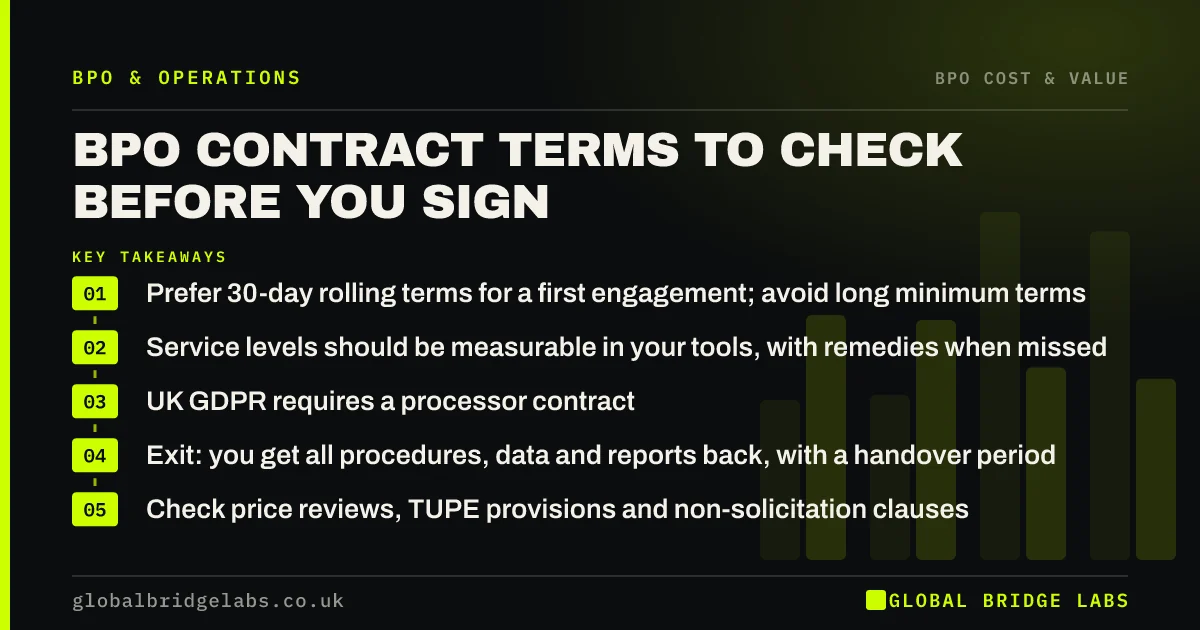
The BPO contract terms that matter most for a UK SME are the notice period and minimum term, the service levels and what happens when they are missed, the data protection clauses, your rights at exit, and how prices change. Read these before comparing hourly rates, because they decide what the rate is really worth.
- Prefer 30-day rolling terms for a first engagement; avoid long minimum terms.
- Service levels should be measurable in your tools, with remedies when missed.
- UK GDPR requires a processor contract; offshore work also needs an IDTA or Addendum.
- Exit: you get all procedures, data and reports back, with a handover period.
- Check price reviews, TUPE provisions and non-solicitation clauses.
Got a BPO contract in front of you? Message us on WhatsApp and we will tell you which clauses to question.
Chat on WhatsApp →What should a BPO contract cover?
A business process outsourcing (BPO) contract should define what the provider will do, to what standard, at what price, how data is protected, how performance is reviewed, and how the relationship ends. For an SME it is usually a master services agreement plus a statement of work or order form for each process.
This article is a practical checklist, not legal advice. For large or regulated engagements, have a solicitor review the contract.
What notice period and minimum term are reasonable?
For a first engagement, 30-day rolling terms are reasonable and increasingly common. They keep the provider accountable and limit your risk while you test the service. Long minimum terms of 12 months or more shift the risk to you, often in exchange for a lower hourly rate.
If you accept a longer term, make sure there is a way out for poor performance: termination rights if service levels are missed repeatedly.
How should service levels be written?
Service levels should be specific, measurable in systems you can see, and tied to consequences. "Fast response" is not a service level. "90% of emails receive a first reply within 1 business hour, measured monthly in the helpdesk" is.
Agree what happens when targets are missed: a service review, a remediation plan, service credits, or termination rights for repeated failure. Also agree what the provider needs from you, such as timely answers to escalations and notice of volume changes.
What data protection clauses are required?
UK GDPR requires a written contract between you as controller and the provider as processor. The ICO lists the required terms: processing only on your documented instructions, confidentiality, appropriate security, rules for sub-processors, help with data subject rights and breaches, deletion or return of data at the end, and audit rights.
If the team is outside the UK in a country without adequacy regulations, add an appropriate safeguard, usually the International Data Transfer Agreement or the UK Addendum, and complete a transfer risk assessment.
What exit rights should you insist on?
Insist on getting back everything needed to run the process without the provider: all procedures and training materials, all data and records, and recent reports. Agree a handover period during which the provider cooperates with you or a new provider. Make sure procedures created for your process belong to you.
What other clauses should you check?
Several smaller clauses cause most disputes. Check each one.
- Price reviews: how often, and linked to what index or cost.
- Scope changes: how new tasks are priced and agreed.
- Sub-contracting: whether the provider can pass work to others.
- Liability caps: how much the provider is liable for, and for what.
- Non-solicitation: restrictions on hiring each other's staff, and for how long.
- TUPE: who bears the risk if UK employees transfer at start or end.
Want a second opinion on the commercial terms in a BPO contract? Send us the key clauses on WhatsApp and we will discuss your requirements.
Chat on WhatsApp →Are there sector rules to consider?
Yes, in regulated sectors. FCA-regulated firms must follow the outsourcing expectations in the FCA Handbook, SYSC 8, including keeping responsibility for outsourced functions and the right to terminate and access data. Healthcare providers with access to NHS patient data must meet the Data Security and Protection Toolkit standards, and their providers need to support that.
What does this look like in practice?
At Global Bridge Labs (GBL), every engagement is scoped and costed on one page before you commit, runs on 30-day rolling terms, and comes with a data processing agreement under UK GDPR. We designed it that way because a short commitment is the clearest signal that a provider expects to keep earning the work.
Checklist: review a BPO contract
Tick each before signing.
- Notice period and minimum term are acceptable.
- Service levels are measurable, with remedies.
- Processor contract includes all ICO-required terms.
- Transfer safeguard is in place for offshore teams.
- Exit clause returns procedures, data and reports.
- Price review mechanism is clear.
- Sub-contracting, liability, non-solicitation and TUPE are understood.
Next step
If you are about to sign a BPO contract, talk to us first. We will walk through the commercial terms that matter and what good looks like. 30 minutes, no pitch.
Message us on WhatsApp about your contract, or book a 30-minute consultation.
Chat on WhatsApp →Sources and further reading
- Contracts and liabilities between controllers and processors · Information Commissioner's Office
- International transfers of personal data · Information Commissioner's Office
- Business transfers, takeovers and TUPE · GOV.UK
- FCA Handbook SYSC 8: Outsourcing · Financial Conduct Authority
Frequently asked questions
What should be in an outsourcing contract?
An outsourcing contract should define scope, service levels and remedies, pricing and price reviews, data protection terms including a processor contract, confidentiality, liability, sub-contracting, notice and minimum term, and exit rights including return of procedures and data. Regulated firms may need extra terms.
What is a reasonable notice period for outsourcing?
For a first engagement with an SME, 30 days is reasonable and common. Longer notice periods or minimum terms shift risk to you. If you accept them, make sure you can terminate for repeated service-level failures without waiting for the term to end.
Do I need a data processing agreement with a BPO provider?
Yes, if the provider handles personal data on your behalf. UK GDPR requires a written contract with specific terms set out by the ICO. If the team is outside the UK in a country without adequacy regulations, you also need a transfer safeguard such as the IDTA.
What are service credits in a BPO contract?
Service credits are reductions in the provider's fee when agreed service levels are missed. They give the provider a financial incentive to meet targets. For SMEs, clear remediation plans and termination rights for repeated failure are often more useful than small credits.
Written by

Global Bridge Labs (GBL) is a UK–Sri Lanka partner for social media, websites and BPO. Everything here comes from client delivery, not theory.