On this page
- 01Key takeaways
- 02What is operating leverage?
- 03How does it work in numbers?
- 04Why does hiring raise operating leverage?
- 05How does outsourcing change it?
- 06What is the right level for your business?
- 07When is high operating leverage a good thing?
- 08What does this look like in practice?
- 09Operating leverage checklist
- 10Next step
- 11Sources and further reading
- 12Frequently asked questions
Key takeaways
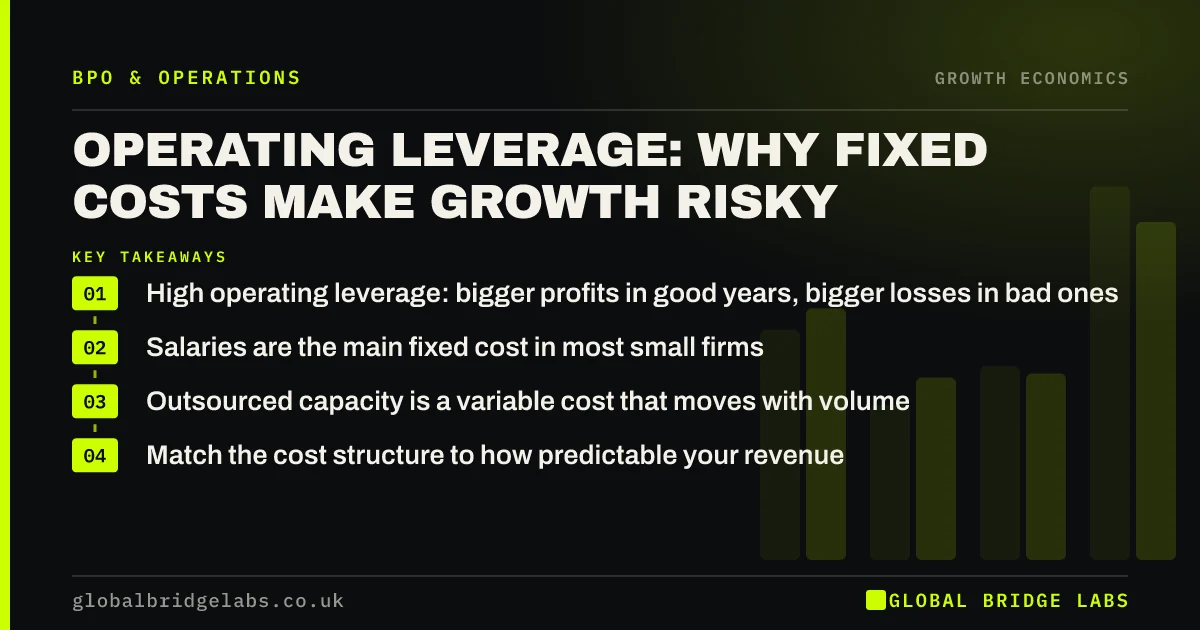
Operating leverage for a small business is the degree to which costs are fixed. High fixed costs mean profit rises quickly when sales grow and falls quickly when they drop. Salaries are the main fixed cost in most small firms, so every hire raises operating leverage. Buying capacity as a service lowers it.
- High operating leverage: bigger profits in good years, bigger losses in bad ones.
- Salaries are the main fixed cost in most small firms.
- Outsourced capacity is a variable cost that moves with volume.
- Match the cost structure to how predictable your revenue is.
Want your fixed and variable costs mapped? Message us on WhatsApp with last year's figures.
Chat on WhatsApp →What is operating leverage?
Operating leverage is a measure of how much a company's profit changes when its revenue changes, determined by the proportion of its costs that are fixed. A business with mostly fixed costs has high operating leverage. A business whose costs mostly vary with sales has low operating leverage.
How does it work in numbers?
Take two illustrative firms, each with £600,000 revenue. Firm A has £300,000 of fixed costs and variable costs of 30% of revenue. Firm B has £200,000 fixed and 50% variable. At £600,000 Firm A makes £120,000 and Firm B £100,000. If revenue falls to £450,000, Firm A makes £15,000 and Firm B £25,000.
At £750,000, Firm A makes £225,000 and Firm B £175,000. Firm A wins in growth and loses in decline. Neither is wrong. They suit different levels of certainty.
- At £450,000: A makes £15,000, B makes £25,000.
- At £600,000: A makes £120,000, B makes £100,000.
- At £750,000: A makes £225,000, B makes £175,000.
- Break-even: A about £429,000, B £400,000.
Why does hiring raise operating leverage?
Hiring raises operating leverage because an employee's cost does not change with sales in the short term. Salary, employer National Insurance and pension are paid in a quiet month and a busy one. Reducing them means notice, consultation and, for staff with two years' service, redundancy pay.
How does outsourcing change it?
Outsourcing converts part of the fixed cost base into a variable one. Hours or seats are bought monthly and adjusted with notice, so cost follows volume more closely. The trade is a slightly lower profit at the top of a strong year in exchange for a much softer landing in a weak one.
- Outsourcing and cash flow: fixed costs to variable
- Scaling an outsourced team up and down: how it works
Want to discuss your requirements for shifting some fixed cost to variable? Message us on WhatsApp.
Chat on WhatsApp →What is the right level for your business?
The right level depends on how predictable revenue is. Contracted, recurring income can carry more fixed cost. Project-based, seasonal or early-stage revenue should carry less. A practical approach is to fix the cost of the capacity needed for your worst realistic month and keep the rest variable.
- Recurring, contracted revenue: more fixed cost is safe.
- Seasonal or project revenue: keep more variable.
- New markets or products: variable until demand is proven.
When is high operating leverage a good thing?
High operating leverage is good when demand is strong and reliable. A firm confident of growth earns more by owning its capacity than by renting it. Software and manufacturing businesses are built this way. The risk is in adopting that structure on the strength of one good year.
What does this look like in practice?
A pattern we see in UK firms after two strong years: the team has grown, the office has grown, and the break-even point has quietly risen by a third. A flat quarter then turns a healthy business into a loss-making one. Firms that kept part of their capacity variable ride the same quarter with margins intact.
Operating leverage checklist
Review this with your annual budget.
- List costs as fixed, variable or stepped.
- Calculate fixed costs as a share of revenue.
- Work out your break-even revenue.
- Model profit at revenue 20% lower.
- Identify fixed costs that could become variable.
- Decide how much certainty your revenue really has.
Next step
Send us a summary of your costs and revenue pattern. We will show you where your break-even sits and which costs could move with volume.
Message us on WhatsApp for a cost structure review, or book a 30-minute consultation.
Chat on WhatsApp →Sources and further reading
- Rates and thresholds for employers 2026 to 2027 · HM Revenue & Customs
- Redundancy: your rights · GOV.UK
- The Green Book: appraisal and evaluation in central government · HM Treasury
Frequently asked questions
What is operating leverage in simple terms?
Operating leverage describes how sensitive profit is to changes in sales. If most of a business's costs are fixed, a small rise in sales produces a large rise in profit, and a small fall produces a large drop. The more fixed costs, the higher the operating leverage.
Is high operating leverage good or bad?
It is good when sales are growing reliably, because extra revenue turns into profit quickly. It is bad when sales are uncertain, because costs cannot be reduced fast enough when revenue falls. Small businesses with variable demand are usually safer with lower operating leverage.
How can a small business reduce fixed costs?
A small business can reduce fixed costs by buying capacity as a service instead of employing for variable work, using flexible premises, choosing monthly software plans over long contracts, and avoiding hiring ahead of proven demand. The aim is for more of the cost base to move with revenue.
Are staff costs fixed or variable?
For salaried employees, staff costs are fixed in the short term: they are paid regardless of sales. Overtime, commission and agency or outsourced hours are variable. Over a longer period headcount can be changed, but notice, consultation and redundancy costs make that slow.
Written by

Global Bridge Labs (GBL) is a UK–Sri Lanka partner for social media, websites and BPO. Everything here comes from client delivery, not theory.