On this page
- 01Key takeaways
- 02What counts as an employee overhead?
- 03Which overheads should you include?
- 04What do overheads add per hour?
- 05Are overheads lower for remote employees?
- 06Do outsourced teams carry overheads too?
- 07Which overheads are legal requirements?
- 08How do you find your real overhead per employee?
- 09What does this look like in practice?
- 10Overhead checklist
- 11Next step
- 12Sources and further reading
- 13Frequently asked questions
Key takeaways
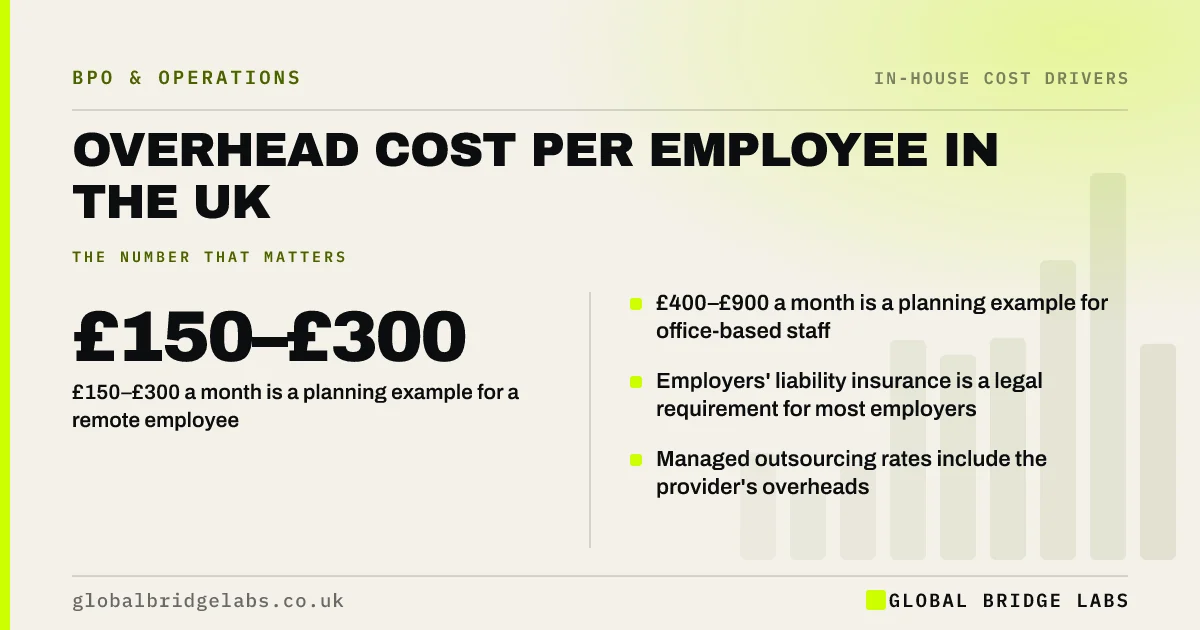
Overhead cost per employee in the UK is everything beyond pay needed for someone to work: equipment, software, space, insurance, IT and HR support. As a planning example, allow about £150–£300 a month for a remote employee and £400–£900 a month for an office-based one, on top of employment costs. Check your own figures.
- £150–£300 a month is a planning example for a remote employee.
- £400–£900 a month is a planning example for office-based staff.
- Employers' liability insurance is a legal requirement for most employers.
- Managed outsourcing rates include the provider's overheads.
Want your real overhead per employee worked out? Message us on WhatsApp.
Chat on WhatsApp →What counts as an employee overhead?
An employee overhead is any cost of supporting a worker that is not pay or a statutory employment cost. It includes the tools they use, the space they sit in, the insurance and compliance that cover them, and the support functions that keep them working. Overheads are easy to miss because they sit in different budget lines.
Which overheads should you include?
Build the list from these categories. Not every business has every cost, but most have more than they first count.
- Equipment: laptop, screens, headset, phone, replaced every 3 to 4 years.
- Software: email, office suite, CRM seat, phone system, security tools.
- Space: desk rent, utilities, cleaning and business rates share.
- Insurance: employers' liability and any other cover per head.
- IT support: set-up, patching, password resets and leavers.
- HR and payroll: payroll software or bureau, HR advice, policies.
- Training and development: courses, subscriptions, conference time.
What do overheads add per hour?
At £300 a month, overheads add about £3,600 a year, or about £2.07 per worked hour across 1,740 hours. At £700 a month, they add about £8,400, or £4.83 per worked hour. For a hire on the National Living Wage costing £16.27 per worked hour, that lifts the total to roughly £18.30–£21.10 before recruitment and management.
Want overheads added to your in-house vs outsourcing comparison? Send us the numbers on WhatsApp.
Chat on WhatsApp →Are overheads lower for remote employees?
Usually, because desk space and utilities fall away. But equipment, software, security and IT support remain, and some employers pay a home-working allowance. Remote staff also need secure devices and access controls, which carry their own costs.
Do outsourced teams carry overheads too?
Yes, but the provider carries them and spreads them across many clients. A managed rate should include the team's equipment, workspace, connectivity, power backup, supervision and quality checks. You may still pay for seats on your own systems, such as a CRM licence, so ask which tools are included.
Which overheads are legal requirements?
Most employers must hold employers' liability insurance from their first employee, with limited exemptions such as some family businesses. Employers must also run payroll through HMRC, auto-enrol eligible staff into a pension and meet health and safety duties. These carry admin time and cost even for one employee.
How do you find your real overhead per employee?
Take last year's costs for rent and rates, utilities, software, equipment, insurance, IT support and HR or payroll services. Exclude anything that would not change with headcount, such as your website. Divide the remainder by average headcount. The result is your own overhead per employee, which is better than any benchmark.
What does this look like in practice?
A pattern we see in UK professional services firms: the hiring budget covers salary and National Insurance, but a new desk, licences for four systems and an IT set-up fee arrive in different budgets. Put together, the overhead per head is often double what the partners assumed.
Overhead checklist
Add these to every staffing comparison.
- List every tool and licence one employee needs.
- Spread equipment over its replacement cycle.
- Add a share of rent, utilities and rates if office-based.
- Include insurance, IT and HR support per head.
- Convert the monthly total into a cost per worked hour.
Next step
Tell us your team size and set-up. We will estimate overhead per employee and include it in an in-house vs outsourcing comparison in a 30-minute call.
Message us on WhatsApp for an overhead estimate, or book a 30-minute consultation.
Chat on WhatsApp →Sources and further reading
- Employers' liability insurance · GOV.UK
- Employing staff for the first time · GOV.UK
- Rates and thresholds for employers 2026 to 2027 · HM Revenue & Customs
Frequently asked questions
What overhead cost should I budget per employee in the UK?
As a planning example, allow about £150–£300 a month for a remote employee and £400–£900 a month for office-based staff, on top of salary, employer National Insurance and pension. Replace these examples with your own figures for equipment, software, space, insurance and support as soon as you have them.
Is employers' liability insurance compulsory?
For most UK employers, yes, from the first employee, with limited exemptions such as some family businesses. GOV.UK sets out who must hold it and the minimum level of cover required. It is one of the overheads that applies even to a single part-time hire.
Do outsourcing rates include overheads?
A managed rate should include the provider's equipment, workspace, connectivity, power backup, supervision and quality checks. You may still pay for seats on your own systems, such as a CRM or helpdesk licence, so check which tools are included before comparing the rate with in-house costs.
Which employee overheads are most often missed?
Software licences spread across several systems, IT support time for starters and leavers, equipment replacement, and a share of rent and business rates. Each looks small in its own budget line, but together they often add several thousand pounds a year per employee.
Written by

Global Bridge Labs (GBL) is a UK–Sri Lanka partner for social media, websites and BPO. Everything here comes from client delivery, not theory.