On this page
- 01Key takeaways
- 02How does outsourcing affect cash flow?
- 03What costs does outsourcing replace?
- 04Which contract terms keep outsourcing variable?
- 05Can outsourcing improve cash coming in?
- 06What does the shift look like in numbers?
- 07What are the cash flow risks of outsourcing?
- 08When does keeping costs fixed make sense?
- 09How should you pay an outsourcing provider?
- 10What does this look like in practice?
- 11Cash flow checklist
- 12Next step
- 13Sources and further reading
- 14Frequently asked questions
Key takeaways
Outsourcing and cash flow are linked because outsourcing turns part of your fixed payroll into a variable monthly fee that can rise and fall with demand. That lowers the break-even point of the business and reduces the cash tied up in recruitment and notice periods. The benefit depends on short notice terms and monthly billing.
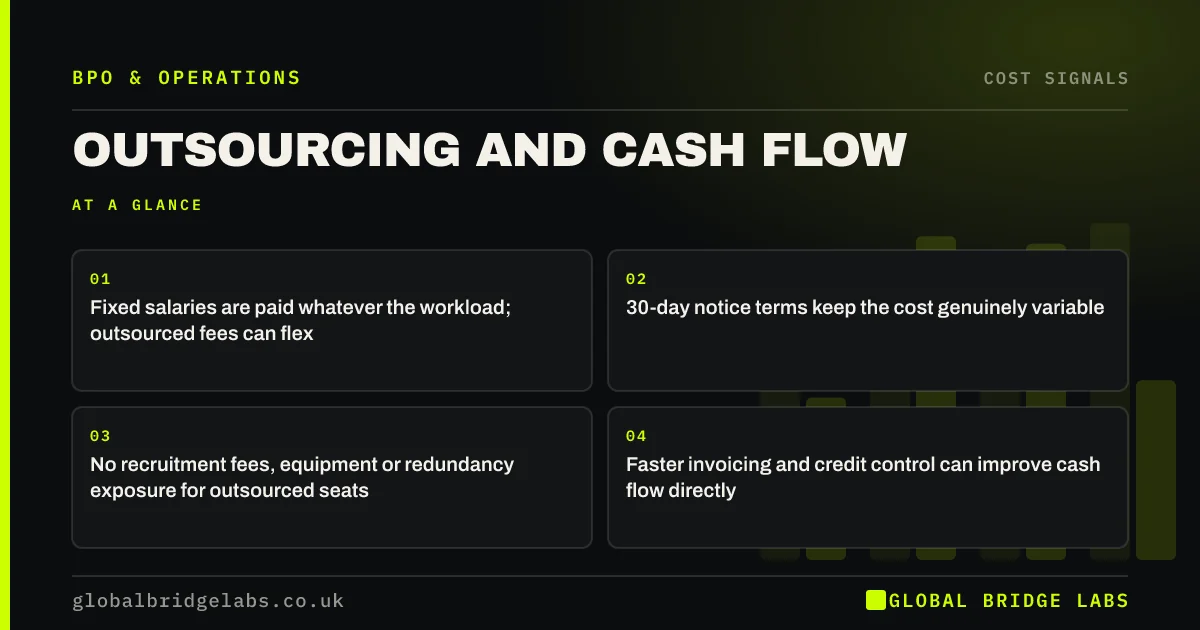
- Fixed salaries are paid whatever the workload; outsourced fees can flex.
- 30-day notice terms keep the cost genuinely variable.
- No recruitment fees, equipment or redundancy exposure for outsourced seats.
- Faster invoicing and credit control can improve cash flow directly.
Worried about fixed costs? Message us on WhatsApp and we will look at what could flex.
Chat on WhatsApp →How does outsourcing affect cash flow?
Outsourcing affects cash flow by changing the shape of your costs. Salaries are fixed: they are paid every month, in full, whatever the workload. An outsourced service on flexible terms is variable: it can be scaled down in a quiet quarter. That makes monthly costs track revenue more closely and reduces the cash needed to survive a dip.
What costs does outsourcing replace?
Outsourcing replaces more than salary. It removes recruitment fees and advertising, equipment and software per person, desk space, training, and the cost of cover. It also avoids the notice periods and, after two years' service, statutory redundancy pay that come with reducing headcount. These are real cash costs, even if they arrive irregularly.
- Recruitment fees and advertising.
- Laptops, phones, licences and desk space.
- Training and induction time.
- Holiday and sickness cover.
- Notice periods and redundancy exposure.
Which contract terms keep outsourcing variable?
Short notice periods, monthly billing and the ability to change hours are what make an outsourced cost variable. A 12-month minimum term turns it back into a fixed cost. Check how quickly you can scale up and down, whether there is a minimum monthly block, and whether setup fees are refundable.
Want a second opinion on contract terms? Send them to us on WhatsApp.
Chat on WhatsApp →Can outsourcing improve cash coming in?
Yes, when the process is invoicing or credit control. Invoices raised the day the job finishes, and polite chasing on a fixed schedule, bring cash in sooner. UK businesses can also claim statutory interest and fixed compensation on late commercial payments, which an outsourced credit control process can apply consistently.
What does the shift look like in numbers?
A business with one full-time administrator pays about £28,309 a year at the National Living Wage in fixed cost, or about £2,360 a month. Replacing half that capacity with a 20-hour outsourced seat at an indicative £12 per hour costs about £1,040 a month, and can be reduced in quiet months. The fixed base falls and the flexible part follows demand.
What are the cash flow risks of outsourcing?
The risks are advance billing, setup fees and minimum terms, which all move cash out before value arrives. Another is paying for unused hours in a fixed block. Ask to be billed monthly in arrears where possible, and match the block to your quiet-month volume rather than your peak.
When does keeping costs fixed make sense?
Fixed staff make sense when demand is steady, the work needs presence or judgement, and you want to build long-term capability. A fixed team is also cheaper per hour when it is fully used. The goal is not to make every cost variable but to stop paying fixed costs for work that swings.
How should you pay an outsourcing provider?
Monthly, and ideally in arrears for hours actually delivered. Paying monthly keeps cost aligned with activity, and paying in arrears means you have seen the work before you pay for it. If a provider needs payment in advance, keep the period to one month and make sure the invoice reconciles to hours or tasks delivered.
- Monthly invoices that show hours or tasks delivered.
- Payment in arrears where possible, or one month in advance at most.
- No large upfront fees before any work is seen.
- A clear process for crediting unused or missed hours.
What does this look like in practice?
A pattern we see in UK construction firms: an office team sized for the busy summer is underused in winter, and cash is tight in January. Keeping a smaller core team and adding an outsourced seat for calls and admin from spring to autumn aligns cost with work, and faster invoicing brings cash in sooner through the year.
Cash flow checklist
Check these before you commit.
- List fixed costs tied to repeatable work.
- Identify how much of that work swings by season.
- Ask for monthly billing, in arrears if possible.
- Keep notice terms to 30 days or similar.
- Size the minimum block to quiet months.
- Consider outsourcing invoicing to bring cash in faster.
Next step
Tell us which costs feel too fixed for your workload. We will suggest what could flex and what it would cost.
Message us on WhatsApp about your cost base, or book a 30-minute consultation.
Chat on WhatsApp →Sources and further reading
- Late commercial payments: charging interest and debt recovery · GOV.UK
- Redundancy: your rights · GOV.UK
- National Minimum Wage and National Living Wage rates · GOV.UK
- Rates and thresholds for employers 2026 to 2027 · HM Revenue & Customs
Frequently asked questions
Does outsourcing improve cash flow?
It can, by turning fixed salaries into variable fees that fall in quiet months, and by removing recruitment and equipment costs. It improves cash coming in directly when you outsource invoicing and credit control. Short notice terms and monthly billing are essential for the benefit to be real.
Is outsourcing a fixed or variable cost?
It depends on the contract. On monthly terms with adjustable hours, it is largely variable. With a long minimum term or a fixed seat commitment, it behaves like a fixed cost. Check notice periods and minimum blocks before signing.
How can a small business reduce fixed overheads?
Review costs tied to work that swings in volume, such as admin and customer contact, and consider flexible capacity for the variable part. Also review premises, software licences and supplier contracts. Protect the fixed roles that hold key knowledge and relationships.
Written by

Global Bridge Labs (GBL) is a UK–Sri Lanka partner for social media, websites and BPO. Everything here comes from client delivery, not theory.