On this page
- 01Key takeaways
- 02What is payroll as a percentage of revenue?
- 03How do you calculate it properly?
- 04What is a normal figure?
- 05What does a rising ratio tell you?
- 06How do you bring the ratio down?
- 07When is a high ratio fine?
- 08What does this look like in practice?
- 09Payroll ratio checklist
- 10Next step
- 11Sources and further reading
- 12Frequently asked questions
Key takeaways
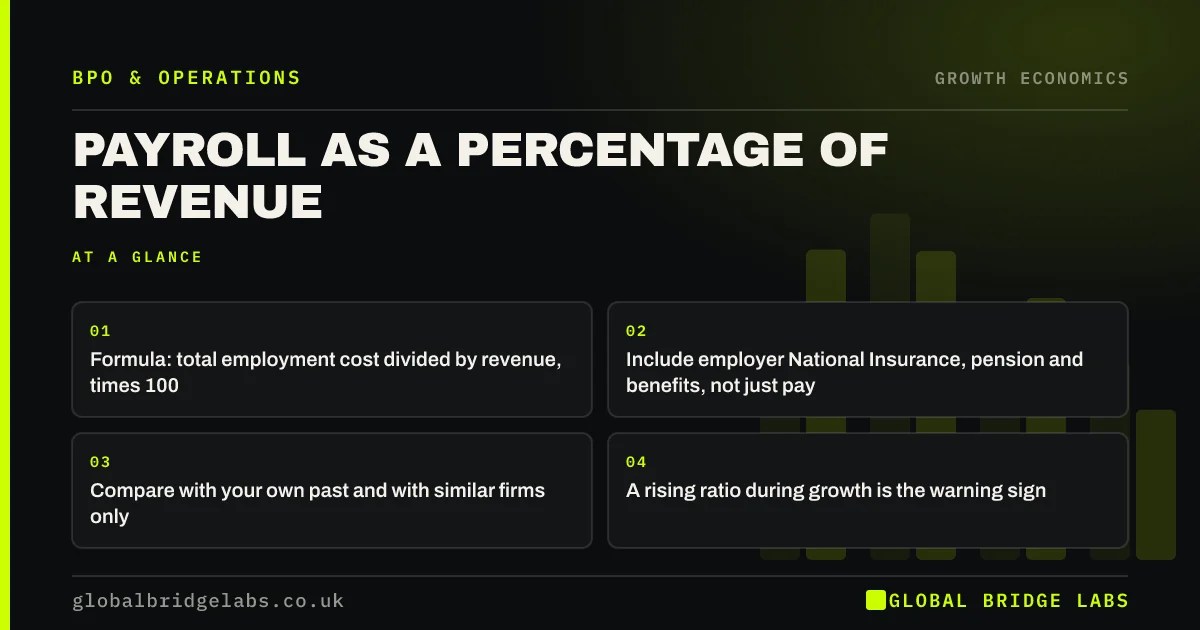
Payroll as a percentage of revenue is total employment cost divided by revenue. There is no single correct figure: labour-intensive service firms run far higher than product resellers. What matters is your own trend. A ratio that rises as revenue rises means staffing is growing faster than sales, and it is the earliest warning of margin trouble.
- Formula: total employment cost divided by revenue, times 100.
- Include employer National Insurance, pension and benefits, not just pay.
- Compare with your own past and with similar firms only.
- A rising ratio during growth is the warning sign.
Want your payroll ratio worked out and tracked? Message us on WhatsApp with last year's figures.
Chat on WhatsApp →What is payroll as a percentage of revenue?
Payroll as a percentage of revenue is a ratio showing how much of each pound of sales is spent on employing people. It is calculated by dividing total employment costs for a period by total revenue for the same period and multiplying by 100. It is also called the staff cost ratio.
How do you calculate it properly?
Use the full cost of employment, not gross pay. Add salaries and wages, employer National Insurance at 15% above the £5,000 threshold, employer pension contributions of at least 3% of qualifying earnings, bonuses and benefits. Include directors' pay at a market rate, or the ratio will look better than it is.
- 1. Total gross pay for the year.
- 2. Add employer National Insurance.
- 3. Add employer pension and benefits.
- 4. Divide by revenue.
- 5. Multiply by 100.
What is a normal figure?
Normal depends on what you sell. A consultancy selling people's time may spend half or more of revenue on payroll. A wholesaler may spend a tenth. Published averages are of limited use unless they are for your sector and size. The Office for National Statistics publishes earnings data that helps check pay levels, not ratios.
What does a rising ratio tell you?
A rising ratio tells you staffing cost is growing faster than sales. If the increase is in revenue-earning roles ahead of signed work, it may be an investment. If it is in support roles, it usually means work is being absorbed by headcount that could have been simplified, automated or bought more cheaply.
- Why profit margin falls as a business grows, and the fix
- Overhiring: what it costs a small business when growth slows
Want payroll split into revenue-earning and support roles? Send us your team list on WhatsApp.
Chat on WhatsApp →How do you bring the ratio down?
Bring the ratio down by growing revenue against a steady payroll, not by cutting first. Hold support hiring, improve the processes that consume staff time, and supply additional routine capacity through a managed team. Outsourced costs appear on a different line, so track total people cost, employed and bought, alongside the payroll ratio.
When is a high ratio fine?
A high ratio is fine when people are the product and they are well used. A firm with 60% payroll and strong utilisation can be more profitable than one with 30% and idle staff. Read the ratio with gross margin and utilisation before drawing conclusions.
What does this look like in practice?
A pattern we see in growing UK firms: the payroll ratio creeps up two points a year for three years. Each individual hire was justified. Together they moved six points of revenue from profit to wages. Tracking the ratio quarterly makes the drift visible while there is still time to choose a different way of adding capacity.
Payroll ratio checklist
Review this every quarter.
- Calculate total employment cost, including employer costs.
- Divide by revenue for the same period.
- Plot the ratio for the last eight quarters.
- Split payroll into revenue-earning and support roles.
- Add bought-in people costs for a total view.
- Test each planned hire against its effect on the ratio.
Next step
Send us your annual payroll cost and revenue for the last three years. We will calculate the trend and show how planned hires would change it.
Message us on WhatsApp for a payroll ratio review, or book a 30-minute consultation.
Chat on WhatsApp →Sources and further reading
- Rates and thresholds for employers 2026 to 2027 · HM Revenue & Customs
- Workplace pensions: what you, your employer and the government pay · GOV.UK
- Employee earnings in the UK (Annual Survey of Hours and Earnings) · Office for National Statistics
Frequently asked questions
What percentage of revenue should payroll be?
There is no universal figure. It depends on sector and business model: people-based service firms spend a much larger share of revenue on payroll than businesses selling goods. Compare your ratio with firms like yours and, above all, with your own figures from previous years.
How do I calculate payroll as a percentage of revenue?
Add all employment costs for the period, including gross pay, employer National Insurance, employer pension contributions, bonuses and benefits. Divide the total by revenue for the same period and multiply by 100. Use full-year figures to avoid seasonal distortion.
Should outsourced costs be included in the payroll ratio?
Not in the payroll ratio itself, which covers employees. But also track a total people cost ratio that adds contractors and outsourced teams. Otherwise moving work to a provider makes the payroll ratio improve automatically, even if the total cost of getting work done has not changed.
How can I reduce payroll costs without redundancies?
Reduce payroll as a share of revenue by not replacing every leaver like for like, pausing support hiring, improving processes, and meeting additional demand with flexible outside capacity. As revenue grows against a stable team, the ratio falls without anyone losing their job.
Written by

Global Bridge Labs (GBL) is a UK–Sri Lanka partner for social media, websites and BPO. Everything here comes from client delivery, not theory.