On this page
- 01Key takeaways
- 02What is a hiring freeze?
- 03Why do freezes go wrong?
- 04What are the five levers?
- 05Does outsourcing break a hiring freeze?
- 06What does flexible cover cost?
- 07When should the freeze be lifted?
- 08What does this look like in practice?
- 09Hiring freeze checklist
- 10Next step
- 11Sources and further reading
- 12Frequently asked questions
Key takeaways
During a hiring freeze you can keep growing by adding capacity in ways that are not headcount. In order of speed: stop low-value work, recover time lost to rework, automate routine steps, cross-train for cover, and buy flexible outside hours. The risk to manage is overloading the people you already have.
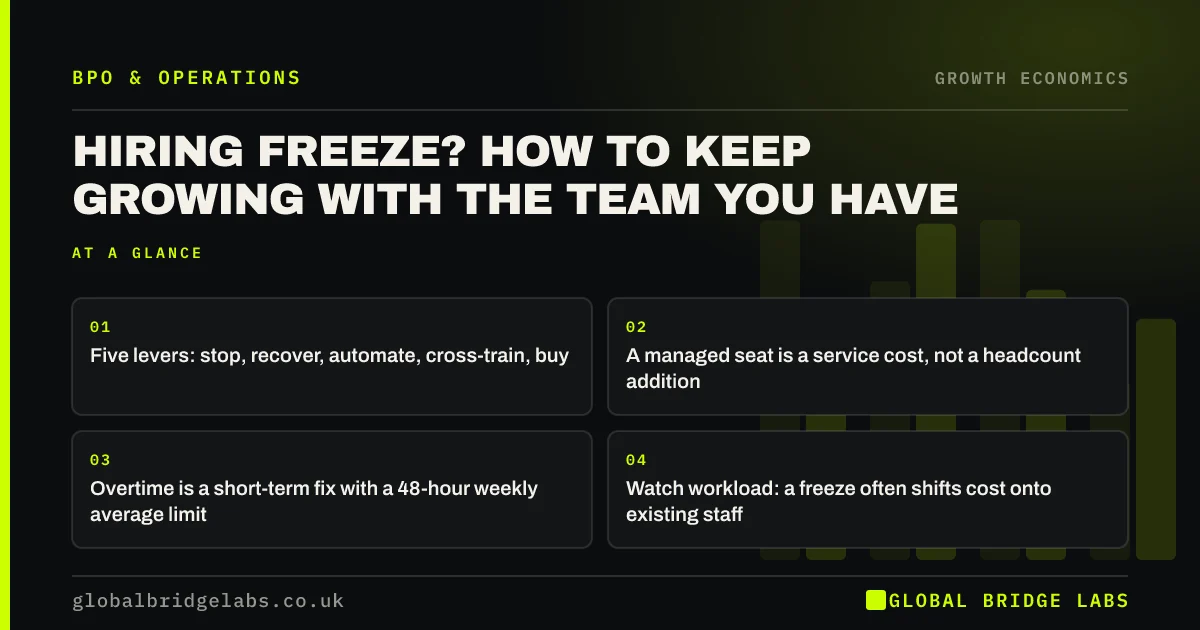
- Five levers: stop, recover, automate, cross-train, buy.
- A managed seat is a service cost, not a headcount addition.
- Overtime is a short-term fix with a 48-hour weekly average limit.
- Watch workload: a freeze often shifts cost onto existing staff.
Frozen headcount and a rising workload? Message us on WhatsApp with what is slipping.
Chat on WhatsApp →What is a hiring freeze?
A hiring freeze is a decision to stop recruiting new or replacement employees for a period, usually to control fixed costs during uncertainty. In a small business it is often informal: the owner simply decides not to replace a leaver. The work that person did does not go away.
Why do freezes go wrong?
Freezes go wrong when the work is left in place and only the headcount is frozen. The remaining team absorbs it through longer hours. Staff cannot normally be required to work more than an average of 48 hours a week, and sustained overload is a recognised cause of work-related stress, absence and resignations, which deepen the gap.
What are the five levers?
Five levers add capacity without a new employee. Use them in this order, because the first three cost little and reduce how much of the last two you need.
- Stop: drop reports, meetings and tasks nobody would miss.
- Recover: fix the causes of rework and repeat contacts.
- Automate: reminders, confirmations and data transfer.
- Cross-train: let people move to where the queue is.
- Buy: flexible outside hours for routine volume.
Does outsourcing break a hiring freeze?
Outsourcing does not add to headcount or to long-term fixed cost, which is what a freeze is meant to control. It is a service on monthly terms that can be reduced with notice. It still costs money, so it should be approved on the same basis as any other spend: what it protects and what it earns.
- Outsourcing and cash flow: fixed costs to variable
- Scaling an outsourced team up and down: how it works
Want to discuss your requirements for cover during a freeze? Send us the gap on WhatsApp.
Chat on WhatsApp →What does flexible cover cost?
As indicative market ranges, managed offshore capacity costs £9–£18 per hour and onshore £20–£35 per hour. Covering a departed administrator's routine tasks for 20 hours a week at £12 an hour is about £1,040 a month, against about £2,870 a month for replacing a £30,000 role at the loaded rate.
When should the freeze be lifted?
Lift the freeze for a specific role when the work is core, has been steady and close to full-time for two or three quarters, and the business can carry the fixed cost in a weak month. Lifting it role by role, on evidence, is safer than a general thaw.
What does this look like in practice?
A pattern we see in UK firms during cautious periods: an administrator leaves, the role is not replaced, and three colleagues share the tasks. Within two months invoices are late and one of the three is looking for another job. Moving the routine tasks to a managed part-time seat costs less than the replacement and stabilises the team.
Hiring freeze checklist
Work through this when a role is frozen or left unfilled.
- List the tasks the role covered and their weekly hours.
- Decide which tasks can stop altogether.
- Identify rework that can be removed.
- Automate confirmations and reminders.
- Assign remaining tasks with a realistic hours check.
- Price flexible cover for routine volume.
- Monitor overtime and absence monthly.
Next step
Tell us which roles are frozen or unfilled and what they used to cover. We will show you what could stop, what could be recovered and what flexible cover would involve.
Message us on WhatsApp for a capacity plan under a freeze, or book a 30-minute consultation.
Chat on WhatsApp →Sources and further reading
- Maximum weekly working hours · GOV.UK
- Work-related stress and how to manage it · Health and Safety Executive
- Rates and thresholds for employers 2026 to 2027 · HM Revenue & Customs
Frequently asked questions
How can a business grow during a hiring freeze?
A business can grow during a hiring freeze by removing low-value work, fixing the causes of rework, automating routine steps, cross-training staff and buying flexible capacity from a managed provider. These add output without adding employees or long-term fixed cost.
Does outsourcing count as hiring?
No. Outsourcing is buying a service. The people are employed and managed by the provider, and the cost is a supplier expense that can be adjusted with notice. It does not increase your headcount or employer obligations, which is why it is often used during a recruitment freeze.
What are the risks of a hiring freeze?
The main risks are overloading remaining staff, slower service, more errors and losing good people who are covering unfilled roles. A freeze saves salary in the short term but can cost more through absence, turnover and lost sales if the workload itself is not reduced or covered.
Should I replace an employee who leaves during a freeze?
Review the role before deciding. List its tasks and hours, stop what is unnecessary, and check whether routine parts could be covered by flexible outside capacity. Replace like for like only if the role is core, full and likely to be needed for the long term.
Written by

Global Bridge Labs (GBL) is a UK–Sri Lanka partner for social media, websites and BPO. Everything here comes from client delivery, not theory.