
On this page
- 01Key takeaways
- 02Why look for alternatives first?
- 03What are the eight alternatives?
- 04What does the law say about lay-offs and short time?
- 05What does the cost comparison look like?
- 06How can work be redesigned to protect jobs?
- 07When is redundancy unavoidable?
- 08What does this look like in practice?
- 09Alternatives to redundancy checklist
- 10Next step
- 11Sources and further reading
- 12Frequently asked questions
Key takeaways
Alternatives to redundancy let a UK employer lower costs while keeping its people. Start with measures that change no one's contract: stop overtime, freeze recruitment, cut agency spend and remove wasted work. Then consider agreed changes such as reduced hours or redeployment. Employers are expected to consider alternatives before making anyone redundant. This article is general information, not legal advice.
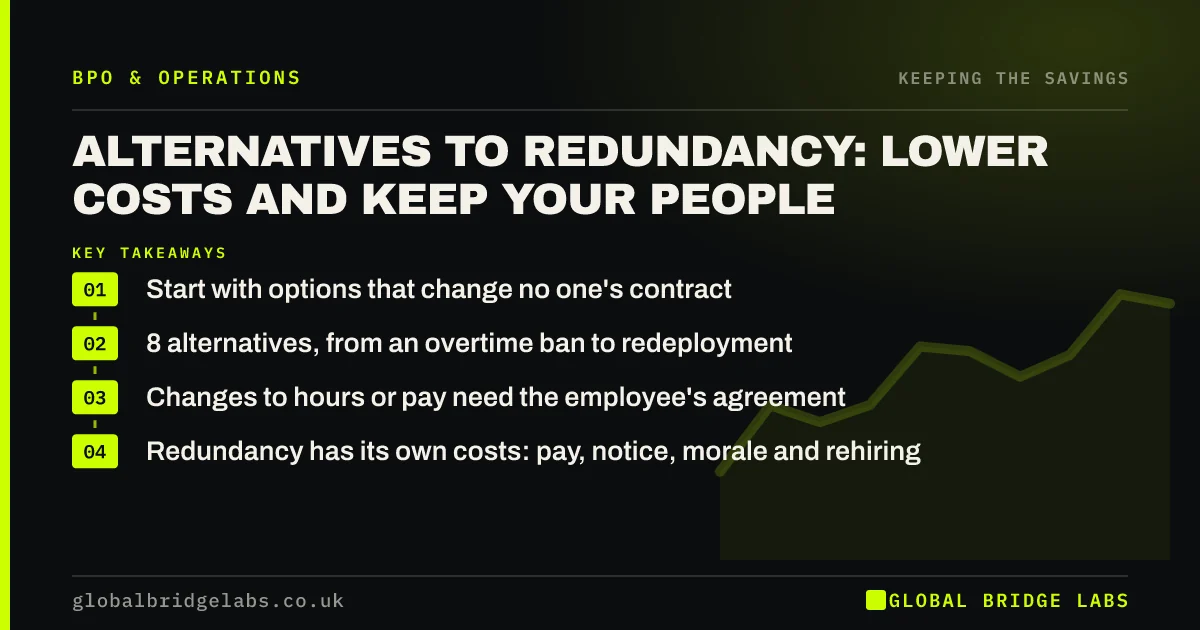
- Start with options that change no one's contract.
- 8 alternatives, from an overtime ban to redeployment.
- Changes to hours or pay need the employee's agreement.
- Redundancy has its own costs: pay, notice, morale and rehiring.
Facing a cost gap and want to avoid job losses? Message us on WhatsApp with the size of the gap.
Chat on WhatsApp →Why look for alternatives first?
Look for alternatives first because redundancy is costly, slow and hard to reverse, and because a fair process requires it. Employees with two years' service are entitled to statutory redundancy pay, and notice must be given or paid. Skills and knowledge leave with the person, and recruiting again when work returns costs more.
What are the eight alternatives?
The alternatives fall into two groups. The first four can be done without changing anyone's terms. The second four need agreement or an existing contract clause.
- 1. Stop or limit overtime.
- 2. Freeze recruitment and do not replace leavers like for like.
- 3. End agency, temporary and contractor arrangements.
- 4. Remove wasted work so fewer hours are needed.
- 5. Offer voluntary reduced hours, part-time or job sharing.
- 6. Redeploy or retrain people into roles that are needed.
- 7. Use short-time working or lay-offs, if the contract allows.
- 8. Offer voluntary redundancy or early retirement.
What does the law say about lay-offs and short time?
An employer can lay staff off or put them on short-time working only if the employment contract allows it, or the employee agrees. Employees who are laid off may be entitled to statutory guarantee pay for up to five days in any three-month period. An employee laid off or on short time for four weeks in a row, or six weeks in any thirteen, may be able to claim redundancy pay.
If you plan 20 or more redundancies at one establishment within 90 days, collective consultation rules apply. Check GOV.UK and take advice before acting.
What does the cost comparison look like?
Take an illustrative firm needing to save £35,000 a year, roughly one £30,000 role with employer costs. Instead of a redundancy, it ends regular overtime (about £9,000), does not replace a part-time leaver (£14,000), and simplifies two processes so remaining admin overflow can be bought as managed hours at lower cost (£12,000 net).
The same £35,000 is found with no redundancy pay, no notice period and no one leaving against their will. These are example figures. The mix will differ in every business.
- Rising overtime costs: when outsourcing is cheaper
- Overflow outsourcing: hand off only work above your limit
Want your cost gap worked through this way? Send us the figures on WhatsApp.
Chat on WhatsApp →How can work be redesigned to protect jobs?
Redesign work by separating what needs your people from what only needs doing. Remove steps nobody uses. Standardise the routine. Move people towards the work that earns revenue, and buy any remaining routine volume as a flexible service. Used this way, outsourcing absorbs variable workload and protects permanent roles from the next downturn.
When is redundancy unavoidable?
Redundancy is unavoidable when the work has gone and will not return, when a site closes, or when the gap is too large for other measures. In that case, follow a fair process: genuine consultation, fair selection, notice, redundancy pay and consideration of suitable alternative roles. Getting it wrong risks unfair dismissal claims.
What does this look like in practice?
A pattern we see in a slow year: the owner assumes the only real saving is a role, and spends weeks dreading the conversation. Adding up overtime, an unfilled vacancy, agency cover and work that could stop often closes most of the gap. The role that seemed unaffordable was carrying costs that were never its own.
Alternatives to redundancy checklist
Work through these before starting any redundancy process.
- The saving needed is stated as an annual figure.
- Overtime, agency and contractor costs are totalled.
- Vacancies and expected leavers are reviewed.
- Wasted work has been identified and stopped.
- Voluntary options have been offered.
- Redeployment has been considered.
- Contracts have been checked for lay-off clauses.
- Professional advice has been taken.
Next step
Tell us the saving you need and your current team, overtime and agency costs. We will show you how much of the gap can be closed through the work itself. For the employment law, speak to an HR adviser or solicitor.
Message us on WhatsApp to explore options before redundancy, or book a 30-minute consultation.
Chat on WhatsApp →Sources and further reading
- Making staff redundant · GOV.UK
- Redundancy: your rights · GOV.UK
- Lay-offs and short-time working · GOV.UK
- Business transfers, takeovers and TUPE · GOV.UK
Frequently asked questions
What are the alternatives to redundancy?
Common alternatives are stopping overtime, freezing recruitment, ending agency and contractor arrangements, removing unnecessary work, offering reduced hours or job sharing, redeploying staff, short-time working or lay-offs where contracts allow, and voluntary redundancy or early retirement.
Does an employer have to consider alternatives to redundancy?
A fair redundancy process is expected to include considering ways to avoid or reduce redundancies and looking for suitable alternative employment. Failing to do so can make a dismissal unfair. Check current GOV.UK guidance and take professional advice.
Can I reduce staff hours instead of making redundancies?
Only with the employees' agreement, unless their contracts already allow short-time working. Hours and pay are contractual terms. Many employees will agree a temporary reduction to protect jobs, but it must be consulted on and confirmed in writing.
Is outsourcing an alternative to redundancy?
It can be, when used to absorb variable workload so permanent roles are sized to steady demand and protected in a downturn. If existing employees' work transfers to a provider, TUPE may apply and those employees may transfer too. Take advice first.
Written by

Global Bridge Labs (GBL) is a UK–Sri Lanka partner for social media, websites and BPO. Everything here comes from client delivery, not theory.


