On this page
Why BPO performance feels unclear
Many BPO partnerships start with clear intentions but drift into vague reporting over time. Teams receive activity numbers, yet still struggle to answer core business questions about service quality, cost efficiency, and customer impact.
When leaders cannot connect delivery metrics to outcomes, decisions slow down. Budget reviews become difficult, quality issues stay hidden longer, and teams react too late.
The difference between activity and outcomes
Activity metrics are useful, but they are not enough on their own. Tracking tickets processed, calls answered, or emails handled does not automatically tell you whether operations are improving.
Outcome metrics show whether the operation is creating business value. A reliable BPO scorecard combines both views so leaders can make confident decisions each week, not just at month end.
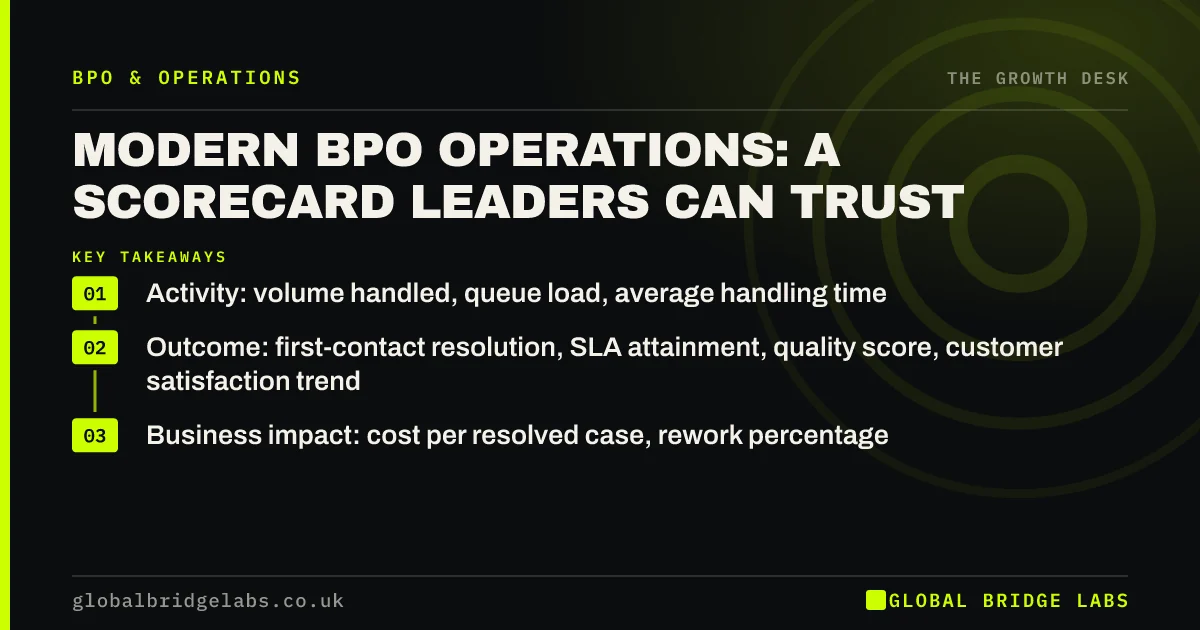
- Activity: volume handled, queue load, average handling time.
- Outcome: first-contact resolution, SLA attainment, quality score, customer satisfaction trend.
- Business impact: cost per resolved case, rework percentage, and revenue protection where relevant.
A practical scorecard structure for BPO leaders
A practical model uses a small set of signals across service, quality, and efficiency. The goal is not to track everything. The goal is to highlight exceptions early and keep teams focused on the few numbers that predict risk.
For most operations, 8 to 12 metrics are enough when they are reviewed with clear ownership and escalation rules.
- Service: response time compliance, backlog age, abandonment rate.
- Quality: audit pass rate, error leakage, repeat-contact ratio.
- Efficiency: throughput per agent, schedule adherence, cost per completed task.
- Stability: attrition trend, training completion, and ramp-up time for new staff.
Common reporting mistakes that reduce trust
The most common issue is inconsistent definitions. If teams calculate metrics differently each month, trends are misleading and debates replace decisions.
Another issue is delayed reporting. Weekly reviews lose value when data arrives too late to adjust staffing, process, or coaching plans.
- Undefined metric formulas across teams or vendors.
- No threshold bands (green/amber/red) tied to action plans.
- Scorecards that ignore quality and focus only on speed.
- No owner assigned for each KPI and escalation path.
How to implement this without disruption
Start with your current reports and map each metric to one of three questions: Are we meeting commitments? Are we delivering quality? Are we operating efficiently? Remove anything that does not support those decisions.
Then run a fixed weekly review rhythm with the same template, definitions, and owners. This creates consistency, speeds up intervention, and improves trust between leadership and operations teams.
Next step
If your current BPO reporting is detailed but still hard to act on, we can help you redesign the scorecard around service reliability, quality outcomes, and commercial performance.
Talk to Global Bridge Labs about building a clearer BPO scorecard.
Chat on WhatsApp →Frequently asked questions
What should a BPO scorecard include?
A reliable BPO scorecard combines three views: activity (volume handled, queue load, handling time), outcomes (first-contact resolution, SLA attainment, quality score, customer satisfaction) and business impact (cost per resolved case, rework percentage). Eight to twelve metrics with clear owners are enough for most operations.
How often should BPO performance be reviewed?
Weekly, using the same template, definitions and owners every time. Monthly reviews arrive too late to adjust staffing, process or coaching. A fixed weekly rhythm surfaces exceptions early and builds trust between leadership and the operations team.
Why do BPO reports lose credibility?
Usually because metric definitions change between teams or months, so trends mislead and debates replace decisions. Delayed reporting, scorecards that ignore quality in favour of speed, and KPIs with no named owner or escalation path are the other common causes.
What is the difference between activity and outcome metrics?
Activity metrics show how much work was done: tickets processed, calls answered, emails handled. Outcome metrics show whether that work created value: resolution rates, SLA compliance, quality and customer satisfaction. Leaders need both, because volume alone never proves an operation is improving.
Written by

Global Bridge Labs (GBL) is a UK–Sri Lanka partner for social media, websites and BPO. Everything here comes from client delivery, not theory.