On this page
- 01Key takeaways
- 02What is an SLA in BPO?
- 03What are good SLA examples for calls?
- 04What are good SLA examples for email and chat?
- 05What are good SLA examples for back-office work?
- 06How do you set realistic targets?
- 07What happens when an SLA is missed?
- 08What makes SLAs backfire?
- 09What does this look like in practice?
- 10Checklist: write your SLAs
- 11Next step
- 12Sources and further reading
- 13Frequently asked questions
Key takeaways
BPO SLA examples are most useful as starting points you adjust to your customers and volumes. A good service level agreement (SLA) sets a measurable target, the measurement period, where it is measured, and what happens when it is missed. Keep it to five to eight measures per process.
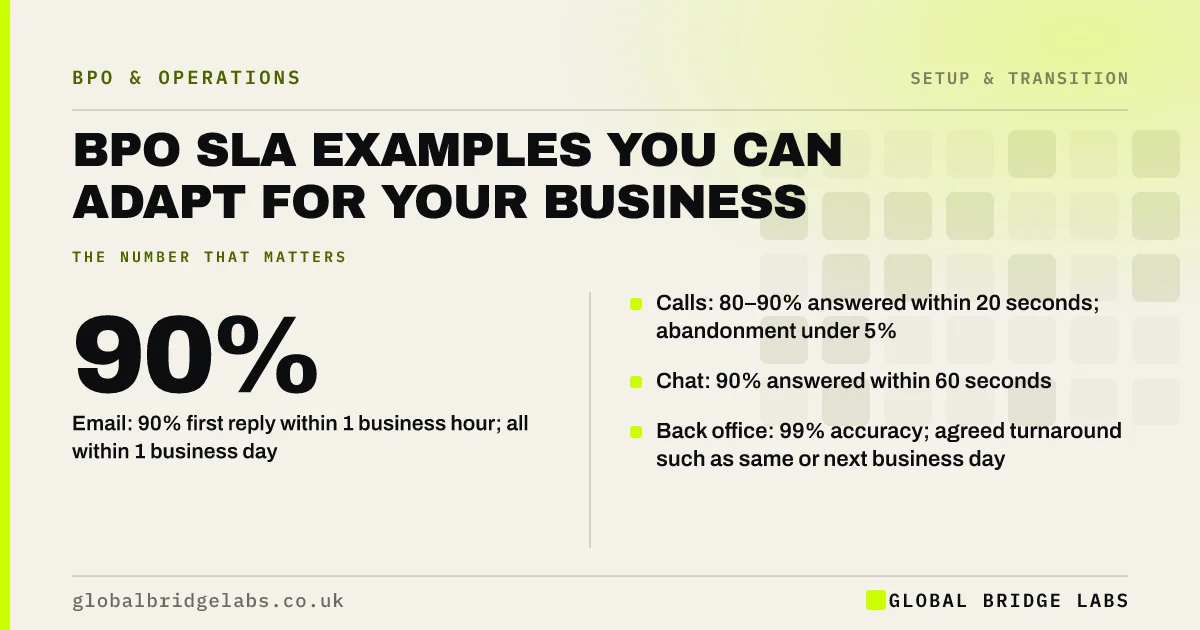
- Email: 90% first reply within 1 business hour; all within 1 business day.
- Calls: 80–90% answered within 20 seconds; abandonment under 5%.
- Chat: 90% answered within 60 seconds.
- Back office: 99% accuracy; agreed turnaround such as same or next business day.
- Every SLA needs a measurement source, a period and a remedy.
Want SLAs drafted for your processes? Message us on WhatsApp with your channels and volumes.
Chat on WhatsApp →What is an SLA in BPO?
An SLA (service level agreement) in business process outsourcing (BPO) is the part of the contract that defines the standard of service the provider must deliver, expressed as measurable targets with a measurement method and consequences when targets are missed.
SLAs turn "good service" into something both sides can check. They should be measured in systems you can see, such as your helpdesk or phone platform, not only in the provider's own reports.
What are good SLA examples for calls?
Call SLAs focus on how fast calls are answered, how many callers give up, and whether the call achieved its purpose. These are starting points for a UK SME.
- Service level: 80–90% of calls answered within 20 seconds, measured monthly.
- Abandonment rate: under 5% of calls abandoned after 10 seconds.
- Call logging: 100% of calls logged in the CRM within 5 minutes.
- Booking or resolution rate: tracked monthly against a target agreed after the first month.
- Quality score: average of 85% or above on sampled calls.
What are good SLA examples for email and chat?
Written channels are measured on first response, resolution and quality. Set business-hours targets and define business hours clearly.
- Email first reply: 90% within 1 business hour; 100% within 1 business day.
- Email resolution: 80% resolved within 1 business day.
- Chat response: 90% of chats answered within 60 seconds.
- First contact resolution: 70% or more resolved without escalation.
- Customer satisfaction: survey score tracked monthly against baseline.
What are good SLA examples for back-office work?
Back-office SLAs focus on accuracy and turnaround. Accuracy should be measured by sampling against source documents, not assumed.
- Accuracy: 99% or better at field level, measured by weekly sample.
- Turnaround: invoices raised within 1 business day of job completion.
- Turnaround: data entry completed same business day if received by 14:00.
- Backlog: no item older than 2 business days at end of each day.
- Exceptions: all exceptions flagged to the named contact within 4 business hours.
How do you set realistic targets?
Start from your baseline, not from an industry average. If your team currently replies to email in six hours, a one-hour target is a big improvement; set it, but allow the first month to stabilise before it counts. Review targets after three months and tighten them where the team is consistently ahead.
Staffing drives service levels. Tighter targets need more capacity at peak times, which costs more. As indicative market ranges, managed offshore teams cost around £9–£18 per hour, so a target that needs an extra part-time seat has a clear price.
Want targets set from your own baseline, with the staffing they need costed? Send us your current numbers on WhatsApp and we will discuss your requirements.
Chat on WhatsApp →What happens when an SLA is missed?
Agree the consequence in advance. For most SMEs, a sensible ladder is: a missed month triggers a root-cause review and a written remediation plan; two consecutive misses trigger a formal service review; repeated failure gives you the right to terminate without waiting for the notice period. Service credits, fee reductions for missed targets, are another option.
SLAs should also list your obligations: answering escalations promptly, giving notice of volume changes and keeping procedures current.
What makes SLAs backfire?
SLAs backfire when they reward the wrong thing. A strict call-handling-time target can push agents to rush customers off the phone. A response-time target without a resolution target encourages fast, useless replies. Balance speed with quality and outcome measures, and read sampled conversations, not only the numbers.
What does this look like in practice?
Across our client work, response time to enquiries has fallen by 71% once service levels were written down and staffed to. The targets themselves were not exotic. What changed was that someone was accountable for them every day and the numbers were reviewed every week.
Checklist: write your SLAs
Use this for each process.
- Measure your current baseline.
- Pick five to eight measures covering speed, quality and outcome.
- Define each: target, period, business hours and data source.
- Allow a stabilisation month before targets count.
- Agree the consequence ladder for misses.
- List your own obligations as the client.
- Review targets after three months.
Next step
Tell us your channels and current performance and we will draft SLAs you can hold any provider to, including us. 30 minutes, no pitch.
Message us on WhatsApp for draft SLAs, or book a 30-minute consultation.
Chat on WhatsApp →Sources and further reading
- UK Customer Satisfaction Index · Institute of Customer Service
- The Sourcing and Consultancy Playbooks · Cabinet Office
- Contracts and liabilities between controllers and processors · Information Commissioner's Office
Frequently asked questions
What is a good SLA for customer service?
A reasonable starting point for a UK SME is 90% of emails answered within one business hour, chats within 60 seconds, 80% to 90% of calls within 20 seconds, abandonment under 5%, and 70% of contacts resolved without escalation. Adjust from your own baseline.
What is the 80/20 service level?
The 80/20 service level means 80% of calls are answered within 20 seconds. It is a long-standing contact-centre benchmark. Many businesses aim higher, such as 90/20, for sales or urgent lines. Stricter targets require more staff at peak times, which costs more.
How many SLAs should an outsourcing contract have?
Five to eight per process is usually enough, covering speed, quality and outcome. More than that becomes hard to monitor and dilutes attention. Track other measures as diagnostics in the monthly report without making each one a contractual SLA.
Who measures the SLA?
Ideally both sides, from the same data. Measure in systems you can access, such as your helpdesk, phone platform or CRM, so you are not relying solely on the provider's report. The provider should share raw data and explain any gaps.
Written by

Global Bridge Labs (GBL) is a UK–Sri Lanka partner for social media, websites and BPO. Everything here comes from client delivery, not theory.