
On this page
- 01Key takeaways
- 02What is average handling time?
- 03How do you calculate it?
- 04Why does a minute matter?
- 05How do you lower AHT without harming service?
- 06When is a low AHT a bad sign?
- 07How should AHT be used with a provider?
- 08What does this look like in practice?
- 09AHT checklist
- 10Next step
- 11Sources and further reading
- 12Frequently asked questions
Key takeaways
Average handling time (AHT) is the average time a team spends on one customer contact, including the conversation and the follow-up work. It drives how many people a service team needs. Lowering it saves money only when the customer's problem is still solved first time. A shorter contact that leads to a second one costs more, not less.
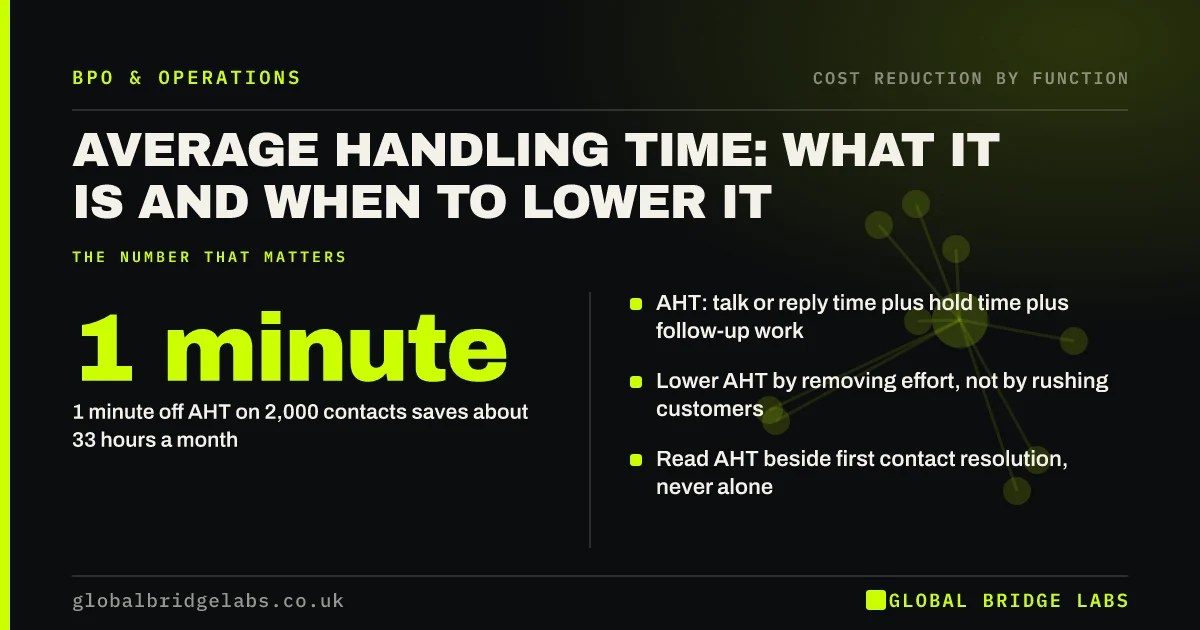
- AHT: talk or reply time plus hold time plus follow-up work.
- 1 minute off AHT on 2,000 contacts saves about 33 hours a month.
- Lower AHT by removing effort, not by rushing customers.
- Read AHT beside first contact resolution, never alone.
Want your handling time measured properly? Message us on WhatsApp with your channels and volumes.
Chat on WhatsApp →What is average handling time?
Average handling time is a customer service metric that measures the average duration of a contact from start to finish, including any work done afterwards to complete it. It began in call centres and now applies to email, chat and messaging as well.
How do you calculate it?
For calls, add total talk time, total hold time and total after-call work, then divide by the number of calls handled. For email and chat, use the total time spent reading, replying and updating records, divided by contacts handled.
In an illustrative week, a team handles 500 calls with 2,000 minutes of talk time, 250 minutes on hold and 750 minutes of follow-up. AHT is 3,000 minutes divided by 500, or 6 minutes.
- Talk or reply time: 2,000 minutes.
- Hold time: 250 minutes.
- After-contact work: 750 minutes.
- AHT: 3,000 divided by 500 calls, 6 minutes.
Why does a minute matter?
A minute matters because it is multiplied by every contact. On 2,000 contacts a month, bringing AHT from 6 minutes to 5 saves 2,000 minutes, about 33 hours. At a loaded £19.81 per worked hour, that is roughly £660 a month, or close to £7,900 a year.
The same arithmetic runs in reverse. A new step that adds a minute to every contact costs the same amount, which is why small process changes deserve scrutiny.
Want to know what a minute is worth in your team? Send us your volumes on WhatsApp.
Chat on WhatsApp →How do you lower AHT without harming service?
Lower AHT by taking effort out of the contact, not by hurrying the customer. Most wasted time is spent searching for information, typing things that could be templated, and updating several systems afterwards.
- Put customer and order details on one screen.
- Use tested replies for routine questions.
- Give handlers authority to resolve without referral.
- Cut after-contact work with simpler record keeping.
- Keep a searchable, current knowledge base.
When is a low AHT a bad sign?
A low AHT is a bad sign when it is achieved by ending contacts before the problem is solved. Handlers targeted on speed learn to transfer, defer or give partial answers. The customer contacts you again, and two short contacts cost more than one thorough one. Complex or high-value queries should take longer.
How should AHT be used with a provider?
With a provider, use AHT for planning capacity, not as a target for individuals. Agree it alongside quality and resolution measures, and review the three together. If you pay per hour, a falling AHT lowers your cost. If you pay per contact, check the provider is not shortening contacts at the expense of resolution.
What does this look like in practice?
A pattern we see in small support teams: most of each contact is spent finding the order, not helping the customer. The handler opens three systems and asks the customer to repeat details. Bringing that information onto one screen shortens every contact, and customers experience it as better service.
AHT checklist
Use this before setting any handling time goal.
- Measure AHT by channel and query type.
- Include after-contact work.
- Find where handlers spend time searching.
- Template the routine replies.
- Track first contact resolution beside AHT.
- Never rank individuals on AHT alone.
Next step
Tell us your contact volumes and roughly how long each takes. We will help you find where the time goes and what could come out without customers noticing.
Message us on WhatsApp to review your handling time, or book a 30-minute consultation.
Chat on WhatsApp →Sources and further reading
- UK Customer Satisfaction Index · Institute of Customer Service
- Labour productivity · Office for National Statistics
Frequently asked questions
What is the formula for average handling time?
Average handling time equals total talk time plus total hold time plus total after-contact work, divided by the number of contacts handled. For email and chat, use total time spent reading, replying and updating records. Measure it separately for each channel.
What is a good average handling time?
There is no single good figure. It depends on the channel, the complexity of queries and the industry. A password reset and a billing dispute should not take the same time. Compare AHT with your own past performance for the same query type.
Does reducing AHT reduce costs?
Yes, if resolution holds. Each minute saved per contact reduces the hours needed to handle the same volume. If shorter contacts lead to more repeat contacts, the saving disappears. Always track first contact resolution alongside handling time.
Should agents be targeted on AHT?
It is safer not to. Individual AHT targets encourage rushing, unnecessary transfers and incomplete answers. Use AHT to plan staffing and to spot process problems, and judge individuals on quality and resolution. Share team averages so people can see the trend without feeling timed.
Written by

Global Bridge Labs (GBL) is a UK–Sri Lanka partner for social media, websites and BPO. Everything here comes from client delivery, not theory.


