On this page
- 01Key takeaways
- 02What is the GBL Conversion Gap Scorecard?
- 03How do you score Clarity?
- 04How do you score Proof?
- 05How do you score Friction?
- 06How do you score Action?
- 07How do you score Follow-up?
- 08What do the scores usually look like?
- 09What are the limits of a scorecard?
- 10What does this look like in practice?
- 11Scorecard summary
- 12Next step
- 13Sources and further reading
- 14Frequently asked questions
Key takeaways
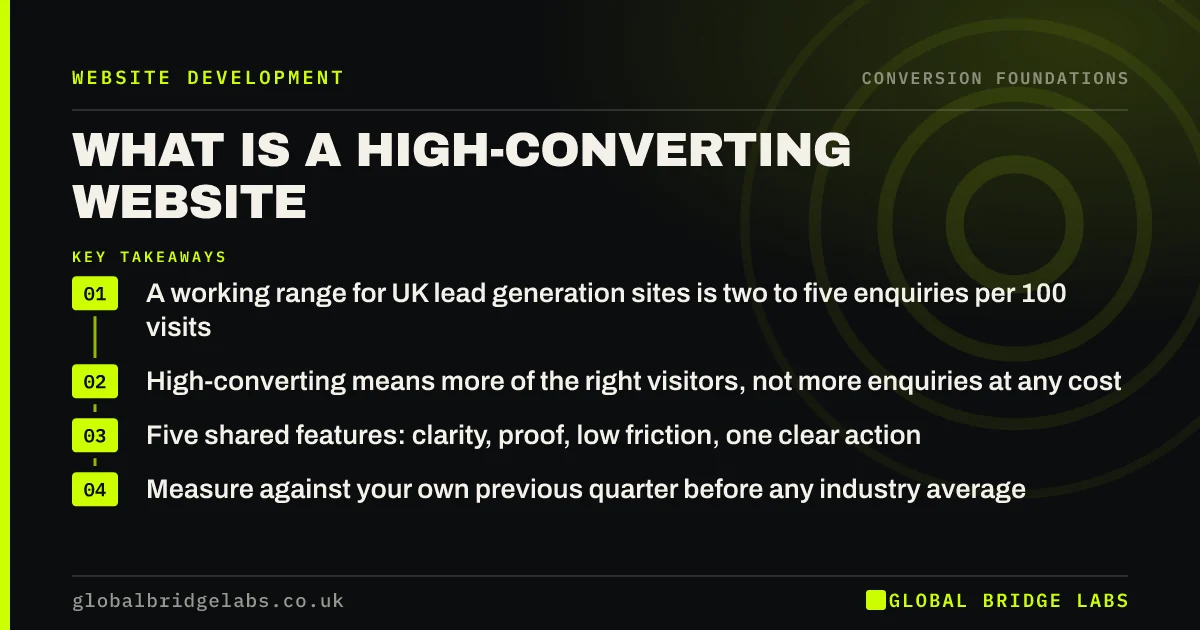
The GBL Conversion Gap Scorecard scores a website on five tests (Clarity, Proof, Friction, Action and Follow-up) from 0 to 2 each, giving a total out of 10. It takes about 30 minutes and shows whether a site is high-converting, good but leaking, or a brochure, and which test to fix first.
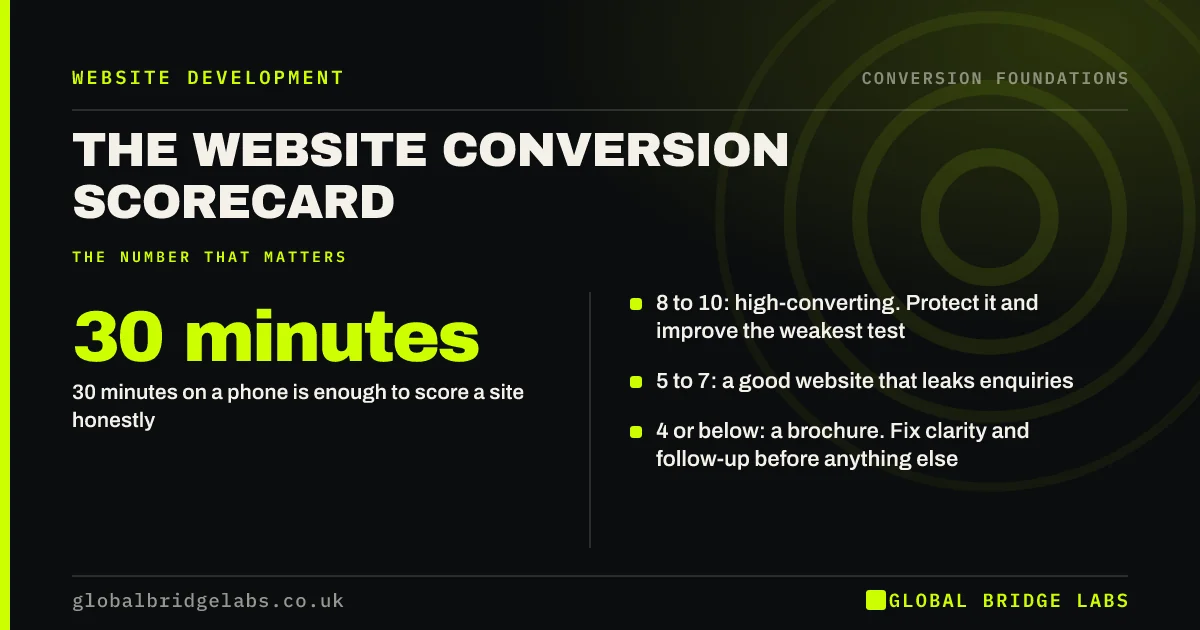
- 8 to 10: high-converting. Protect it and improve the weakest test.
- 5 to 7: a good website that leaks enquiries. Most sites land here.
- 4 or below: a brochure. Fix clarity and follow-up before anything else.
- 30 minutes on a phone is enough to score a site honestly.
Want us to score your site for you? Send us the URL on WhatsApp.
Chat on WhatsApp →What is the GBL Conversion Gap Scorecard?
The GBL Conversion Gap Scorecard is a 10-point assessment that measures the gap between a good website and a high-converting one. It uses five tests, each scored 0 (missing), 1 (partly there) or 2 (done well), and it is designed to be completed by a business owner on a phone, without analytics expertise.
We built it because owners were asking 'is my website any good?' and getting design opinions in return. The scorecard replaces taste with questions a buyer would ask.
How do you score Clarity?
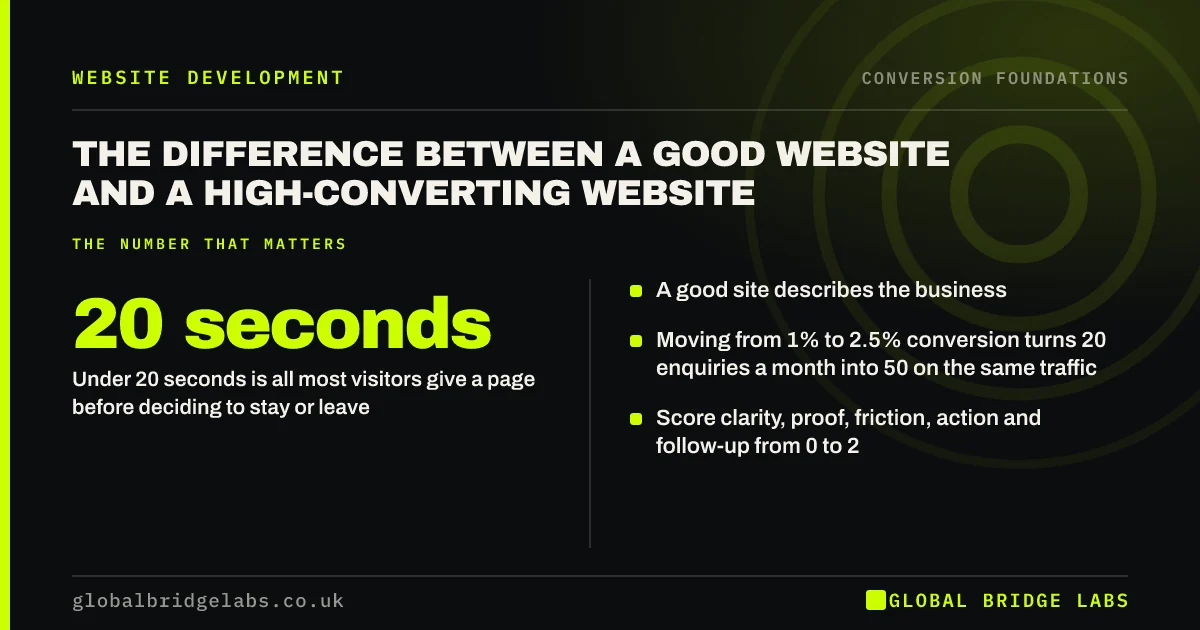
Show your homepage and top service page to someone who does not know the business for five seconds, then ask what you do, for whom and where. Score 2 if they get all three, 1 if they get one or two, 0 if they cannot say.
How do you score Proof?
Look at each main claim on your top three pages. Score 2 if specific proof (a number, named project, detailed review) sits beside most claims, 1 if proof exists but lives on a separate page, 0 if there is no specific proof at all.
How do you score Friction?
On a phone, over mobile data, time yourself from landing on a service page to sending an enquiry. Score 2 if it takes under a minute with no problems, 1 if it takes longer or something is awkward, 0 if you hit an error, a slow page or a dead end.
How do you score Action?
Check each key page for one obvious next step. Score 2 if every key page has one dominant action suited to the visitor, 1 if actions exist but compete or only appear at the bottom, 0 if the only route is a contact page in the menu.
How do you score Follow-up?
Answer two questions: can you say how many enquiries the website produced last month and from which source, and is every enquiry answered within one working hour? Score 2 for yes to both, 1 for yes to one, 0 for neither.
Scored below 8? Send us your five scores on WhatsApp and we will tell you which fix to start with.
Chat on WhatsApp →What do the scores usually look like?
Most UK small business sites we score for the first time land between 4 and 6. Clarity and Friction are often 1s, Proof is often a 1 because testimonials live on their own page, and Follow-up is the most common 0 because calls and WhatsApp are not tracked. Sites that recently had an expensive redesign score no higher on average, which is the whole point of the gap.
- Most common weakest test: Follow-up (tracking and reply speed).
- Most common quick win: Proof moved beside claims.
- Most improved after one quarter of work: Clarity.
What are the limits of a scorecard?
A scorecard shows where a site is weak. It does not replace real data. A site can score 9 and still get few enquiries if nobody visits it, or if it attracts the wrong visitors. Use the scorecard alongside enquiries by source, and re-score after each change to see whether the gap is closing.
What does this look like in practice?
A UK garden design firm scored 4: Clarity 1, Proof 1, Friction 1, Action 1, Follow-up 0. The owner had planned a £9,000 redesign. We started with Follow-up (tracking and a reply rule), then Clarity and Proof on the top pages. Three months later the site scored 8, the redesign was postponed, and the owner could see enquiries by source for the first time.
Scorecard summary
- Clarity: offer, audience and area understood in five seconds.
- Proof: specific evidence beside the main claims.
- Friction: enquiry sent on a phone in under a minute.
- Action: one dominant next step on every key page.
- Follow-up: enquiries tracked by source and answered within one working hour.
- Re-score every quarter and fix the lowest test first.
Next step
Score your site this week. If it lands below 8, you have found the gap between a good website and a high-converting one, and you know where to start closing it.
Message us on WhatsApp and we will score your site on the GBL Conversion Gap Scorecard with you.
Chat on WhatsApp →Sources and further reading
- How long do users stay on web pages? · Nielsen Norman Group
- About key events · Google Analytics Help
- PageSpeed Insights · Google
Frequently asked questions
How do I score my website's conversion?
Use the GBL Conversion Gap Scorecard: score Clarity, Proof, Friction, Action and Follow-up from 0 to 2 each. Test on a phone, show the page to someone new for five seconds, time the enquiry route and check whether enquiries are tracked and answered within an hour.
What score means a website is high-converting?
A total of 8 to 10 indicates a high-converting site. 5 to 7 is a good site that leaks enquiries, which is where most small business websites sit. 4 or below means the site works more like a brochure than a lead source.
How often should I re-score my website?
Every quarter, and after any significant change to key pages. Keep the scores in a simple log with the date and what changed, so you can see whether the gap is closing and which changes moved the numbers. Share the log with anyone who edits the site.
Can a high score still mean few enquiries?
Yes. The scorecard measures how well the site converts the visitors it gets. If traffic is very low or poorly matched to your buyers, enquiries will stay low. Look at visibility and traffic sources alongside the score. Fixing visibility may matter more than fixing pages.
Written by

Global Bridge Labs (GBL) is a UK–Sri Lanka partner for social media, websites and BPO. Everything here comes from client delivery, not theory.