On this page
- 01Key takeaways
- 02What is a website conversion audit?
- 03Hour 1: What data do you need?
- 04Hour 2: How do you review the landing pages?
- 05Hour 3: How do you test the enquiry routes?
- 06Optional: What do recordings and heatmaps add?
- 07Hour 4: How do you turn findings into a fix list?
- 08What are the limits of a one-afternoon audit?
- 09What does this look like in practice?
- 10Conversion audit checklist
- 11Next step
- 12Sources and further reading
- 13Frequently asked questions
Key takeaways
A website conversion audit is a structured review of how well a site turns visitors into enquiries or sales, and where it loses them. Unlike a general website audit, it ignores most technical and SEO detail and follows the buyer's path. A small business can complete one in about four hours with free tools.
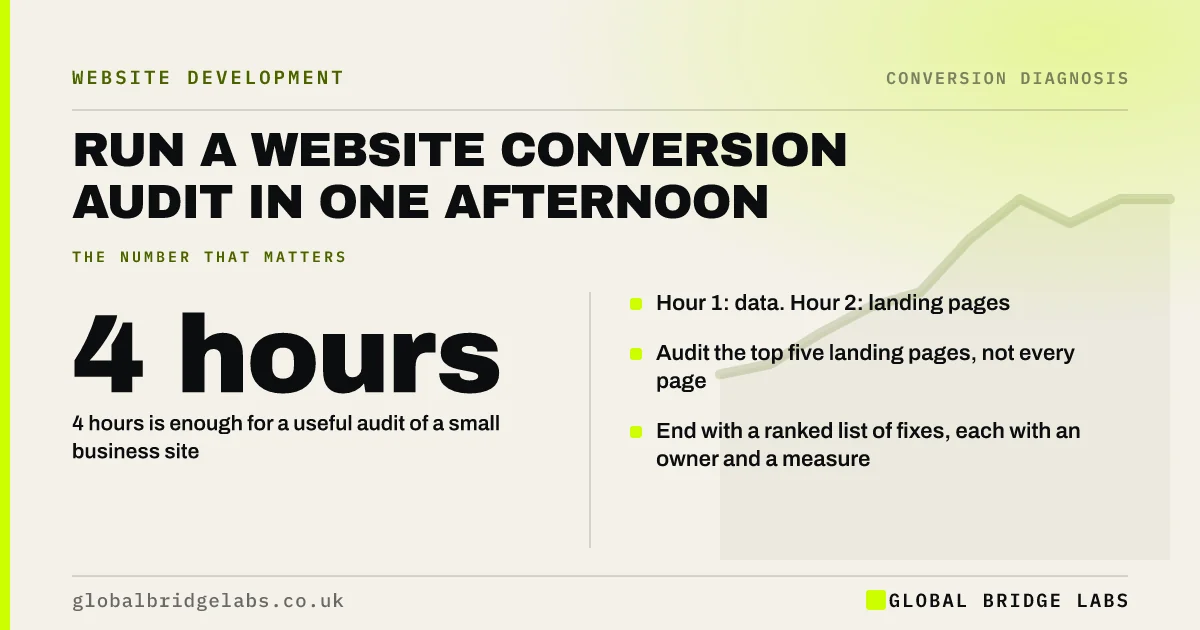
- 4 hours is enough for a useful audit of a small business site.
- Hour 1: data. Hour 2: landing pages. Hour 3: routes on a phone. Hour 4: fix list.
- Audit the top five landing pages, not every page.
- End with a ranked list of fixes, each with an owner and a measure.
Want the audit done with you? Message us on WhatsApp.
Chat on WhatsApp →What is a website conversion audit?
A website conversion audit is a review of a site's ability to turn the right visitors into enquiries, bookings or sales, covering data, landing pages, enquiry routes and follow-up. It differs from a general website audit, which covers security, SEO and maintenance. The conversion audit asks one question: where do buyers drop out, and why?
Hour 1: What data do you need?
Pull three months of data from Google Analytics 4 and Google Search Console. You need sessions and key events by landing page, by channel and by device, plus the top search queries. If key events are not set up, the first finding of the audit is that tracking must be fixed before anything else.
- Top 10 landing pages by sessions, with key events for each.
- Conversion rate by channel: organic, paid, social, referral, direct.
- Conversion rate by device: mobile versus desktop.
- Top 20 search queries and the pages they land on.
- Enquiries recorded outside analytics: calls, walk-ins, WhatsApp.
Hour 2: How do you review the landing pages?
Take the five landing pages with the most sessions and review each on a phone as a first-time buyer. Score each on the GBL Conversion Gap Scorecard (Clarity, Proof, Friction, Action, Follow-up) and note the specific gap: missing price guidance, proof on another page, a vague headline, a competing button.
Hour 3: How do you test the enquiry routes?
Complete every route to enquire or buy, on a phone over mobile data, and time each one. Submit each form, tap each phone link, start a WhatsApp chat, run a test booking or purchase. Check the notification arrives in an inbox someone watches, and note how long a reply takes.
- Form: fields, errors, confirmation message, notification received.
- Phone: number clickable, correct, answered in business hours.
- WhatsApp: opens correctly with a pre-filled message.
- Booking or checkout: completes, confirms and records the key event.
Optional: What do recordings and heatmaps add?
Free tools such as Microsoft Clarity show where visitors click, how far they scroll and where they hesitate. Twenty or thirty recordings on your top landing page often reveal a problem in minutes, such as people tapping an image that is not a link, or never scrolling past a large header.
Hour 4: How do you turn findings into a fix list?
List every finding, then rank by expected impact and effort. Broken routes and missing tracking go first because they cost nothing to justify. Then clarity and proof on the busiest pages. Each fix gets an owner, a date and the measure you will watch for 8 weeks after the change.
Send us your fix list on WhatsApp and we will help you rank it.
Chat on WhatsApp →What are the limits of a one-afternoon audit?
An afternoon audit finds the obvious leaks, which are usually the expensive ones. It will not find subtle issues that need weeks of data or proper user testing, and it is only as good as the tracking behind it. If the site is large, sells online at scale or has several audiences, plan a longer audit with user research.
What does this look like in practice?
An afternoon audit for a UK removals company found three things: WhatsApp clicks were not tracked, the quote form failed when a postcode had a space in it, and the top landing page (a moving checklist) had no link to the quote form. None needed a designer. All three were fixed within a week.
Conversion audit checklist
- Confirm every enquiry route is tracked as a key event.
- Pull three months of data by page, channel and device.
- Score the top five landing pages on the scorecard.
- Test every enquiry and checkout route on a phone.
- Watch 20 to 30 recordings of the busiest page.
- Rank fixes by impact and effort; give each an owner and a measure.
Next step
A conversion audit is the fastest way to find out whether your site needs small fixes or something bigger. We can run it with you and hand over a ranked fix list you can act on.
Message us on WhatsApp for a conversion audit, or book a 30-minute consultation.
Chat on WhatsApp →Sources and further reading
- About key events · Google Analytics Help
- Google Search Console · Google
- About Microsoft Clarity (heatmaps and session recordings) · Microsoft
- PageSpeed Insights · Google
Frequently asked questions
What is included in a conversion audit?
A conversion audit covers tracking, conversion data by page, channel and device, a review of the top landing pages, a test of every enquiry and checkout route, and optionally session recordings. It ends with a ranked list of fixes, each with an owner and a measure.
How long does a website conversion audit take?
For a small business site, about four hours covers data, the top five landing pages, route testing and a fix list. Larger sites or online shops with several audiences need longer, often including user testing and a few weeks of recordings.
How is a conversion audit different from an SEO audit?
An SEO audit asks whether search engines can find, understand and rank your pages. A conversion audit asks whether visitors who arrive take the next step, and where they drop out. You need both, but a conversion audit often pays back faster because it uses traffic you already have.
What tools do I need for a conversion audit?
Google Analytics 4 with key events, Google Search Console, a phone on mobile data, and optionally a free recording tool such as Microsoft Clarity. PageSpeed Insights helps check mobile speed on the landing pages you review. None of these tools cost anything for a small site.
Written by

Global Bridge Labs (GBL) is a UK–Sri Lanka partner for social media, websites and BPO. Everything here comes from client delivery, not theory.