On this page
- 01Key takeaways
- 02Why does a website get traffic but no sales?
- 03Step 1: Is every enquiry actually being tracked?
- 04Step 2: Are the visitors people who could buy?
- 05Step 3: Do visitors land on the right page?
- 06Step 4: Does the page answer the buyer?
- 07Step 5: Does the enquiry or checkout route work?
- 08How much traffic should produce a sale?
- 09What does this look like in practice?
- 10Traffic but no sales checklist
- 11Next step
- 12Sources and further reading
- 13Frequently asked questions
Key takeaways
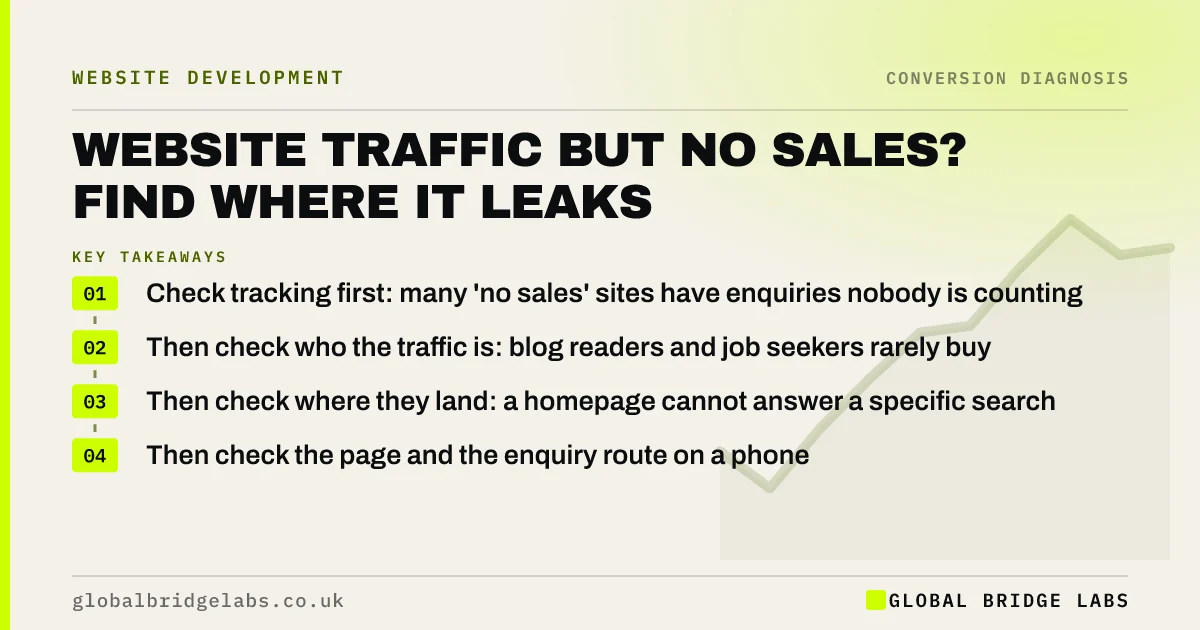
When a website gets traffic but no sales, the leak is almost always in one of four places: the wrong visitors, the wrong landing page, a page that does not answer the buyer, or a broken or untracked enquiry route. Check them in that order, because fixing a page will not help if the visitors could never buy.
- Check tracking first: many 'no sales' sites have enquiries nobody is counting.
- Then check who the traffic is: blog readers and job seekers rarely buy.
- Then check where they land: a homepage cannot answer a specific search.
- Then check the page and the enquiry route on a phone.
Send us your top five landing pages on WhatsApp and we will point to the leak.
Chat on WhatsApp →Why does a website get traffic but no sales?
Traffic without sales means visitors are arriving and leaving without taking the step the business needs. That happens when the visitors are not buyers, when they land on a page that does not match why they came, when the page fails to answer their questions, or when the route to enquire or buy is broken.
Each has a different fix, so guessing wastes money. A redesign will not help visitors who were never buyers, and better ads will not help a checkout that fails on mobile.
Step 1: Is every enquiry actually being tracked?
Start by confirming the zero is real. Many sites track form submissions but not phone clicks, WhatsApp chats, email clicks or bookings made through a third-party tool. Set each up as a key event in Google Analytics 4 and ask the team how many calls mention the website. The 'no sales' problem sometimes shrinks to a measurement problem.
Step 2: Are the visitors people who could buy?
Look at which pages attract the traffic and which searches bring it. In Google Search Console, sort queries by clicks. If most visits come from a popular how-to article, a job advert, or searches outside your area, the traffic is real but not commercial. That is a visibility problem, not a conversion one.
- Blog posts ranking for broad questions: useful, but rarely immediate buyers.
- Searches outside your service area: cannot convert whatever the page says.
- Job seekers, suppliers and students: real visits, no buying intent.
- Brand searches: high intent, usually already converting well.
Step 3: Do visitors land on the right page?
Visitors convert best on a page that matches exactly what they searched or clicked. If ads, social posts or search results send people interested in one service to the homepage, most of them leave rather than hunt. Check the top landing pages in GA4 and match each traffic source to a specific page.
Step 4: Does the page answer the buyer?
Once the right visitors reach the right page, the page has to answer what, for whom, where, how much, why you and what next. Read your top landing page as a buyer on a phone. If any of those answers is missing or buried below several screens, that is the leak.
Want a buyer's-eye review of your top landing page? Ask us on WhatsApp.
Chat on WhatsApp →Step 5: Does the enquiry or checkout route work?
Test every route yourself on a phone over mobile data: submit the form, tap the phone number, start a WhatsApp chat, complete a test purchase. Forms that fail silently, notification emails that go to an old inbox and checkouts that break on one browser are more common than most owners think.
How much traffic should produce a sale?
As working ranges for UK SMEs, lead generation sites convert around 2% to 5% of visits into enquiries, and e-commerce sites 1% to 3% of sessions into orders. So 1,000 relevant visits a month should produce roughly 20 to 50 enquiries or 10 to 30 orders. Far fewer than that from relevant traffic means the page or route is leaking.
What does this look like in practice?
A UK dog grooming business had around 4,000 visits a month and almost no online bookings. Search Console showed most visits came from one article about grooming at home, read nationwide. Visitors from the salon's own town were a few hundred a month, and the booking link sent them to a third-party page that failed on iPhone.
Fixing the booking link and adding a local booking prompt to the article produced more bookings in a month than the previous six. The traffic had been fine. Only a small share of it could ever buy, and that share had been hitting a broken route.
Traffic but no sales checklist
- Track forms, calls, WhatsApp, bookings and purchases as key events.
- Check which queries and pages bring the traffic.
- Separate buyers from readers, job seekers and out-of-area visitors.
- Match each traffic source to a specific landing page.
- Read the top landing page as a buyer on a phone.
- Test every enquiry and checkout route yourself.
Next step
Traffic with no sales is frustrating but usually diagnosable in an afternoon. We will work through the steps with you and tell you which one is leaking.
Message us on WhatsApp to find your leak, or book a 30-minute consultation.
Chat on WhatsApp →Sources and further reading
- About key events · Google Analytics Help
- Google Search Console · Google
- Performance report (Search results) · Search Console Help
Frequently asked questions
Why is my website getting traffic but no sales?
The usual causes are visitors who could never buy, visitors landing on a page that does not match their search, pages that do not answer buyer questions, or a broken or untracked enquiry route. Check tracking first, then traffic quality, then landing pages, then the route itself.
How many website visitors does it take to get a sale?
As a working range, UK lead generation sites turn 2% to 5% of relevant visits into enquiries, and e-commerce sites 1% to 3% of sessions into orders. So roughly 20 to 50 relevant visits per enquiry. Irrelevant traffic, such as out-of-area visitors, does not count.
Can too much blog traffic hurt conversion rate?
It lowers the overall rate without hurting sales, because readers of general articles are rarely ready to buy. Segment conversion rate by page type and source. Judge service pages on enquiries and blog posts on whether they lead readers to service pages over time.
Should I buy ads if my site gets traffic but no sales?
Not until you know why current traffic is not converting. Ads sent to the same leaking pages will cost more per enquiry. Fix tracking, landing page match and the enquiry route first, then use ads to scale a page that already converts.
Written by

Global Bridge Labs (GBL) is a UK–Sri Lanka partner for social media, websites and BPO. Everything here comes from client delivery, not theory.