On this page
Key takeaways
After a migration, rankings usually wobble while Google crawls old URLs, follows their redirects and transfers signals to the new pages. For a small site with complete redirects, most of that settles within a few weeks. Domain moves and large sites take longer. If traffic is still well below the baseline after two or three months, stop waiting and start diagnosing.
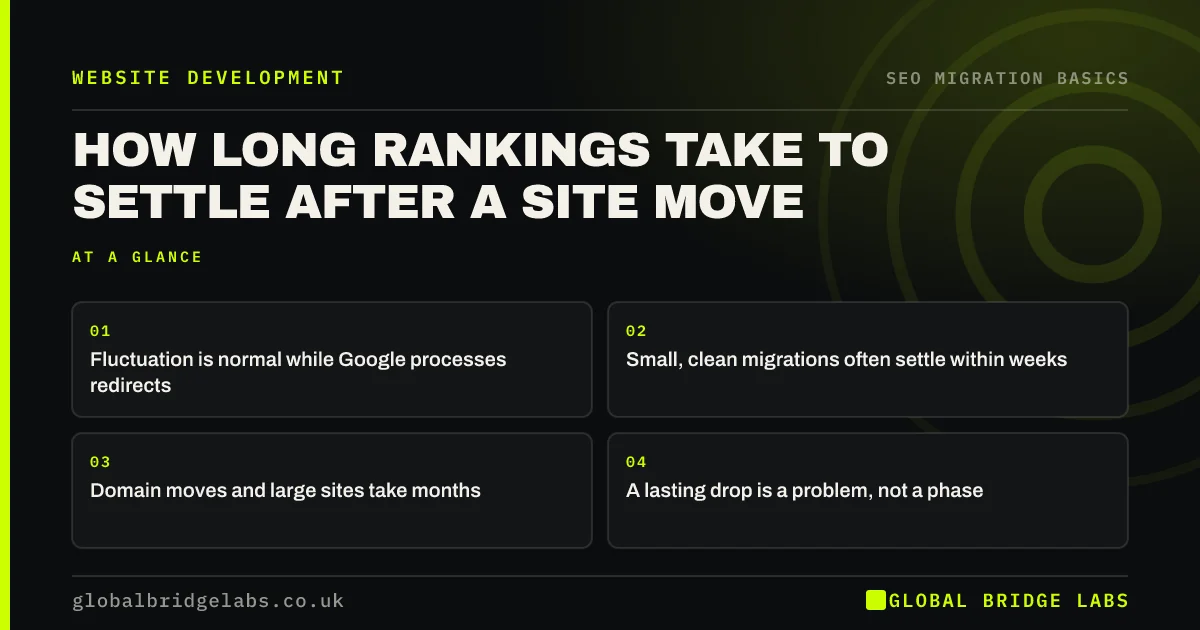
- Fluctuation is normal while Google processes redirects.
- Small, clean migrations often settle within weeks.
- Domain moves and large sites take months.
- A lasting drop is a problem, not a phase.
Worried about rankings after a site move? Message us on WhatsApp.
Chat on WhatsApp →Why do rankings fluctuate after a migration?
Google does not process a migration in one go. It has to recrawl each old URL, discover the redirect, crawl the new URL and decide that the new page should replace the old one in its index. Important pages that are crawled often are usually processed first. Rarely visited pages can take much longer, so for a while some of your site is indexed at old addresses and some at new ones.
During that period, rankings for individual pages can move up and down. That is expected, as long as the overall trend returns to the baseline.
How long does it usually take?
Google's documentation on site moves says a medium-sized website can take a few weeks for most pages to move in the index, and larger sites can take longer. In our experience the speed depends on a few factors.
- Size: more URLs means more to recrawl.
- Completeness: missing redirects slow everything down.
- Type of move: domain moves take longer than path changes.
- Crawl frequency: busy sites are recrawled sooner.
How do you know it is settling?
Track three things against your baseline each week. In the Page indexing report, old URLs should move into the page with redirect group while new URLs appear as indexed. In the Performance report, clicks and impressions for your top pages should recover towards their old levels. And branded searches should be stable from the first week, because a drop there usually points to a technical problem.
Want help reading your post-launch data? Send us a screenshot on WhatsApp.
Chat on WhatsApp →What does this look like in practice?
A pattern we see on small service sites with complete redirects: clicks fall by a modest amount in the first fortnight, top pages swap between old and new URLs in search results, and by week four or five the new URLs have taken over and traffic is back to the baseline. Where a few pages stay down, the cause is usually a missed redirect or a page that lost content.
Settling period checklist
- Save a baseline before launch.
- Check indexing and clicks weekly against it.
- Expect a few weeks of movement on a small site.
- Watch branded searches for early warning.
- Diagnose any drop that lasts beyond two or three months.
Next step
Put a date in the diary eight weeks after launch to compare traffic with the baseline. If you are not back to normal by then, run a recovery audit rather than waiting longer.
Message us on WhatsApp about a slow recovery, or book a 30-minute consultation.
Chat on WhatsApp →Sources and further reading
- Site moves with URL changes · Google Search Central
- Performance report (Search results) · Search Console Help
- Page indexing report · Search Console Help
Frequently asked questions
How long does Google take to process a site move?
For a small or medium site with complete redirects, most pages usually move in the index within a few weeks. Large sites and domain changes can take several months. The speed depends on how often Google crawls your pages, how many URLs changed and whether every old URL redirects correctly.
Should I change anything while rankings settle?
Avoid large changes for the first few weeks, so you can see the effect of the migration on its own. Do fix clear errors straight away: missing redirects, broken links, noindex tags or server errors. Leave new content, structure changes and redesign tweaks until the numbers have settled.
When should I worry about a drop after migration?
Worry if branded searches fall, if Search Console shows many not found errors for old URLs, or if traffic is still well below the baseline after two or three months. Those signs point to missing redirects, lost content or blocked pages, which need investigating rather than more waiting.
Written by

Global Bridge Labs (GBL) is a UK–Sri Lanka partner for social media, websites and BPO. Everything here comes from client delivery, not theory.