On this page
- 01Key takeaways
- 02Why does conversion matter more on a low-traffic site?
- 03What should a low-traffic site fix first?
- 04How do you measure changes with little traffic?
- 05When must visibility come first?
- 06Is low traffic always a problem?
- 07What does this look like in practice?
- 08Low-traffic website checklist
- 09Next step
- 10Sources and further reading
- 11Frequently asked questions
Key takeaways
On a low-traffic website every visitor is scarce, so converting a higher share of them matters more than on a busy site. Doubling conversion from 1% to 2% on 500 visits adds as many enquiries as doubling traffic, usually at far lower cost. But below a few hundred relevant visits a month, visibility has to come first, because there is too little to convert.
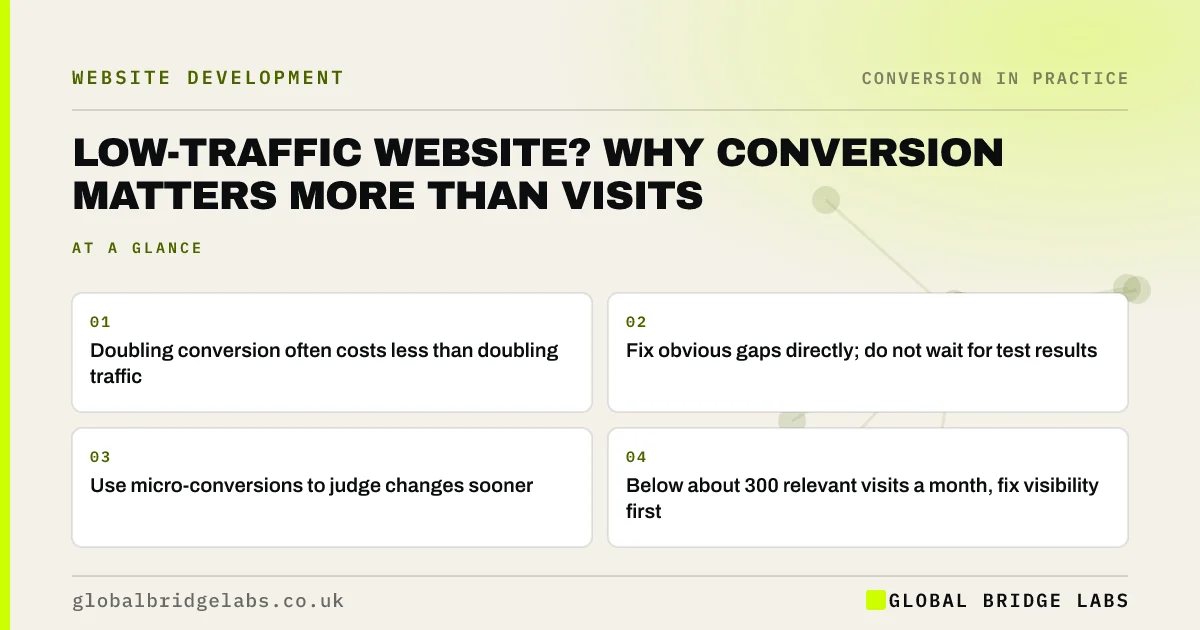
- Doubling conversion often costs less than doubling traffic.
- Fix obvious gaps directly; do not wait for test results.
- Use micro-conversions to judge changes sooner.
- Below about 300 relevant visits a month, fix visibility first.
Want to know whether to fix conversion or traffic first? Ask us on WhatsApp.
Chat on WhatsApp →Why does conversion matter more on a low-traffic site?
When a site gets 500 visits a month, losing half of the ready buyers to a vague headline or broken form costs a large share of total enquiries. Winning more traffic is usually slow and expensive for a small business. Converting a higher share of existing visitors is often quicker and cheaper, and it makes every future visitor more valuable too.
What should a low-traffic site fix first?
Fix things that do not need data to justify: they are clearly broken or missing.
- Every enquiry route works and is tracked.
- Headlines state offer, audience and area.
- Service pages give price guidance.
- Specific proof sits beside each call to action.
- Forms are short and work on phones.
- Each page has a clear next step.
Send us your URL on WhatsApp and we will list the obvious fixes.
Chat on WhatsApp →How do you measure changes with little traffic?
A/B testing is rarely possible, because reaching a reliable sample would take months or years. Instead, change one area at a time, compare equal periods allowing for seasonality, track micro-conversions such as pricing page views and form starts, and ask new enquirers how they found you and what nearly stopped them.
When must visibility come first?
If the site receives very few relevant visits, perhaps under 300 a month from people who could buy, even a perfect conversion rate produces few enquiries. Then the priority is being found: a complete Google Business Profile, local SEO, service pages that match real searches and sharing the site through social media and email.
Is low traffic always a problem?
Not always. A specialist B2B firm with 200 highly relevant visits a month, each worth thousands, may be doing well. Judge traffic by relevance and value, not volume. A small, well-targeted audience with a high conversion rate can support a healthy business.
What does this look like in practice?
A UK specialist joinery firm had about 400 visits a month and two or three enquiries. The owner wanted to spend on ads. We first added price bands, project photos with captions and a short enquiry form. Enquiries roughly doubled on the same traffic within two months. Only then did the firm start a small ad budget, which now reached a site that could convert.
Low-traffic website checklist
- Check how many visits are relevant, not just total.
- Fix obvious conversion gaps first.
- Change one area at a time and compare equal periods.
- Track micro-conversions for earlier signals.
- Build visibility if relevant visits are under about 300 a month.
- Add paid traffic only once the site converts.
Next step
A small audience is not a reason to ignore conversion; it is a reason to prioritise it. We can tell you whether your site needs more visitors, better conversion or both, and in which order.
Message us on WhatsApp for a low-traffic website review, or book a 30-minute consultation.
Chat on WhatsApp →Sources and further reading
- Google Search Console · Google
- Google Business Profile Help · Google
- Sample size calculator for A/B tests · Evan Miller
Frequently asked questions
Should I focus on traffic or conversion first?
If your site gets a reasonable number of relevant visits, focus on conversion first; it is usually cheaper and makes future traffic more valuable. If relevant visits are very low, perhaps under 300 a month, build visibility first. Check how many visits are from people who could actually buy.
How can I improve conversion with low traffic?
Fix clear gaps without waiting for data: working, tracked routes, clear headlines, price guidance, proof beside calls to action and short forms. Measure by comparing equal periods and tracking micro-conversions rather than A/B testing. Change one area at a time so you know what caused any movement.
Can a low-traffic website still be successful?
Yes, if the traffic is relevant and valuable. A specialist firm with a few hundred well-targeted visits, a good conversion rate and high-value jobs can generate plenty of business. Judge traffic by relevance and value, not volume, and compare enquiries and their value with the same period last year rather than with larger competitors.
Should I pay for ads if my website gets little traffic?
Only once the site converts reasonably well. Sending paid traffic to a page that loses most visitors wastes budget. Fix the conversion basics first, then use ads to reach more of the right people. Point each ad at the matching service page.
Written by

Global Bridge Labs (GBL) is a UK–Sri Lanka partner for social media, websites and BPO. Everything here comes from client delivery, not theory.