On this page
- 01Key takeaways
- 02What is social proof on a website?
- 03Why does placement matter more than volume?
- 04Where should social proof go?
- 05What kind of proof works best?
- 06What are the rules on using reviews?
- 07What does this look like in practice?
- 08Social proof placement checklist
- 09Next step
- 10Sources and further reading
- 11Frequently asked questions
Key takeaways
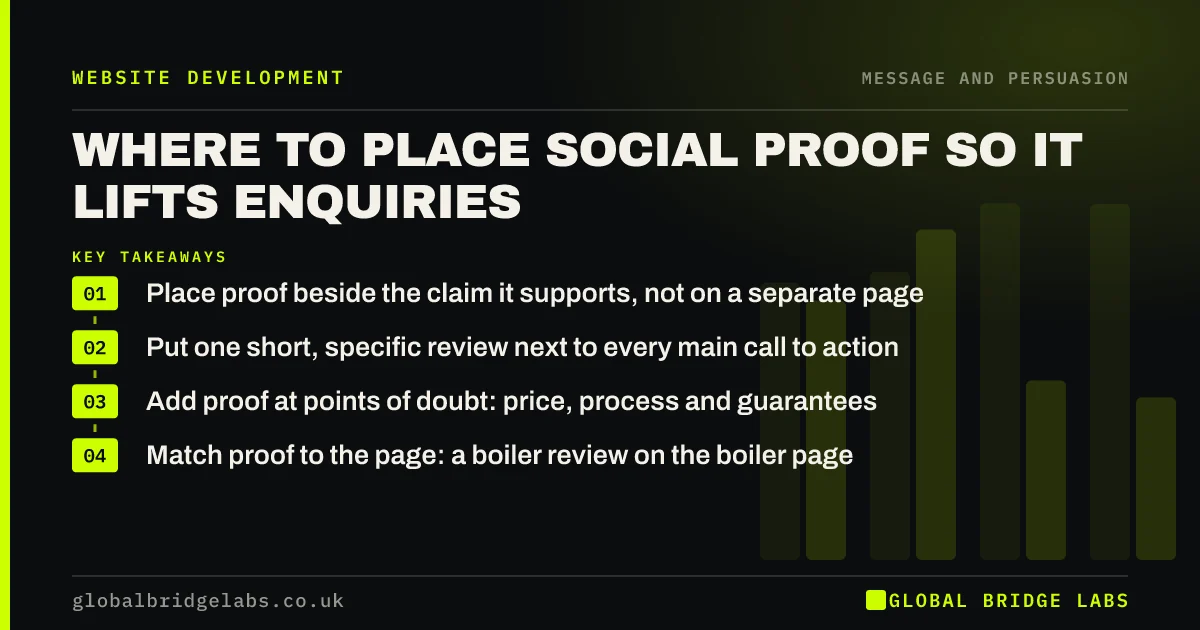
Social proof lifts enquiries most when it sits where the buyer is deciding: beside the claim it supports, next to the call to action and at points of doubt such as price. A testimonials page on its own does little, because few buyers visit it. Place specific proof throughout the pages that already get traffic.
- Place proof beside the claim it supports, not on a separate page.
- Put one short, specific review next to every main call to action.
- Add proof at points of doubt: price, process and guarantees.
- Match proof to the page: a boiler review on the boiler page.
Want your proof moved to where it works? Send us the URL on WhatsApp.
Chat on WhatsApp →What is social proof on a website?
Social proof is evidence that other people have chosen and been happy with your business: reviews, testimonials, case studies, client logos, accreditations, ratings and numbers such as jobs completed. It reduces the buyer's risk by showing that people like them made the same choice and it went well.
Why does placement matter more than volume?
Buyers look for reassurance at the moment they feel doubt, not in a separate section. A hundred reviews on a testimonials page nobody visits do less than one specific review beside the enquiry button. Placement puts proof in the buyer's path at the exact point it answers a question.
Where should social proof go?
These placements work on most small business sites. Start with the ones on your busiest pages.
- Under the headline: a rating summary or a single strong result.
- Beside each main claim: proof of that claim specifically.
- Next to every call to action: one short review about the experience of enquiring or working with you.
- Beside prices: a review mentioning value or a clear quote.
- On the form: a line such as '140 local homeowners enquired this year'.
- On the thank-you page: what past clients said about the next step.
- Website trust signals that make visitors enquire
- The thank-you page: the most ignored page on your site
Want a proof placement plan for your top pages? Ask us on WhatsApp.
Chat on WhatsApp →What kind of proof works best?
Specific, relevant and attributable proof works best. 'Great service!' persuades nobody. 'Rewired our three-bed in Guildford in four days and left it spotless, Sarah P.' persuades the next Guildford homeowner planning a rewire. Match the proof to the page and the buyer, and include names, places or numbers wherever the client allows.
What are the rules on using reviews?
UK consumer law requires reviews to be genuine and presented fairly. The Competition and Markets Authority's guidance on publishing consumer reviews covers not hiding negative reviews, not publishing fake ones and disclosing incentivised reviews. The Digital Markets, Competition and Consumers Act 2024 makes fake reviews a banned practice. Use real reviews, with permission, and do not cherry-pick in a misleading way.
What does this look like in practice?
A UK dental practice had over 300 five-star Google reviews and a testimonials page that was barely visited. We placed a treatment-specific review beside each 'book a consultation' button, added the rating under the homepage headline, and put a review about pain-free treatment beside the implant pricing. Consultation bookings from the treatment pages rose over the next two months.
Social proof placement checklist
- List your top five pages by traffic.
- Place a rating or strong result under each headline.
- Put proof beside each main claim.
- Add one specific review next to every call to action.
- Add proof beside prices and guarantees.
- Use genuine reviews with permission, and follow CMA guidance.
Next step
Most businesses already have enough proof. It is just in the wrong place. We can help you move it to where buyers are deciding.
Message us on WhatsApp for a proof placement review, or book a 30-minute consultation.
Chat on WhatsApp →Sources and further reading
- Publishing consumer reviews and complying with consumer protection law · Competition and Markets Authority
- Digital Markets, Competition and Consumers Act 2024 · legislation.gov.uk
- Visual hierarchy in UX: definition · Nielsen Norman Group
Frequently asked questions
Where should testimonials go on a website?
Beside the claims they support, next to calls to action and at points of doubt such as prices. A separate testimonials page is fine as an archive, but on its own it is rarely seen. Place specific, relevant testimonials on the pages that already get traffic.
How many reviews should I show on my website?
Enough to cover the main claims and decision points, usually one to three per page, each matched to the page's topic. A rating summary adds scale. Quality and relevance matter far more than volume. Match each review to the page topic, so a boiler review sits on the boiler page, and keep an archive page for the rest.
Can I edit customer reviews for my website?
Only lightly and with permission, such as shortening, without changing the meaning. Reviews must be genuine and not misleading. The CMA's guidance on publishing reviews and the Digital Markets, Competition and Consumers Act 2024 set the rules for UK businesses.
What is the most persuasive type of social proof?
Specific proof from someone similar to the buyer, with details they recognise: location, type of job, problem solved and a measurable result. A short case study with a before-and-after number is often the strongest for B2B and high-value services. Ask permission to use names.
Written by

Global Bridge Labs (GBL) is a UK–Sri Lanka partner for social media, websites and BPO. Everything here comes from client delivery, not theory.