On this page
- 01Key takeaways
- 02Why do vague claims fail?
- 03What makes a claim specific?
- 04Where do you find specific facts?
- 05How do you rewrite vague copy quickly?
- 06When can being specific backfire?
- 07What does this look like in practice?
- 08Specific copy checklist
- 09Next step
- 10Sources and further reading
- 11Frequently asked questions
Key takeaways
Specific claims convert better than adjectives because buyers can believe them and competitors cannot copy them. 'Fast, friendly, professional' describes every business in the country. 'Reply within 2 hours, 900 boilers fitted in Kent since 2015' describes one. Most businesses already have the numbers; they are just not on the website.
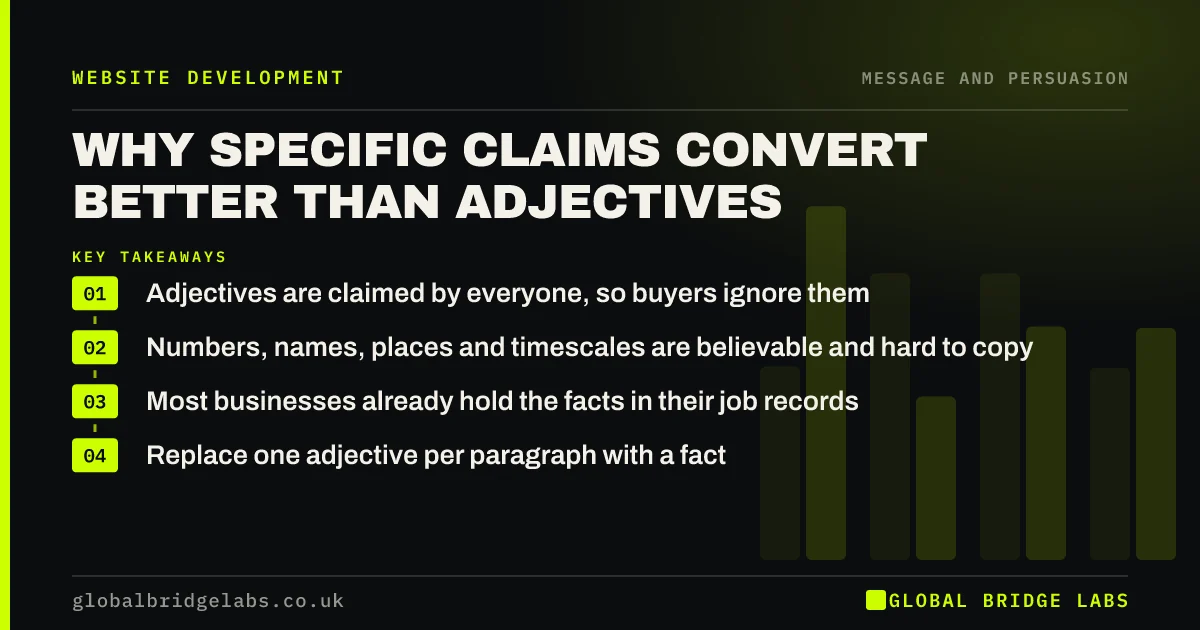
- Adjectives are claimed by everyone, so buyers ignore them.
- Numbers, names, places and timescales are believable and hard to copy.
- Most businesses already hold the facts in their job records.
- Replace one adjective per paragraph with a fact.
Want your homepage copy made specific? Send it to us on WhatsApp.
Chat on WhatsApp →Why do vague claims fail?
Vague claims fail because they are unfalsifiable and universal. Every competitor says quality, reliable, trusted, bespoke and passionate. Buyers have learned to skip those words. They take up the seconds a visitor gives your page without telling them anything that helps them decide.
What makes a claim specific?
A specific claim contains something checkable: a number, a timescale, a place, a named client or project, a standard or accreditation, or a precise description of the result. The test is whether a competitor could make the same claim without lying. If they could, it is not specific enough.
- Vague: 'Fast response'. Specific: 'Reply within 2 working hours'.
- Vague: 'Experienced team'. Specific: '14 engineers, average 11 years in the trade'.
- Vague: 'Trusted by local businesses'. Specific: 'IT support for 60 offices in Bristol and Bath'.
- Vague: 'Great results'. Specific: 'Cut month-end close from 10 days to 4'.
Where do you find specific facts?
The facts are usually already in the business. Job management systems, invoices, review platforms, CRM records and the team's memory hold numbers that nobody has thought to publish.
- Jobs, projects or clients completed, in total or per year.
- Average response or completion times.
- Areas and postcodes covered.
- Before-and-after results from recent work.
- Years in business, team size and qualifications.
- Review count and average rating.
Not sure which of your numbers to use? Ask us on WhatsApp.
Chat on WhatsApp →How do you rewrite vague copy quickly?
Highlight every adjective and vague phrase on your top five pages. For each, ask 'how would a customer know this is true?' and replace it with the answer. Start with headlines and the lines around calls to action, because those are read most.
When can being specific backfire?
Specifics backfire when they are untrue, out of date or impossible to keep. A published two-hour response time that the team misses becomes a complaint. Numbers must be accurate, kept current and defensible, because under UK consumer law misleading claims are an unfair practice. Review specific claims every quarter.
What does this look like in practice?
A UK landscaping firm's homepage said 'Quality landscaping with a personal touch'. Its records showed 380 gardens completed in Hertfordshire, an average project time of 9 days and 4.9 stars from 210 reviews. We put those facts into the headline area. Visitors engaged longer with the homepage and quote requests increased over the following weeks.
Specific copy checklist
- Highlight every adjective on your top five pages.
- Ask 'how would a customer know this is true?' for each.
- Replace with numbers, places, names or timescales.
- Check every claim is accurate and current.
- Review specific claims every quarter.
Next step
Your business has facts that make it different. The job is getting them onto the pages buyers read. We can help you find and publish them.
Message us on WhatsApp for a specific copy rewrite, or book a 30-minute consultation.
Chat on WhatsApp →Sources and further reading
- Unfair commercial practices guidance (CMA207) · Competition and Markets Authority
- Writing to GOV.UK standards: writing guidelines · GOV.UK
- How long do users stay on web pages? · Nielsen Norman Group
Frequently asked questions
Why are numbers effective in website copy?
Numbers are specific and checkable, so buyers find them more believable than adjectives. They also make your business distinct, because competitors cannot claim your exact figures. Use accurate, current numbers about results, response times, experience and customers. Keep them current and accurate.
What words should I avoid in website copy?
Avoid words every competitor uses without proof: quality, trusted, passionate, bespoke, leading, solutions, excellence. Replace them with specific facts that show the same thing, such as response times, results and customer numbers. Your job records, reviews and CRM usually hold these facts already, so the rewrite rarely needs new research.
How do I make my website copy more specific?
For each vague phrase, ask how a customer would know it is true, and write that instead. Draw on job records, reviews and CRM data for numbers, places, timescales and results. Start with headlines and the text around calls to action.
Can specific claims get me into legal trouble?
Only if they are untrue or misleading. UK consumer law treats misleading claims as unfair commercial practices. Keep claims accurate, up to date and supported by records, and review them regularly. A published response time the team regularly misses can also become a complaint, so only publish promises you keep.
Written by

Global Bridge Labs (GBL) is a UK–Sri Lanka partner for social media, websites and BPO. Everything here comes from client delivery, not theory.