On this page
- 01Key takeaways
- 02Why do conversion myths spread?
- 03Myth 1: Does a redesign fix a low conversion rate?
- 04Myth 2: Does button colour change conversion?
- 05Myth 3: Will more traffic fix low enquiries?
- 06Myth 4: Do short pages always convert better?
- 07Myth 5: Must every change be A/B tested?
- 08Myth 6: Do urgency tricks always lift sales?
- 09Which myths contain some truth?
- 10What does this look like in practice?
- 11Myth-busting checklist
- 12Next step
- 13Sources and further reading
- 14Frequently asked questions
Key takeaways
Website conversion myths waste budget because they send money to the visible parts of a site, such as design and button colours, while the real causes of low conversion (unclear offers, missing proof, friction and untracked enquiries) go unfixed. Most myths come from large-site case studies applied to small sites that cannot reproduce them.
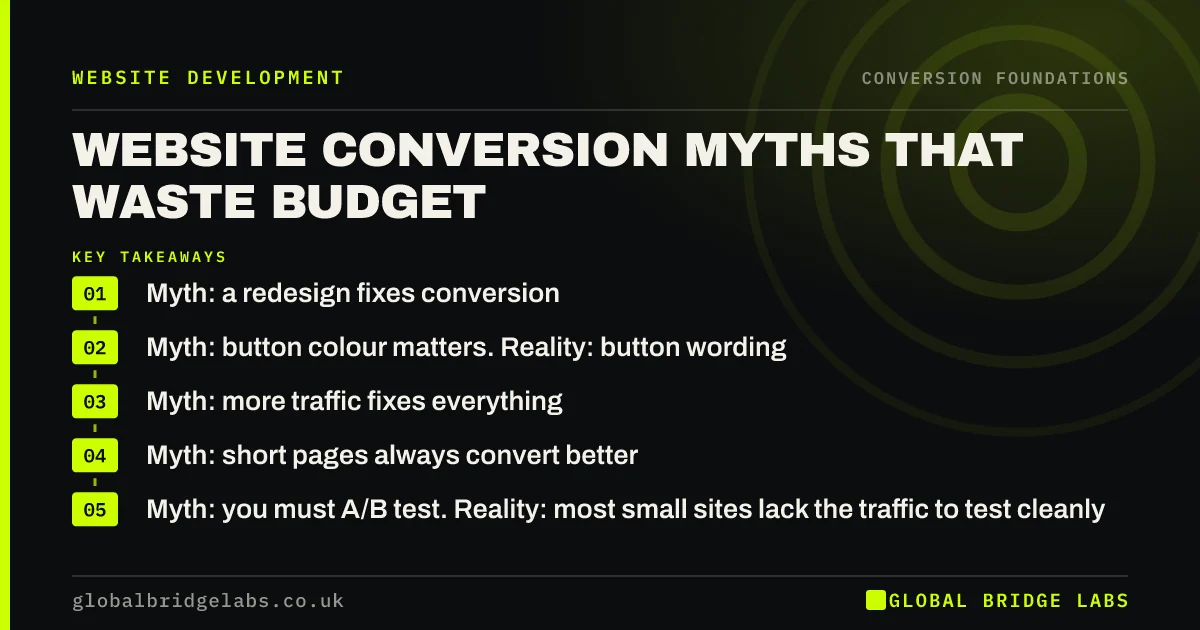
- Myth: a redesign fixes conversion. Reality: most gaps are copy, proof and tracking.
- Myth: button colour matters. Reality: button wording and placement matter more.
- Myth: more traffic fixes everything. Reality: low conversion wastes the extra traffic.
- Myth: short pages always convert better. Reality: complex offers need more answers.
- Myth: you must A/B test. Reality: most small sites lack the traffic to test cleanly.
Heard advice you are not sure about? Ask us on WhatsApp for a straight answer.
Chat on WhatsApp →Why do conversion myths spread?
Conversion myths spread because they are simple, easy to sell and drawn from real results at a different scale. A retailer with a million visits a month can detect a 0.3% lift from a colour change. A small service business with 1,500 visits cannot, so the tactic becomes an article, then a rule, without ever being true for the reader.
Myth 1: Does a redesign fix a low conversion rate?
Rarely on its own. A redesign changes how a site looks, and most conversion problems are about what it says and how easy it is to act. New sites often carry across the same vague headline, hidden prices and untracked phone number. Fix those in place first. Redesign when the structure or platform prevents the fixes.
Myth 2: Does button colour change conversion?
Colour matters only in so far as the button stands out from its surroundings and meets contrast standards such as WCAG 2.2. Beyond that, the words on the button, where it sits and what the page says before it have far larger effects. 'Get a price for your loft conversion' beats 'Submit' in any colour.
Myth 3: Will more traffic fix low enquiries?
More traffic to a page that converts at 0.5% mostly buys more people leaving. Improving conversion first makes every future visitor more valuable, including those from SEO, social media and ads. The exception is a site with so little traffic that nothing can be learned, where visibility comes first.
Myth 4: Do short pages always convert better?
Short pages convert better for simple, low-risk offers. For considered purchases, such as a £20,000 extension or a legal matter, buyers want price guidance, process, proof and reassurance. Remove those and they leave to find a site that answers. Put the essentials first and add depth below.
Myth 5: Must every change be A/B tested?
A/B testing needs traffic. Detecting a realistic improvement usually needs thousands of visitors per variant, which many small sites take months to reach. For them, fixing clear problems and comparing periods carefully is more practical. Use testing for close calls on high-traffic pages, not for obvious fixes.
Not sure whether your traffic supports testing? Ask us on WhatsApp.
Chat on WhatsApp →Myth 6: Do urgency tricks always lift sales?
Fake countdown timers and 'only 2 left' messages can lift short-term clicks, but in the UK they can also breach consumer law. The Digital Markets, Competition and Consumers Act 2024 gives the Competition and Markets Authority power to fine businesses directly for unfair practices, including false urgency. Honest deadlines are fine. Invented ones are a risk.
Which myths contain some truth?
Most myths have a kernel worth keeping. Design does affect trust. Speed does affect conversion. Testing is valuable on busy pages. The mistake is treating the kernel as the whole answer and spending on it before the basics of clarity, proof, friction, action and follow-up are in place.
What does this look like in practice?
A UK kitchen fitter had spent on two redesigns in five years and paid a consultant to test button colours. Enquiries had not moved. The site had no prices, no areas served and a phone number that was not clickable on mobile. Fixing those three things, plus tracking, lifted enquiries more than both redesigns combined.
Myth-busting checklist
- Check tracking before believing any conversion claim.
- Fix copy, proof and friction before paying for a redesign.
- Change button wording and placement before colour.
- Improve conversion before buying more traffic.
- Match page length to the complexity of the offer.
- Test only where traffic supports it.
- Avoid invented urgency and scarcity.
Next step
If you have been told your site needs a redesign, more traffic or a round of tests, check the basics first. We will tell you honestly which advice applies to your site and which does not.
Message us on WhatsApp for a myth-free conversion review, or book a 30-minute consultation.
Chat on WhatsApp →Sources and further reading
- Digital Markets, Competition and Consumers Act 2024 · legislation.gov.uk
- Sample size calculator for A/B tests · Evan Miller
- Minimise A/B testing impact in Google Search · Google Search Central
- Web Content Accessibility Guidelines (WCAG) 2.2 · W3C
Frequently asked questions
Does changing button colour increase conversions?
Only if the current button does not stand out or fails contrast standards. Beyond that, the button's wording, position and the page content before it have far more effect. Test colour last, and only on pages with enough traffic to measure a small change.
Will a new website increase my enquiries?
Not necessarily. A new website helps if the old platform prevented important fixes or the structure no longer fits your services. If the problem is vague copy, missing proof or untracked enquiries, a redesign that carries those across will not help.
Is A/B testing worth it for small businesses?
Sometimes. It is worth it on pages with thousands of visitors a month and a clear question to answer. For lower-traffic sites, results take too long to become reliable, so fix obvious problems directly and compare before-and-after periods instead. Testing suits busy pages and close calls.
Are countdown timers legal in the UK?
Genuine deadlines are legal. Fake countdown timers that reset, or false claims of limited stock, can be unfair commercial practices under UK consumer law. Since the Digital Markets, Competition and Consumers Act 2024, the CMA can fine businesses directly for these practices.
Written by

Global Bridge Labs (GBL) is a UK–Sri Lanka partner for social media, websites and BPO. Everything here comes from client delivery, not theory.