On this page
Key takeaways
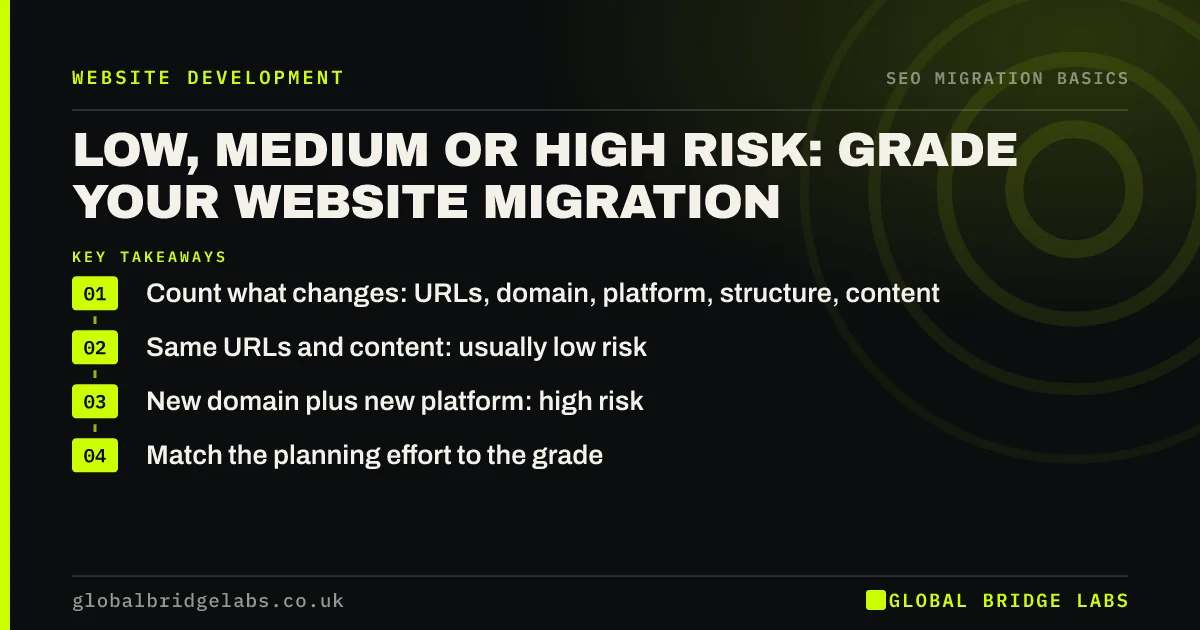
Not every website change carries the same search risk. Grade yours by counting what changes: URLs, domain, platform, structure and content. One change with the same URLs is low risk. Several changes at once, on a site that earns most of its enquiries from search, is high risk and needs a full plan, testing on staging and 90 days of monitoring.
- Count what changes: URLs, domain, platform, structure, content.
- Same URLs and content: usually low risk.
- New domain plus new platform: high risk.
- Match the planning effort to the grade.
Not sure how risky your website change is? Message us on WhatsApp.
Chat on WhatsApp →What makes a migration risky?
Risk comes from two things: how much changes, and how much search traffic depends on the old site. Every changed URL needs a redirect that search engines must find and process. Every rewritten page might lose the words it ranked for. Every new template might hide content or slow the page down. When several of these happen together, problems are harder to trace back to a cause.
The second factor is exposure. A site that gets most enquiries from referrals and social media can absorb a dip. A site where organic search brings most enquiries cannot.
How do you grade low, medium and high risk?
Score the project against five changes and see how many apply. Google's guidance treats moves without URL changes, such as a new host, separately from moves with URL changes, because the second kind is much harder for search engines to process.
- Low: new host or new design, every URL and page kept.
- Medium: same domain, some URLs changed or a new theme.
- High: new domain, new platform, merged sites or many pages cut.
- Very high: several high-risk changes launched on the same day.
What should each grade trigger?
A low-risk move still needs a quick crawl, a check that nothing returns errors and a look at Search Console for two weeks. A medium-risk move needs a full redirect map for the changed URLs, content checks on top pages and four to six weeks of monitoring. A high-risk move needs the whole process: inventory, baseline, redirect map, staging tests, launch-day checks and 90 days of monitoring.
If the grade is very high, the safest option is often to split the project. Move platform first with the same URLs, then change structure or domain once things have settled.
Want us to grade your project? Send a short description on WhatsApp.
Chat on WhatsApp →What does this look like in practice?
A pattern we see: a business plans a new design, a new platform and new service page addresses in one launch and calls it a refresh. Graded honestly, it is a high-risk migration. Splitting it into a platform move with identical URLs, followed by a structure change two months later, keeps each step easy to check and easy to reverse.
Risk grading checklist
- List every change in the project.
- Note how much of your enquiry flow comes from search.
- Grade the project low, medium, high or very high.
- Match planning and monitoring to the grade.
- Split very high-risk projects into stages.
Next step
Write down every change your website project includes and how many enquiries come from search each month. That short list will tell you how much migration planning you need.
Message us on WhatsApp to grade your migration, or book a 30-minute consultation.
Chat on WhatsApp →Sources and further reading
- Site moves with URL changes · Google Search Central
- Moving a site without URL changes · Google Search Central
- Google Search Console · Google
Frequently asked questions
Is a new website design a migration?
Only if something search engines rely on changes. A new design that keeps every URL, the same content and the same platform is low risk. Once URLs, domain, platform or content change, it becomes a migration and needs a redirect map, content checks and monitoring after launch to protect rankings.
What is the riskiest type of website migration?
Changing domain, platform and URL structure at the same time is usually the riskiest, especially on a site that relies on search for enquiries. Each change is manageable alone, but together they make problems hard to diagnose. Splitting the work into stages reduces the risk considerably and makes recovery easier.
How much traffic is normal to lose in a migration?
A well-planned migration often sees a small dip for a week or two, then a return to the previous level. There is no standard acceptable loss. Large or lasting drops usually point to missing redirects, removed content or leftover staging blocks, which can be found and fixed page by page.
Written by

Global Bridge Labs (GBL) is a UK–Sri Lanka partner for social media, websites and BPO. Everything here comes from client delivery, not theory.