On this page
- 01Key takeaways
- 02How should you use this checklist?
- 03Clarity: does the page say what it needs to?
- 04Proof: does the page earn trust?
- 05Friction: is acting easy?
- 06Action: is the next step obvious?
- 07Follow-up: is every enquiry captured and answered?
- 08When is a checklist not enough?
- 09What does this look like in practice?
- 10Next step
- 11Sources and further reading
- 12Frequently asked questions
Key takeaways
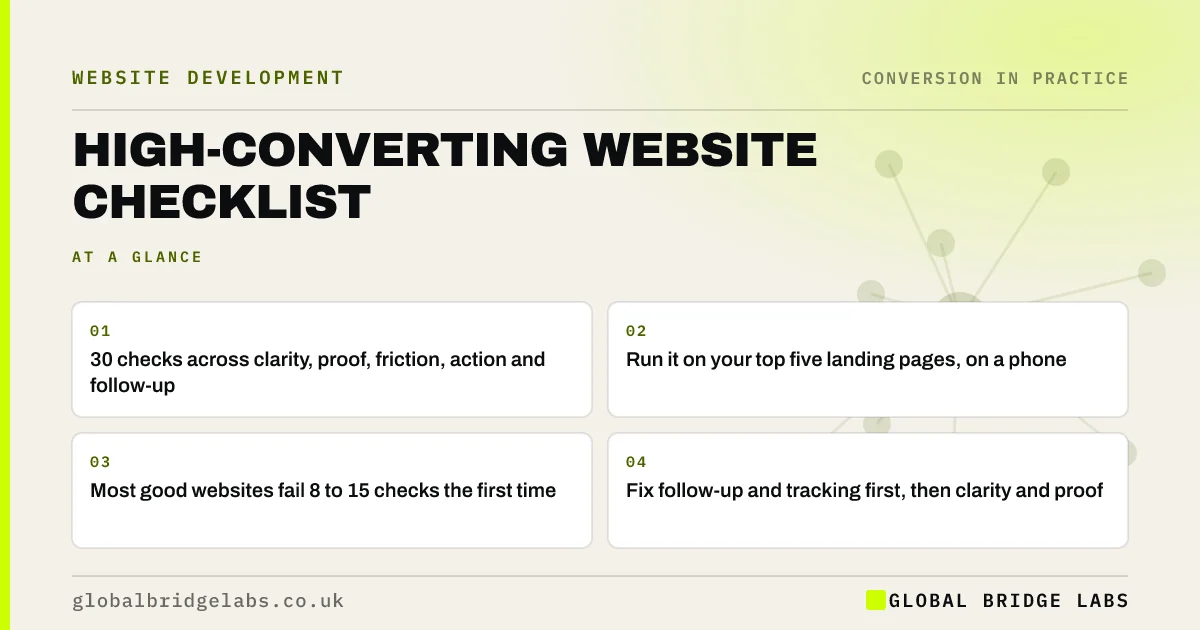
This high-converting website checklist has 30 checks grouped under the five tests of the GBL Conversion Gap Scorecard: Clarity, Proof, Friction, Action and Follow-up. Work through it on your top five landing pages, on a phone. Most good websites fail between 8 and 15 checks, and fixing the Follow-up group first usually gives the fastest return.
- 30 checks across clarity, proof, friction, action and follow-up.
- Run it on your top five landing pages, on a phone.
- Most good websites fail 8 to 15 checks the first time.
- Fix follow-up and tracking first, then clarity and proof.
Want us to run the checklist on your site with you? Message us on WhatsApp.
Chat on WhatsApp →How should you use this checklist?
Open your top five landing pages from Google Analytics 4 on a phone. Go through each group and mark each check pass or fail. Count the fails by group. The group with the most fails is where to start, except that tracking and follow-up failures always come first, because without them you cannot measure any other fix.
Clarity: does the page say what it needs to?
Clarity checks confirm a first-time visitor understands the offer within seconds.
- The headline states what you do, for whom and where.
- The first screen on mobile shows the offer and a next step.
- Service names use the buyer's words, not internal jargon.
- Each service has its own page.
- Areas served are stated.
- Copy uses specific facts, not adjectives.
Proof: does the page earn trust?
Proof checks confirm evidence sits where decisions are made.
- Specific proof sits beside each main claim.
- A short review sits next to every main call to action.
- Case studies include numbers, places or timescales.
- Photos show real work and real people.
- Accreditations and ratings are visible near the top.
- Reviews are genuine and presented fairly.
Friction: is acting easy?
Friction checks confirm nothing slows or blocks the next step.
- Key pages pass Core Web Vitals on mobile.
- The enquiry form asks only what is needed to reply.
- Phone numbers and emails are tappable.
- Errors keep the visitor's entered data.
- No pop-up blocks the page on arrival.
- Costs and terms are clear before the last step.
Failed more than two friction checks? Send us the page on WhatsApp.
Chat on WhatsApp →Action: is the next step obvious?
Action checks confirm every page leads somewhere.
- Each key page has one dominant call to action.
- Button text describes what happens next.
- The call to action repeats after each major section.
- Price guidance appears on service pages.
- Visitors not ready to enquire have a softer option.
- No page is a dead end.
Follow-up: is every enquiry captured and answered?
Follow-up checks confirm the website's work is not wasted after the form is sent.
- Forms, calls, WhatsApp and bookings are tracked as key events.
- Enquiry notifications reach a monitored inbox.
- A thank-you page says what happens next and when.
- Enquiries are answered within one working hour.
- Each enquiry's source is recorded.
- Outcomes (won or lost) are recorded.
When is a checklist not enough?
A checklist catches the common gaps. It cannot tell you what your particular buyers need, which is where on-site surveys, user testing and sales team knowledge come in. If the site passes most checks and still converts poorly, the issue is likely traffic quality or an offer that does not fit the market.
What does this look like in practice?
A UK mortgage broker ran the checklist and failed 13 checks, 5 of them in Follow-up. Calls were not tracked, the form notifications went to a shared inbox checked once a day and there was no thank-you page. Fixing those first showed the website was producing more enquiries than anyone realised, and the faster replies lifted completed applications.
Next step
Run the checklist this week on your top five pages. If you fail more than ten checks, the gap between a good website and a high-converting one is costing you enquiries every month.
Message us on WhatsApp and we will run the checklist with you, or book a 30-minute consultation.
Chat on WhatsApp →Sources and further reading
- About key events · Google Analytics Help
- Understanding Core Web Vitals and Google search results · Google Search Central
- Publishing consumer reviews and complying with consumer protection law · Competition and Markets Authority
- Structuring forms · GOV.UK Service Manual
Frequently asked questions
What makes a website high-converting?
Clear offers, specific proof beside claims, low friction on mobile, one obvious next step per page, and every enquiry tracked and answered quickly. These five areas, scored in the GBL Conversion Gap Scorecard, separate high-converting sites from good-looking ones. Design matters less than most expect.
How do I check if my website converts well?
Track every enquiry route as a GA4 key event, compare your conversion rate with your own history and sector ranges, and run a checklist like this on your top five landing pages on a phone. Fix the failed checks starting with tracking and follow-up.
What should I fix first on my website?
Tracking and follow-up, because without them you cannot measure other fixes and enquiries may be lost after they arrive. Then clarity on the top landing pages, then proof, then friction, then calls to action. Change one area at a time and measure the effect.
How often should I use a website conversion checklist?
Every quarter, and after any major change to key pages. A monthly 30-minute review covers the most important numbers and routes in between. Log every check result with the date, so you can see which groups improve over time and which fixes moved enquiries.
Written by

Global Bridge Labs (GBL) is a UK–Sri Lanka partner for social media, websites and BPO. Everything here comes from client delivery, not theory.