On this page
- 01Key takeaways
- 02What does high-converting actually mean?
- 03What conversion rate counts as high?
- 04What features do high-converting websites share?
- 05How do you know if your website is high-converting?
- 06When does chasing a high conversion rate backfire?
- 07What does this look like in practice?
- 08High-converting website check
- 09Next step
- 10Sources and further reading
- 11Frequently asked questions
Key takeaways
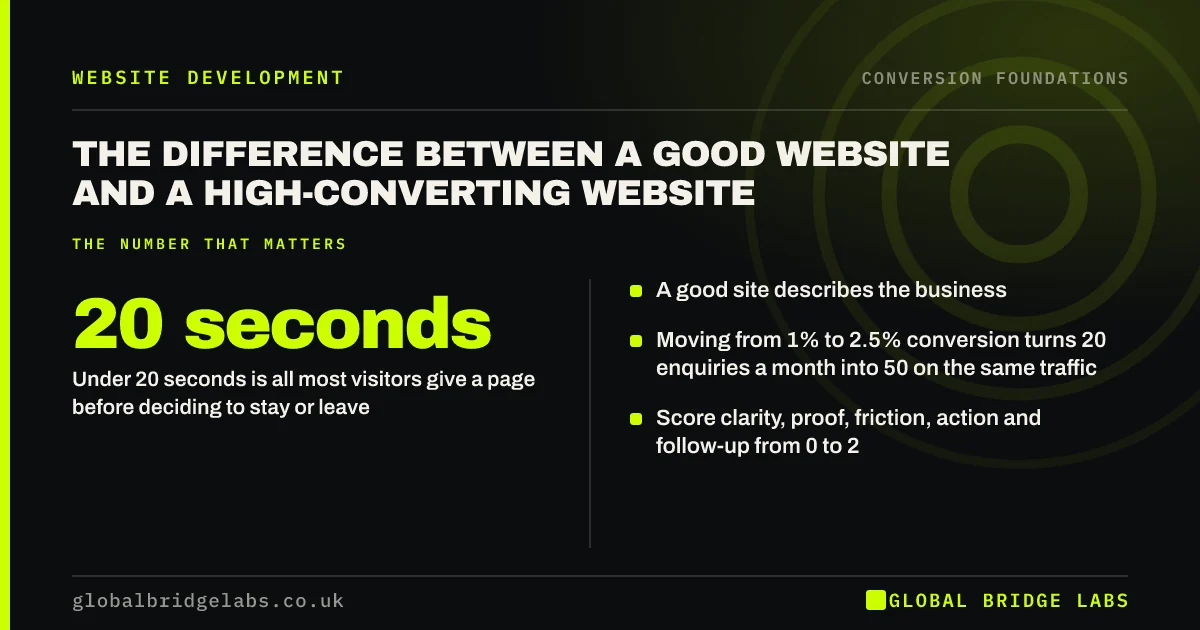
A high-converting website is a business website that turns a consistently higher share of the right visitors into enquiries, bookings or sales than comparable sites, because each page is built around the buyer's next decision. 'High' is relative to your own past performance and your sector, not a single universal number.
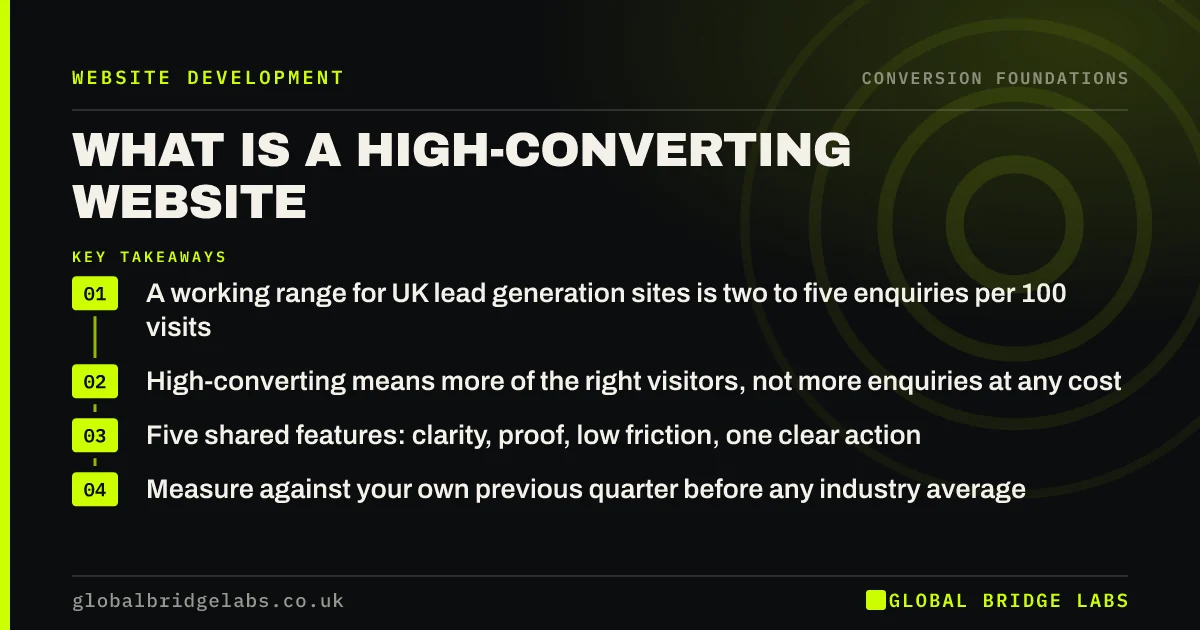
- A working range for UK lead generation sites is two to five enquiries per 100 visits.
- High-converting means more of the right visitors, not more enquiries at any cost.
- Five shared features: clarity, proof, low friction, one clear action and tracked follow-up.
- Measure against your own previous quarter before any industry average.
Want to know whether your site counts as high-converting? Send us the URL on WhatsApp.
Chat on WhatsApp →What does high-converting actually mean?
A conversion is a visitor completing a valuable action, such as submitting an enquiry, calling, starting a WhatsApp chat, booking or buying. A high-converting website is one where that happens for a noticeably larger share of the right visitors than on a typical site of the same type.
Two words in that definition carry the weight. 'Right' means visitors who could become customers, not everyone who lands on the site. 'Consistently' means the rate holds month after month, not for one campaign. A site that converts well only because of one busy week is not high-converting.
What conversion rate counts as high?
There is no universal threshold, because price, urgency and traffic mix change the numbers. As working ranges for UK SMEs, local service businesses convert around 3% to 8% of visits, professional services and B2B around 1% to 4%, and e-commerce 1% to 3% of sessions. A site at the top of its range, and rising, is high-converting.
- Urgent local services (plumbers, locksmiths, clinics): often above 5%.
- Considered B2B services: 1% to 3% can be strong if enquiries are qualified.
- Low-price e-commerce: 2% to 4% of sessions.
- High-price e-commerce: 0.5% to 2% of sessions.
What features do high-converting websites share?
High-converting websites share five features, which we score in the GBL Conversion Gap Scorecard. None of them depend on a particular design style, platform or budget.
- Clarity: the headline says what you do, for whom and where.
- Proof: specific numbers, named work and reviews sit next to the claims they support.
- Low friction: pages are fast on mobile and forms ask only what is needed to reply.
- One clear action: each page offers one obvious next step suited to the visitor's stage.
- Tracked follow-up: every enquiry is recorded by source and answered quickly.
- The website conversion scorecard: good or high-converting?
- High-converting website examples and what they share
Want your site scored on those five features? Message us on WhatsApp.
Chat on WhatsApp →How do you know if your website is high-converting?
You know by measuring, not by looking. Track every enquiry route as a key event in Google Analytics 4, collect at least three months of data, and compare enquiries per visit by channel. If your rate is at the top of your sector range and qualified enquiries are rising quarter on quarter, the site is high-converting.
If you cannot answer 'how many enquiries did the website produce last month, and from where?', the site cannot be called high-converting, whatever it looks like. That is the first gap to close.
When does chasing a high conversion rate backfire?
Chasing the rate backfires when it lowers enquiry quality. Removing prices, offering free quotes to anyone or adding pushy pop-ups can lift the percentage while filling the diary with people who will never buy. The sales team then spends its time filtering instead of closing.
The measure that matters is qualified enquiries per month and the cost of each one. A slightly lower rate with better-fit buyers is a better website.
What does this look like in practice?
A UK accountancy practice we worked with believed its site converted well at 6%. Once tracking separated brand searches from everything else, the picture changed: people searching the firm's name converted at 14%, while visitors arriving from service searches converted at 0.8%. The site was converting existing fans and losing new buyers.
The fix was on the service pages: clear fees guidance, sector-specific proof and a short callback form. The headline rate barely moved, but new-client enquiries from search roughly doubled over the next quarter, which is the number the partners actually cared about.
High-converting website check
Answer these to see whether your site qualifies.
- Every enquiry route is tracked as a key event.
- You know your conversion rate by channel, not just overall.
- Your rate sits at the top of your sector range.
- Qualified enquiries have risen over the last two quarters.
- Each key page has one clear next step.
- Enquiries are answered within one working hour.
Next step
If you are not sure whether your site is high-converting or just good-looking, we will review the numbers and the key pages with you in 30 minutes and tell you where it stands.
Message us on WhatsApp for a straight answer, or book a 30-minute consultation.
Chat on WhatsApp →Sources and further reading
- About key events · Google Analytics Help
- How long do users stay on web pages? · Nielsen Norman Group
- Creating helpful, reliable, people-first content · Google Search Central
Frequently asked questions
What is a high-converting website?
A high-converting website is a business website that turns a consistently higher share of the right visitors into enquiries, bookings or sales than comparable sites. It does this by making each page answer the buyer's next question, backing claims with proof, removing friction and offering one clear next step.
What is a good conversion rate for a website?
For UK lead generation websites, 2% to 5% of visits becoming enquiries is a reasonable working range. Urgent local services often exceed that, while considered B2B services may sit lower with more valuable enquiries. E-commerce sites typically convert 1% to 3% of sessions into orders.
Does a high-converting website have to look modern?
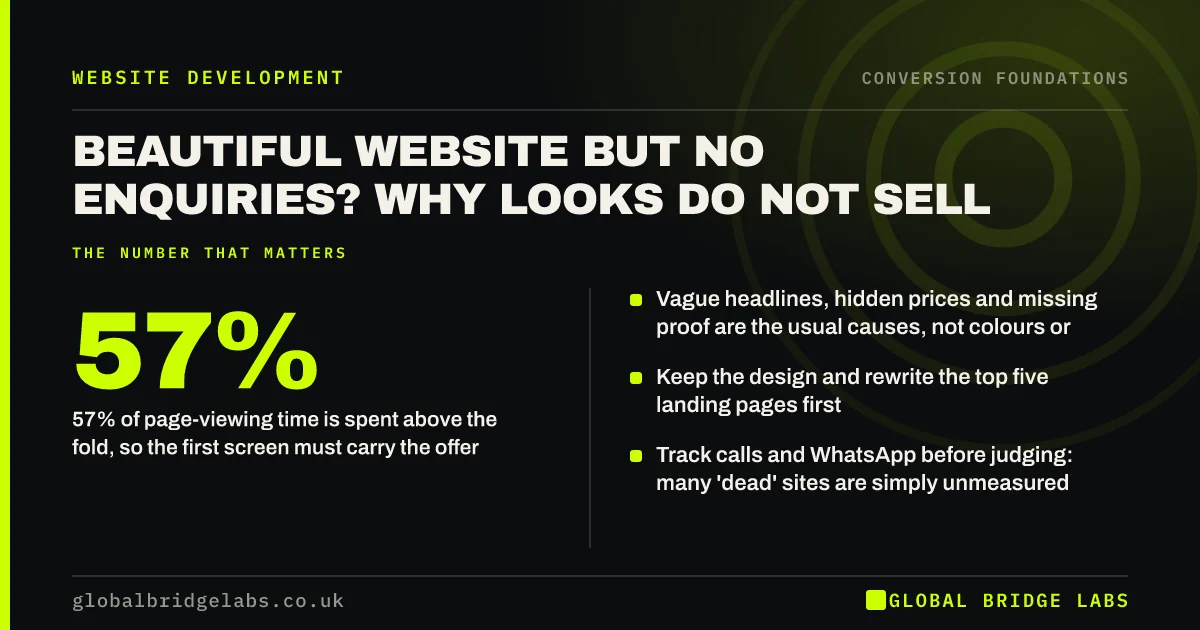
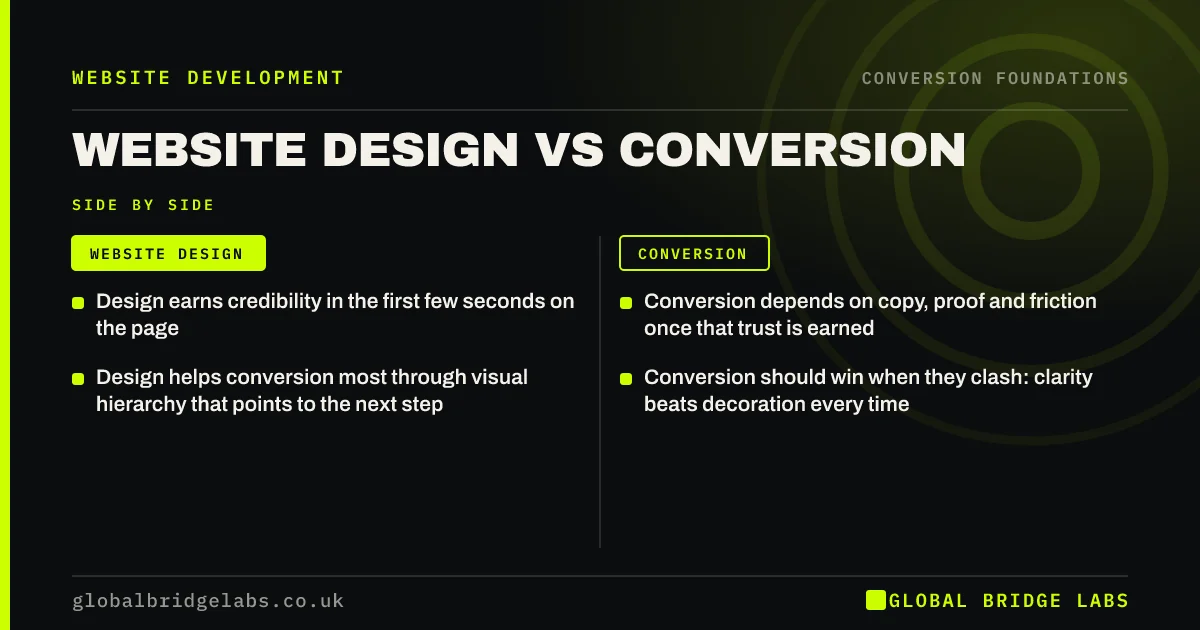
No. A modern look helps credibility, but conversion depends far more on clarity, proof, pricing guidance and an easy next step. Plain sites with strong messaging regularly outperform beautiful sites with vague copy. Design should support the message, not replace it.
How do I make my website high-converting?
Start by tracking every enquiry route so you can measure change. Then rewrite the headlines on your top landing pages, put specific proof beside each claim, add pricing guidance, shorten forms and make one next step obvious on every page. Measure qualified enquiries for 8 weeks after each change.
Written by

Global Bridge Labs (GBL) is a UK–Sri Lanka partner for social media, websites and BPO. Everything here comes from client delivery, not theory.