On this page
- 01Key takeaways
- 02What are buyer objections?
- 03What are the most common objections?
- 04How do you find your real objections?
- 05Where and how should you answer objections?
- 06Should objections go in an FAQ section?
- 07When can answering objections go too far?
- 08What does this look like in practice?
- 09Objection handling checklist
- 10Next step
- 11Sources and further reading
- 12Frequently asked questions
Key takeaways
Buyer objections are the doubts that stop a visitor enquiring: too expensive, not for me, not now, not sure you are better, worried about the process. On a sales call, you would answer them. On a website, the buyer leaves instead of asking. High-converting sites find the real objections and answer each one on the page, near the point where it arises.
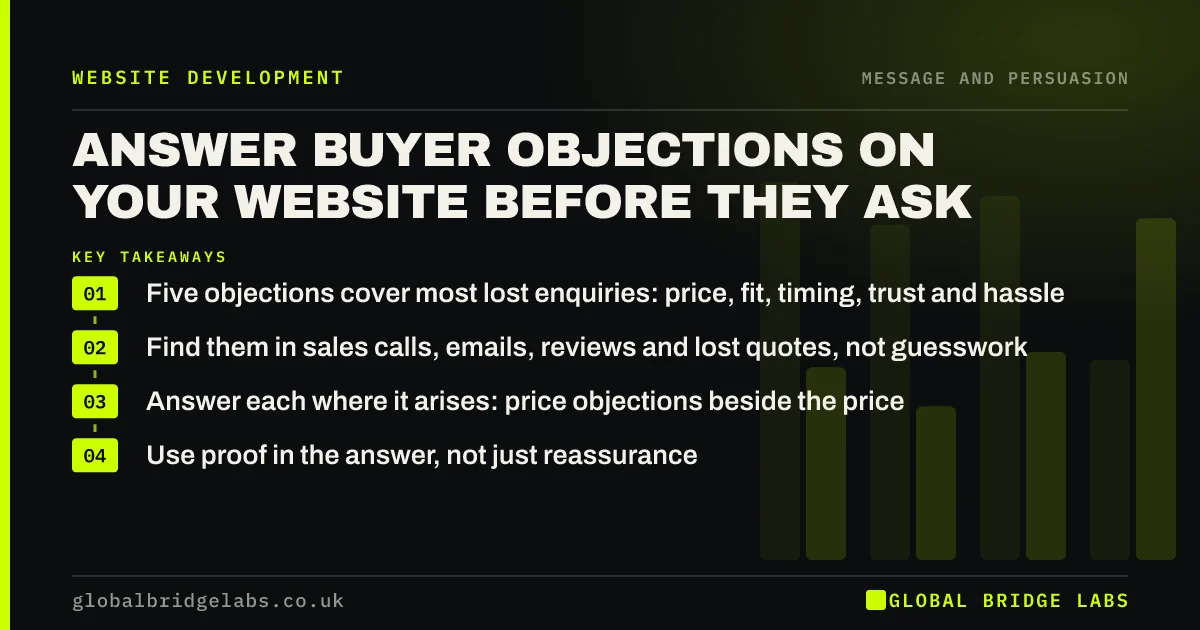
- Five objections cover most lost enquiries: price, fit, timing, trust and hassle.
- Find them in sales calls, emails, reviews and lost quotes, not guesswork.
- Answer each where it arises: price objections beside the price.
- Use proof in the answer, not just reassurance.
Want your top objections answered on your pages? Message us on WhatsApp.
Chat on WhatsApp →What are buyer objections?
A buyer objection is a reason, spoken or unspoken, that a potential customer gives themselves for not acting. On a website objections are almost always unspoken, which is why they are so costly: the visitor simply closes the tab. Answering them in advance is one of the clearest differences between a good website and a high-converting one.
What are the most common objections?
Across UK service businesses, the same five objections come up repeatedly. The wording differs by sector, but the shape is the same.
- Price: 'This will be too expensive for me.'
- Fit: 'They probably do not do jobs like mine, or in my area.'
- Timing: 'They will be booked up for months.'
- Trust: 'How do I know they are any good?'
- Hassle: 'This will be disruptive or complicated.'
How do you find your real objections?
Ask the people who hear them. Sales staff, receptionists and whoever answers the phone know the questions buyers ask before committing. Look at enquiry emails, lost quotes, reviews that say 'I was worried that' and competitor reviews. On-site surveys asking 'what stopped you enquiring today?' capture the silent ones.
- List the first five questions asked on sales calls.
- Read 20 recent enquiry emails for doubts.
- Ask lost prospects why they chose someone else.
- Search reviews for 'worried', 'nervous', 'unsure', 'expected'.
Send us your top five sales call questions on WhatsApp and we will show where to answer them.
Chat on WhatsApp →Where and how should you answer objections?
Answer each objection where it naturally arises, with proof rather than reassurance. Price objections go beside the price with a breakdown or a finance option. Fit objections go near the top with areas served and job types. Trust objections go beside the call to action with specific reviews. Hassle objections go in a short process section.
- Price: ranges, what is included, payment options, a value example.
- Fit: areas, job sizes and sectors served, with examples.
- Timing: current lead time, updated monthly.
- Trust: specific reviews, accreditations, named projects.
- Hassle: a four- or five-step process with timescales.
Should objections go in an FAQ section?
An FAQ section helps, especially for search and AI answers, but it should not be the only place objections are answered. Many visitors never reach it. Answer the biggest objections in the body of the page, then use the FAQ for the rest and for detail.
When can answering objections go too far?
Pages can become defensive walls of reassurance. If every paragraph answers a worry, the page stops selling. Focus on the three to five objections that actually lose you work, answer them briefly with proof, and keep the offer and next step prominent.
What does this look like in practice?
A UK conservatory company's sales team said the first question on nearly every call was 'Do I need planning permission?' The website did not mention it. We added a short section on each product page explaining when planning permission is and is not needed, with a note that the company handles applications. Enquiries rose, and sales calls became shorter because the biggest worry was answered before the call.
Objection handling checklist
- Collect objections from sales calls, emails, reviews and lost quotes.
- Rank them by how often they come up.
- Answer the top three to five on the relevant pages.
- Use proof in each answer, not just reassurance.
- Put remaining questions in an FAQ section.
- Review objections every six months.
Next step
Your team already knows why buyers hesitate. Putting those answers on your website means the hesitation is dealt with before the visitor leaves. We can help you turn sales knowledge into page copy.
Message us on WhatsApp for help answering objections on your site, or book a 30-minute consultation.
Chat on WhatsApp →Sources and further reading
- User research · GOV.UK Service Manual
- Creating helpful, reliable, people-first content · Google Search Central
- Writing to GOV.UK standards: writing guidelines · GOV.UK
Frequently asked questions
How do you handle objections on a website?
Find the real objections from sales calls, emails and reviews, then answer each on the page where it arises, using proof rather than reassurance. Put price answers beside prices, trust answers beside the call to action and process answers in a short steps section.
What are the most common customer objections?
Price, fit, timing, trust and hassle. Buyers worry it will be too expensive, that you do not serve people like them, that you are booked up, that you might not be good, or that the process will be difficult. Your sales team hears them daily.
Should I address price objections on my website?
Yes. Unanswered price doubts are a major reason visitors leave without enquiring. Give ranges or starting points, explain what is included and offer payment options if you have them. This also filters out buyers far outside your range. Explain what moves the price up or down.
Is an FAQ page enough to handle objections?
Not on its own, because many visitors never reach it. Answer the biggest objections within the main page content near where they arise, and use FAQs for the remaining questions and for extra detail. Use proof in each answer rather than reassurance alone, because buyers trust evidence more than promises.
Written by

Global Bridge Labs (GBL) is a UK–Sri Lanka partner for social media, websites and BPO. Everything here comes from client delivery, not theory.