On this page
- 01Key takeaways
- 02What are the main types of BPO?
- 03What is front-office BPO?
- 04What is back-office BPO?
- 05What is specialist or knowledge process outsourcing?
- 06How do onshore, nearshore and offshore BPO differ?
- 07Which type of BPO suits which UK business?
- 08What does each type of BPO cost?
- 09When does the type of BPO not matter?
- 10What does this look like in practice?
- 11Checklist: classify your work in 30 minutes
- 12Next step
- 13Sources and further reading
- 14Frequently asked questions
Key takeaways
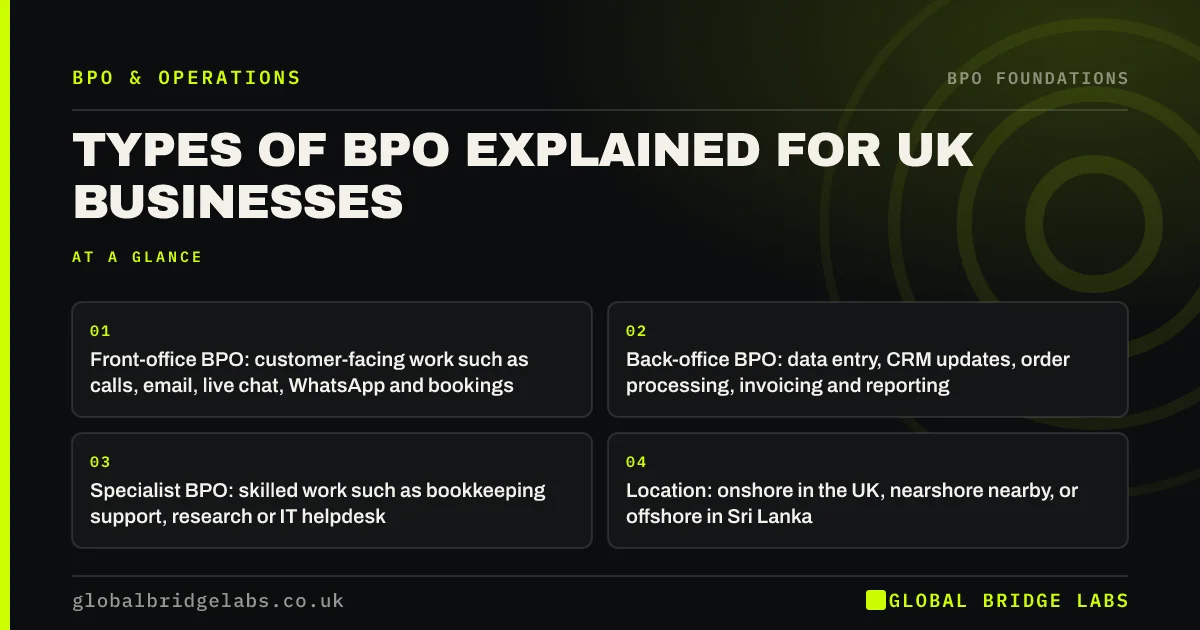
The types of BPO are usually grouped two ways: by the work (front office, back office and specialist) and by location (onshore, nearshore and offshore). For a UK SME the useful question is which combination fits a given process, because a phone line and a reconciliation queue rarely need the same answer.
- Front-office BPO: customer-facing work such as calls, email, live chat, WhatsApp and bookings.
- Back-office BPO: data entry, CRM updates, order processing, invoicing and reporting.
- Specialist BPO: skilled work such as bookkeeping support, research or IT helpdesk.
- Location: onshore in the UK, nearshore nearby, or offshore in Sri Lanka, India or the Philippines.
- Most SMEs start with one front-office and one back-office process from the same provider.
Not sure which type your work falls into? Message us on WhatsApp with the tasks and we will sort them for you.
Chat on WhatsApp →What are the main types of BPO?
The main types of BPO are front-office outsourcing, back-office outsourcing and specialist or knowledge-based outsourcing. Each can then be delivered onshore, nearshore or offshore. The type describes what the team does; the location describes where and at what cost.
Business process outsourcing (BPO) itself is the handover of a defined, repeatable process to a provider that staffs and manages it. Classifying the process first stops you from buying the wrong kind of service, such as a pay-per-call answering service when what you needed was a team that could also update your CRM.
What is front-office BPO?
Front-office BPO is outsourced work that customers see or hear: answering calls, replying to emails and chats, handling WhatsApp messages, booking appointments and dealing with complaints. It is judged on speed, tone and resolution, because every interaction carries your brand.
For UK SMEs, front-office work is usually the most urgent to fix, because slow replies cost sales immediately. A missed call on a Tuesday morning is often a job booked with a competitor by lunchtime. The trade-off is that front-office teams need the most training in your voice, products and escalation rules.
- Inbound calls and call answering, including quote requests.
- Email and helpdesk tickets.
- Live chat on your website.
- WhatsApp Business and social media direct messages.
- Appointment booking and diary management.
What is back-office BPO?
Back-office BPO is outsourced work that keeps the business running but that customers never see: data entry, CRM hygiene, order and invoice processing, supplier bills, reconciliation support, document handling and reporting. It is judged on accuracy, turnaround and cost per task.
Back-office work is often the easiest to outsource well, because it is rules-based, measurable and less time-critical. It is also where owners lose the most evenings. Across our client work, back-office cost per task has fallen by 42% once the work was written down and run by a managed team.
- Data entry and document processing.
- CRM updates, de-duplication and data hygiene.
- Order processing, returns and stock updates.
- Invoicing, credit control and supplier bill preparation.
- Weekly and monthly reporting packs.
What is specialist or knowledge process outsourcing?
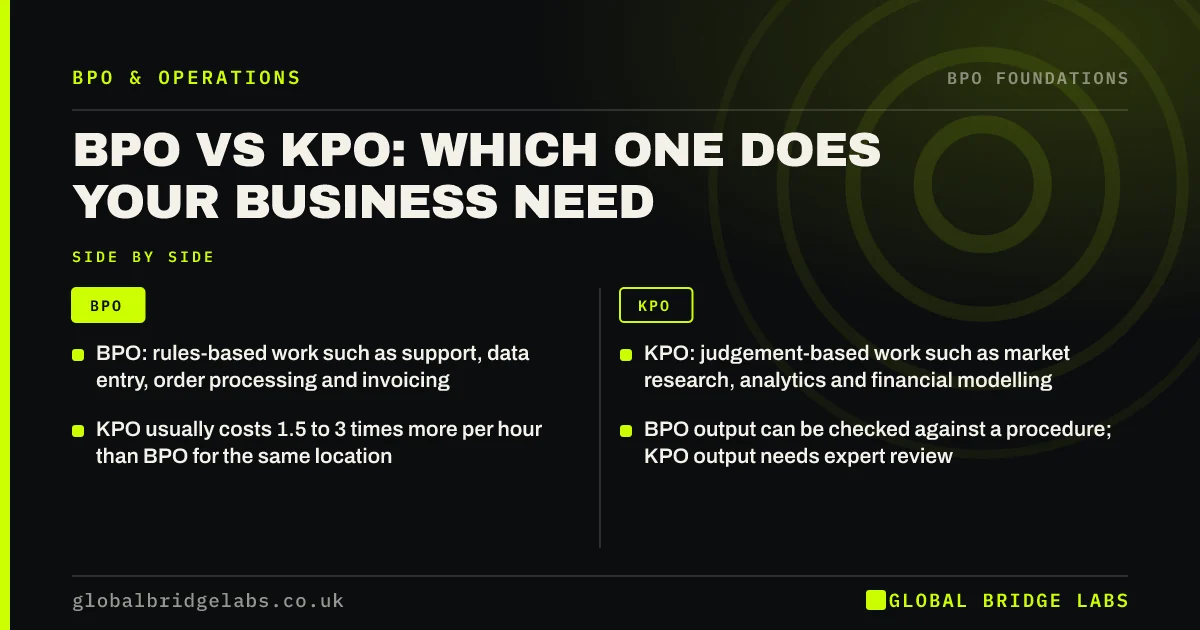
Specialist outsourcing covers work that needs a qualification or deeper judgement, such as bookkeeping support, research, analytics or technical support. When the work depends mainly on expertise rather than a fixed procedure, it is often called knowledge process outsourcing (KPO).
KPO costs more per hour and needs closer oversight, because the output is harder to check against a simple rule. Most UK SMEs get more value from standard BPO first, then add specialist work once they trust the provider and have a governance rhythm in place.
How do onshore, nearshore and offshore BPO differ?
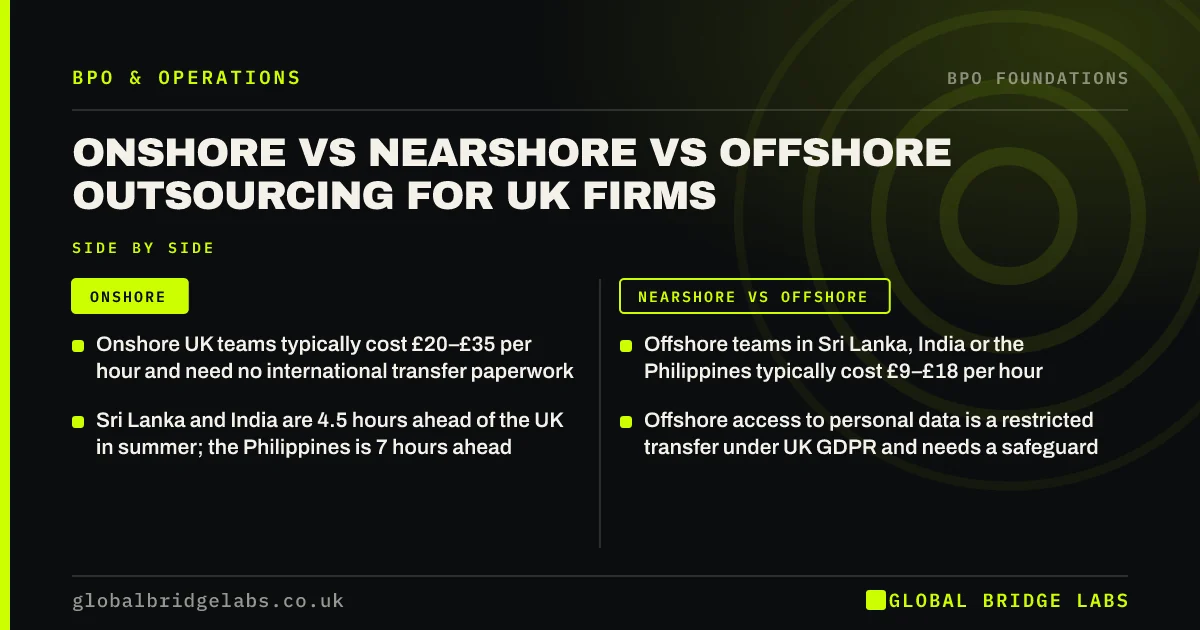
Onshore BPO uses a UK-based team, nearshore uses a nearby country, and offshore uses a more distant country, typically with lower labour costs. The main differences are hourly cost, time-zone overlap and the data protection paperwork required.
- Onshore (UK): roughly £20–£35 per hour; simplest for regulated or highly local work.
- Nearshore (for example Eastern Europe): mid-range cost, one to two hours of time difference.
- Offshore (Sri Lanka, India, Philippines): roughly £9–£18 per hour; needs a UK GDPR transfer safeguard.
Which type of BPO suits which UK business?
Match the type to your bottleneck. If customers wait too long for replies, start with front-office BPO. If the owner spends evenings on paperwork, start with back-office BPO. If both are true, which is common, start with whichever costs you more revenue today.
- Trades and construction: call answering, quote booking and job admin.
- E-commerce: order queries, returns, live chat and product data entry.
- Professional services: inbox triage, document chasing and CRM updates.
- Healthcare clinics: reception calls, appointment booking and patient admin.
- Logistics: delivery queries, proof-of-delivery chasing and booking admin.
- Hospitality: reservations, enquiries and review responses.
What does each type of BPO cost?
Cost depends more on location and skill than on the label. As indicative market ranges, standard offshore front-office and back-office work sits around £9–£18 per hour fully managed, onshore UK work around £20–£35, and specialist KPO work above both.
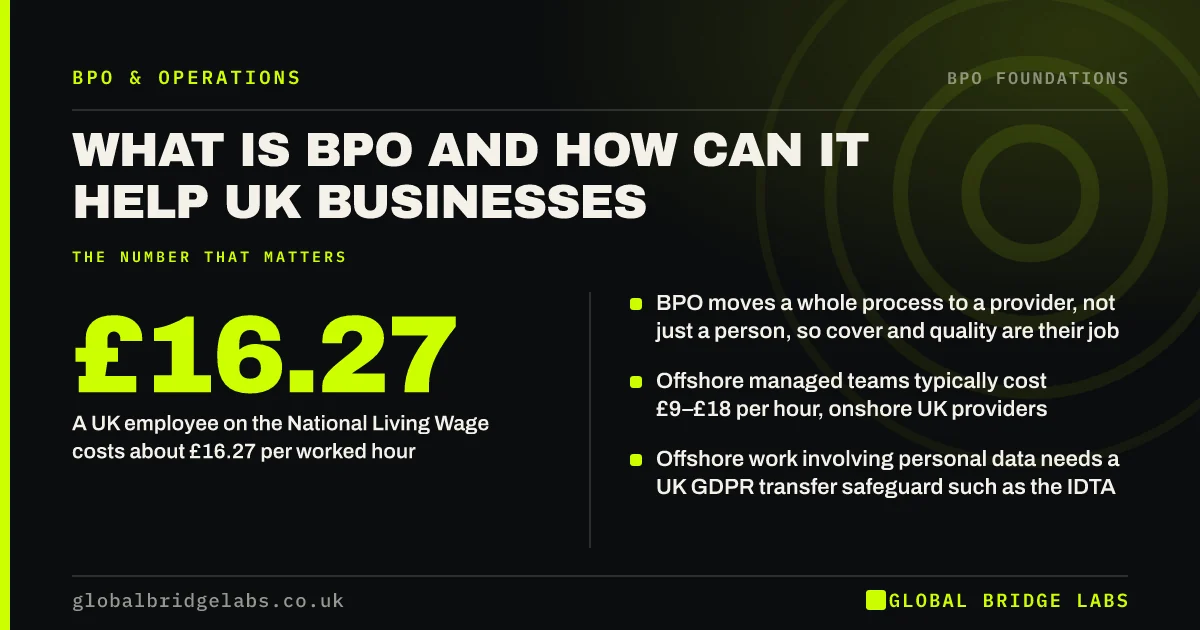
Pricing models also differ by type. Front-office work is often priced per seat or per hour because demand arrives unpredictably. Back-office work can suit per-transaction pricing, such as per invoice or per record, once volumes are stable. A UK employee on the National Living Wage costs about £16.27 per worked hour once employer National Insurance, pension and holiday are included, which is the fair baseline for any comparison.
Want a costed plan for one front-office and one back-office process? Send us the volumes on WhatsApp and we will discuss your requirements.
Chat on WhatsApp →When does the type of BPO not matter?
The type does not matter if the process itself is broken. A badly designed refund policy is just as frustrating when an outsourced team applies it. Labels also matter less than scope: a well-scoped seat that answers calls and then updates the CRM is often better value than two separate services.
Be wary of providers that insist on one type because it is all they sell. A pay-per-call answering service is fine for overflow, but it will not chase your invoices or clean your data.
What does this look like in practice?
A pattern we see in growing service businesses: the owner asks for "a receptionist" and gets quotes from answering services, virtual assistants and call centres that cannot be compared. Once the work is listed, it turns out to be 60% front office (calls and WhatsApp) and 40% back office (CRM updates and quote follow-up).
The better fit is one managed seat covering both, working to a written process inside the business's own tools. Classifying the work first is what makes that visible.
Checklist: classify your work in 30 minutes
Use this before you ask anyone for a quote.
- List every recurring task and its weekly hours.
- Tag each task front office, back office or specialist.
- Note whether it needs UK hours, extended hours or can be done any time.
- Note which systems and personal data each task touches.
- Mark tasks that are fully documented, partly documented or not at all.
- Pick the one task that costs you most revenue when it slips.
- Decide whether onshore, nearshore or offshore suits that task.
Next step
Send us your task list and we will tell you which type of BPO each item suits, what we would outsource first and what we would keep in-house. It takes 30 minutes and there is no pitch.
Message us on WhatsApp with your task list, or book a 30-minute consultation.
Chat on WhatsApp →Sources and further reading
- Rates and thresholds for employers 2026 to 2027 · HM Revenue & Customs
- National Minimum Wage and National Living Wage rates · GOV.UK
- International transfers of personal data · Information Commissioner's Office
Frequently asked questions
What are the two main types of BPO?
The two main types are front-office BPO, which covers customer-facing work such as calls, email, chat and bookings, and back-office BPO, which covers internal work such as data entry, order processing, invoicing and reporting. Specialist or knowledge process outsourcing is sometimes treated as a third type.
Is customer service front office or back office?
Customer service is front-office work, because customers interact with the team directly by phone, email, chat or WhatsApp. The admin that supports it, such as updating orders, logging complaints in the CRM or processing refunds, is usually treated as back-office work, even when the same team does both.
What is the difference between BPO and ITO?
BPO outsources business processes such as support, admin and finance operations. ITO, or IT outsourcing, outsources technology functions such as infrastructure management, software development or IT support. Some providers do both, but they are bought, measured and managed differently, so treat them as separate decisions.
Which type of BPO is best for a small business?
Start with the process that costs you the most revenue or owner time today. For many service businesses that is call and enquiry handling; for e-commerce it is order queries; for professional services it is inbox and document admin. One well-run process builds the trust to add a second.
Written by

Global Bridge Labs (GBL) is a UK–Sri Lanka partner for social media, websites and BPO. Everything here comes from client delivery, not theory.