On this page
- 01Key takeaways
- 02What is data entry outsourcing?
- 03Which data entry tasks suit outsourcing?
- 04How accurate should outsourced data entry be?
- 05What does data entry outsourcing cost?
- 06How do you keep the data safe?
- 07Should you automate data entry instead?
- 08When is outsourcing data entry a bad idea?
- 09What does this look like in practice?
- 10Checklist: outsource data entry
- 11Next step
- 12Sources and further reading
- 13Frequently asked questions
Key takeaways
Data entry outsourcing in the UK is one of the easiest processes to hand over well: the rules are clear, the output is easy to check, and it rarely needs to happen at a particular hour. The risks are accuracy and data protection, and both are controlled with sampling, validation rules and the right contracts.
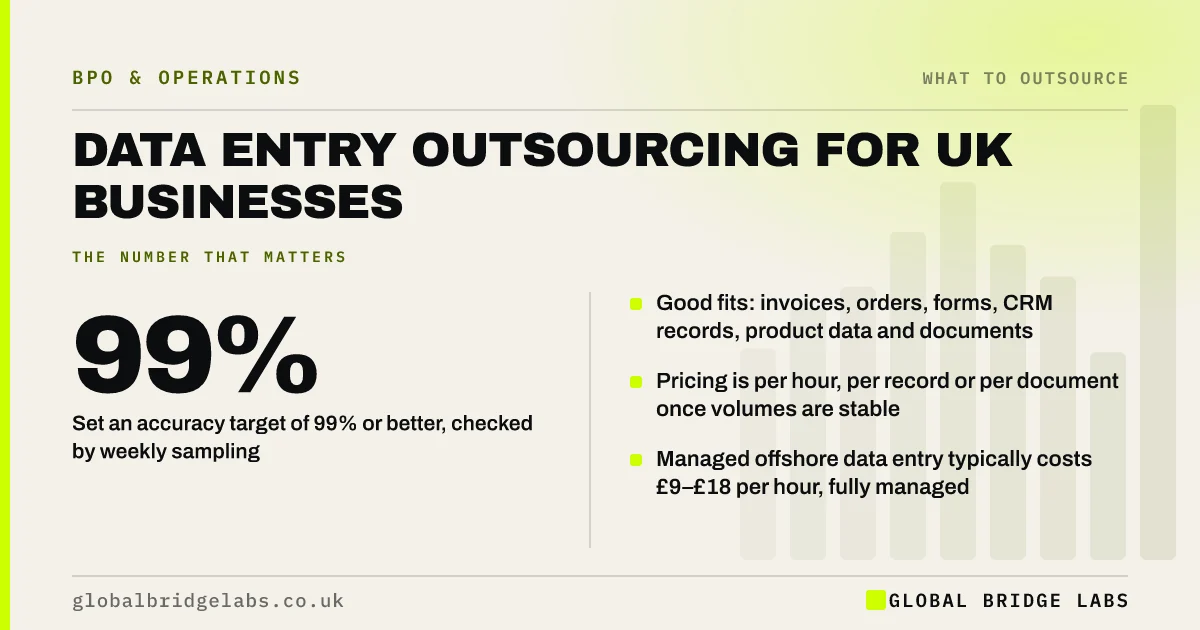
- Good fits: invoices, orders, forms, CRM records, product data and documents.
- Set an accuracy target of 99% or better, checked by weekly sampling.
- Pricing is per hour, per record or per document once volumes are stable.
- Managed offshore data entry typically costs £9–£18 per hour, fully managed.
- Work inside your systems, not on emailed spreadsheets, to protect personal data.
Got a backlog of data entry? Message us on WhatsApp with what it is and roughly how much.
Chat on WhatsApp →What is data entry outsourcing?
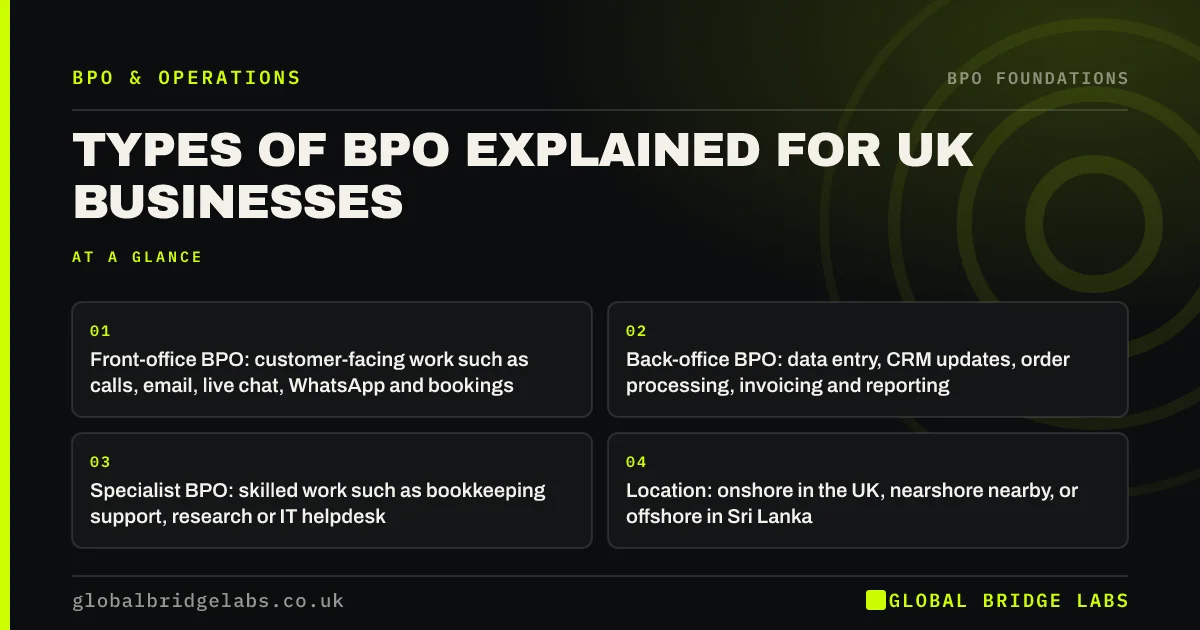
Data entry outsourcing is a back-office business process outsourcing (BPO) service in which a provider's team transfers information from documents, emails, forms or other systems into your business systems, to agreed accuracy and turnaround standards.
It covers far more than typing. A good data entry team validates what it enters, flags missing or inconsistent information, and follows rules for formats, duplicates and exceptions, so the data is usable when it lands.
Which data entry tasks suit outsourcing?
Tasks suit outsourcing when the source is clear, the rules can be written down, and the output can be checked. Most SMEs have several of these hidden in someone's week.
- Supplier invoices and receipts into accounting software.
- Orders, delivery notes and returns into order systems.
- Web forms, enquiries and business cards into the CRM.
- Product listings, descriptions and specifications for e-commerce.
- Scanned documents indexed into a document management system.
- Survey, timesheet or job-sheet data into spreadsheets or reports.
How accurate should outsourced data entry be?
Aim for 99% or better at field level, measured by sampling, not assumed. A quality analyst checks a random sample of records each week against the source, counts errors per field, and feeds recurring errors back into training or the procedure.
Validation rules in your systems help: mandatory fields, format checks for postcodes and VAT numbers, and duplicate detection. For critical data, such as bank details, use double-entry or a second-person check.
What does data entry outsourcing cost?
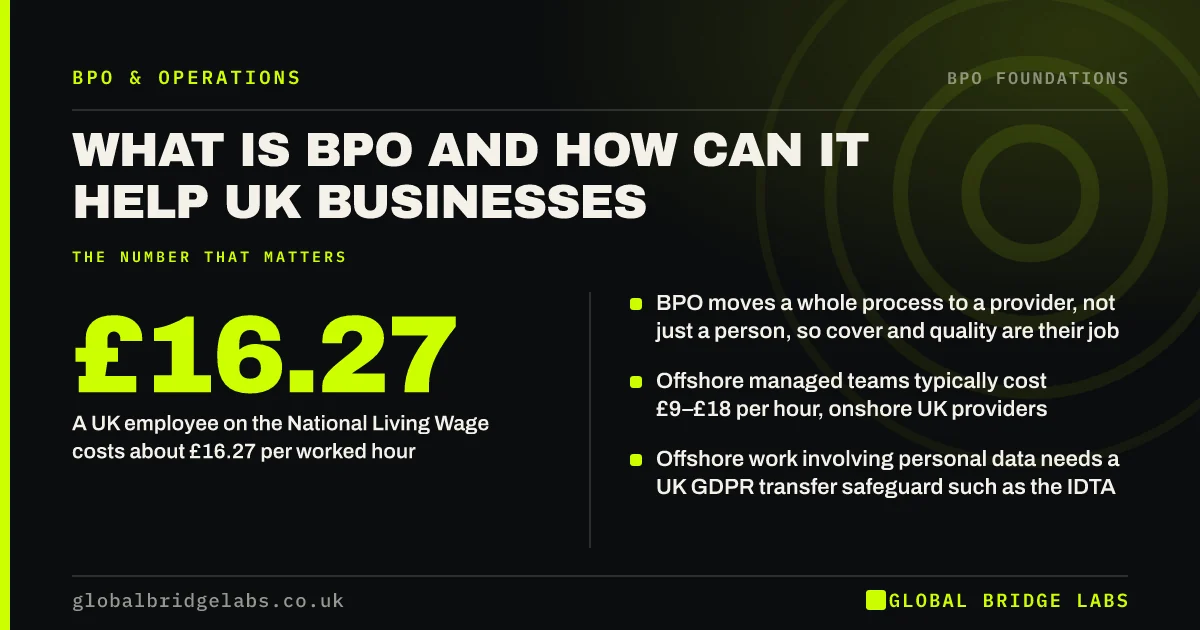
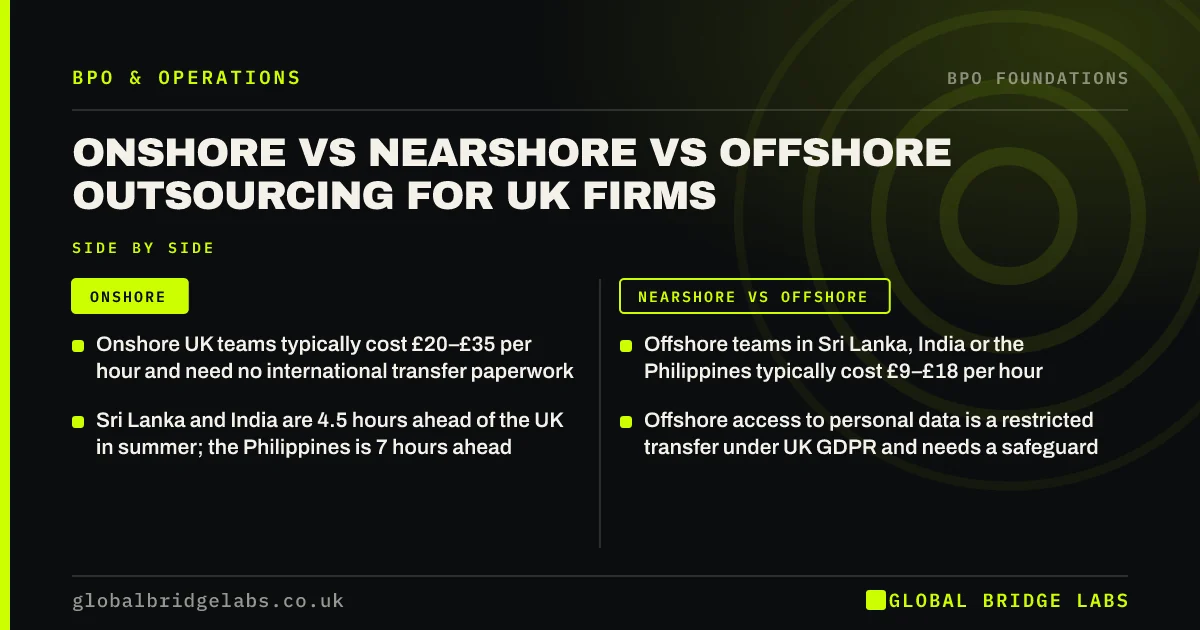
As indicative market ranges, managed offshore data entry costs around £9–£18 per hour and onshore UK providers around £20–£35. Once volumes are stable, per-record or per-document pricing is common, which ties cost directly to output.
The in-house comparison is a UK administrator. On £26,000, one costs about £29,743 a year once 15% employer National Insurance above £5,000 and the 3% pension contribution are added, or about £17.09 per worked hour after 28 days' holiday, before equipment and overheads. Data entry done by an owner or a senior employee costs far more.
Want a costed plan for your data entry volumes? Send us a sample and weekly volume on WhatsApp and we will discuss your requirements.
Chat on WhatsApp →How do you keep the data safe?
Keep data safe by having the team work inside your systems with individual logins, least-privilege permissions and multi-factor authentication, rather than emailing spreadsheets back and forth. Most data entry involves personal data, so a written processor contract is required under UK GDPR.
If the team is outside the UK, the ICO treats remote access to personal data as a restricted transfer, which needs a safeguard such as the International Data Transfer Agreement and a transfer risk assessment.
Should you automate data entry instead?
Automate it where the source is structured and consistent, such as form submissions going straight into your CRM, or invoices from one supplier in a fixed format. Use people where sources are messy, varied or need judgement: handwritten job sheets, mixed supplier invoices, or records that need checking against other data.
Many businesses combine both: optical character recognition extracts the data, and a person checks and corrects it.
When is outsourcing data entry a bad idea?
It is a bad idea when the data is so sensitive that you cannot put proper controls around access, when the rules change constantly, or when the volume is a few records a week. It is also a bad idea to outsource entry into a system that is itself badly designed; fix the fields and validation first.
What does this look like in practice?
A pattern we see in growing product businesses: a spreadsheet of orders re-keyed into an accounts package and a courier portal, by the owner, on Friday afternoons. Handing that to a team working inside the systems, with a weekly accuracy sample, frees the afternoon and usually exposes steps that can be removed entirely.
Checklist: outsource data entry
Prepare these before handing over.
- List every data entry task, its source and its weekly volume.
- Write field-by-field rules, formats and exception handling.
- Add validation rules in your systems where possible.
- Set an accuracy target and a weekly sampling method.
- Set up individual logins with least-privilege permissions.
- Sign a processor contract and, if offshore, a transfer safeguard.
- Agree turnaround times and a monthly report.
Next step
Send us a sample of the documents or records and we will tell you what can be outsourced, what should be automated, and what it would cost. 30 minutes, no pitch.
Message us on WhatsApp with your data entry task, or book a 30-minute consultation.
Chat on WhatsApp →Sources and further reading
- International transfers of personal data · Information Commissioner's Office
- Contracts and liabilities between controllers and processors · Information Commissioner's Office
- Rates and thresholds for employers 2026 to 2027 · HM Revenue & Customs
Frequently asked questions
How much does it cost to outsource data entry in the UK?
As indicative market ranges, managed offshore data entry costs around £9–£18 per hour and onshore UK providers around £20–£35. Once volumes are predictable, many providers price per record or per document instead. Compare with an in-house administrator at about £17.09 per worked hour on a £26,000 salary.
Is it safe to outsource data entry offshore?
Yes, with the right controls: individual logins inside your systems, least-privilege access, multi-factor authentication, a processor contract and, because offshore access is a restricted transfer, a UK GDPR safeguard such as the IDTA with a transfer risk assessment. Avoid emailing spreadsheets.
What accuracy should I expect from outsourced data entry?
Expect 99% or better at field level once the team is trained, confirmed by weekly sampling against the source documents. For critical fields such as bank details or prices, use a second-person check. Accuracy during the first few weeks will be lower, so review work before it is relied on.
Can data entry be fully automated?
Structured, consistent data can often be automated through integrations or document extraction tools. Messy, varied or handwritten sources still need people, at least to check and correct. Most businesses end up with a mix: automation for the easy volume and a team for exceptions.
Written by

Global Bridge Labs (GBL) is a UK–Sri Lanka partner for social media, websites and BPO. Everything here comes from client delivery, not theory.