On this page
- 01Key takeaways
- 02What is burn rate?
- 03How do you calculate runway?
- 04What should you cut, and what should you protect?
- 05How do you turn fixed costs into variable ones?
- 06What does founder time cost?
- 07When does cutting burn do harm?
- 08What does this look like in practice?
- 09Burn rate checklist
- 10Next step
- 11Sources and further reading
- 12Frequently asked questions
Key takeaways
To reduce startup burn rate without stalling growth, turn fixed costs into variable ones and cut spending that is not tied to a milestone. Burn rate is the cash a company loses each month. In our example, lowering net burn from £40,000 to £32,000 extends runway from 7.5 months to more than 9, without removing a single builder or seller.
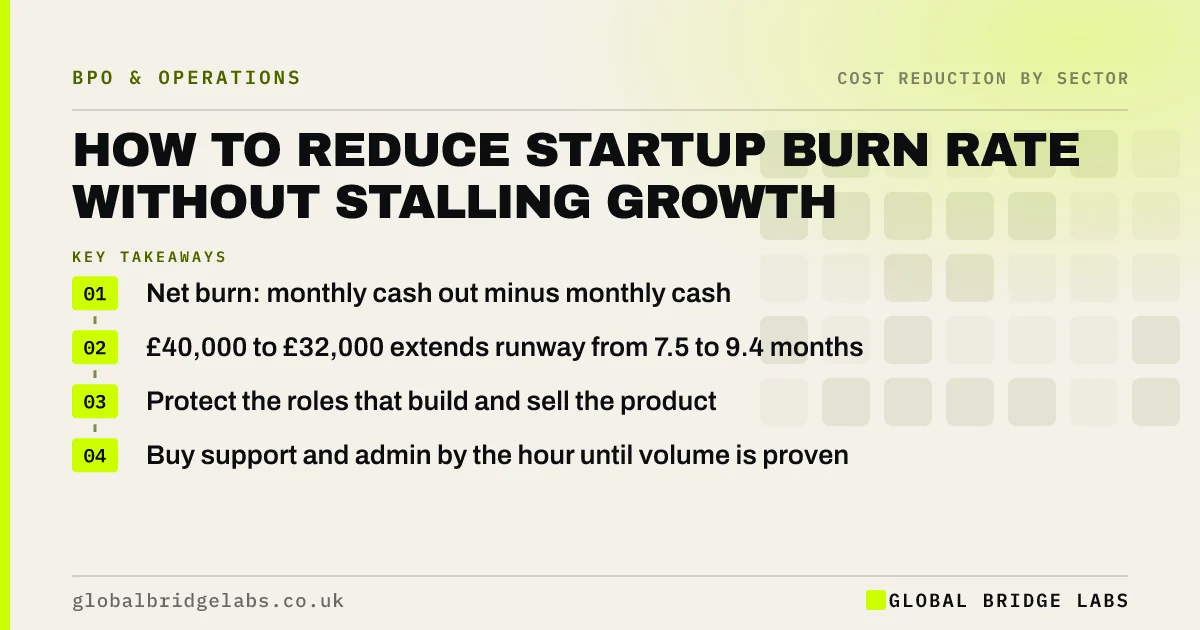
- Net burn: monthly cash out minus monthly cash in.
- £40,000 to £32,000 extends runway from 7.5 to 9.4 months.
- Protect the roles that build and sell the product.
- Buy support and admin by the hour until volume is proven.
Want your runway recalculated with a leaner cost base? Message us on WhatsApp with your monthly burn.
Chat on WhatsApp →What is burn rate?
Burn rate is the rate at which a company spends its cash reserves. Gross burn is total monthly cash spending. Net burn is spending minus cash received from customers. Runway is the number of months the cash will last, calculated as cash in the bank divided by net burn.
How do you calculate runway?
Divide cash by net monthly burn. In an illustrative start-up with £300,000 in the bank, monthly spending of £55,000 and monthly receipts of £15,000, net burn is £40,000 and runway is 7.5 months. Reducing spending by £8,000 a month lowers net burn to £32,000 and extends runway to about 9.4 months.
Nearly two extra months can be the difference between raising from strength and raising in a hurry.
- Cash: £300,000.
- Net burn: £40,000 a month, runway 7.5 months.
- Net burn: £32,000 a month, runway about 9.4 months.
What should you cut, and what should you protect?
Cut what does not move you towards the next milestone, and protect what does. For most early-stage companies the milestone is product progress or revenue, so the people who build and the people who sell are protected. Everything else is examined.
- Protect: product, engineering and sales capacity.
- Examine: office space, software seats, agencies and contractors.
- Examine: support and admin roles hired ahead of volume.
- Cut: tools, subscriptions and projects with no owner.
How do you turn fixed costs into variable ones?
Turn fixed costs into variable ones by buying capacity that rises and falls with demand. A start-up that hires a full support and operations team before volume justifies it carries the salaries through every quiet month. Buying those hours from a managed team means the cost follows customer numbers.
As indicative market ranges, a managed offshore team costs UK businesses £9–£18 per hour. A UK employee on a £30,000 salary costs about £34,500 a year once employer costs are added, whether or not the work is there.
- Outsourcing and cash flow: fixed costs to variable
- Operating leverage: why fixed costs make growth risky
- Raised investment? Where outsourcing fits the plan
Want to see which of your fixed costs could become variable? Send us your team list on WhatsApp.
Chat on WhatsApp →What does founder time cost?
Founder time is the scarcest resource in the company and does not appear in the burn rate. A founder answering support tickets and reconciling invoices is not raising, selling or deciding. Moving that work costs little cash and often does more for the runway than any cut, because it speeds up the milestone.
When does cutting burn do harm?
Cutting burn does harm when it slows the thing investors are paying for. A start-up that halves its burn and halves its growth has not improved its position. Cuts to product quality or customer response time can also raise churn. Measure the effect of each cut on the milestone, not just on the bank balance.
What does this look like in practice?
A pattern we see after a funding round: the first hires include an office manager, a support lead and an operations person, because a proper company has them. A year later the runway is short and those roles are hard to undo. Buying the same functions as a service until the workload is proven keeps the option open.
Burn rate checklist
Review these monthly.
- Calculate gross burn, net burn and runway.
- Tag each cost as tied to a milestone or not.
- List fixed costs that could be variable.
- Review software seats and subscriptions.
- Log founder hours spent on routine work.
- Check you claim the Employment Allowance if eligible.
Next step
Send us your monthly spending by category and your next milestone. We will show you which costs could flex with demand and what that would do to your runway.
Message us on WhatsApp to extend your runway, or book a 30-minute consultation.
Chat on WhatsApp →Sources and further reading
- Rates and thresholds for employers 2026 to 2027 · HM Revenue & Customs
- Employment Allowance · GOV.UK
- Business population estimates for the UK and regions 2025 · Department for Business and Trade
Frequently asked questions
What is the formula for burn rate?
Gross burn is total monthly cash spending. Net burn is monthly cash spending minus monthly cash received. Runway in months equals cash in the bank divided by net burn. A company with £300,000 and a net burn of £40,000 has 7.5 months of runway.
How can a startup reduce burn rate quickly?
Cancel unused software and subscriptions, pause projects with no clear owner, renegotiate or end agency and contractor arrangements, and review office costs. For support and admin, replace fixed roles with bought-in hours so the cost follows demand.
What is a good runway for a startup?
Many founders aim to keep 12 to 18 months of runway, because fundraising commonly takes several months and negotiating with little cash left is difficult. The right figure depends on how far away your next milestone is.
Should a startup outsource to save money?
For functions that are not the core product, often yes. Buying customer support, administration and bookkeeping as services keeps fixed costs low while volume is uncertain. Keep product, engineering and sales in-house, where the company's value is created.
Written by

Global Bridge Labs (GBL) is a UK–Sri Lanka partner for social media, websites and BPO. Everything here comes from client delivery, not theory.