On this page
- 01Key takeaways
- 02Why do funded businesses consider outsourcing?
- 03What should a funded business outsource?
- 04How does outsourcing affect runway?
- 05What do investors want to see?
- 06What are the risks of outsourcing too early after funding?
- 07What about data protection and due diligence?
- 08How do you plan outsourcing alongside a hiring plan?
- 09Which operations scale best with outsourcing after a raise?
- 10What does this look like in practice?
- 11Post-investment checklist
- 12Next step
- 13Sources and further reading
- 14Frequently asked questions
Key takeaways
Outsourcing after raising investment lets a business put more of its funding into growth, such as product, sales and marketing, and less into fixed back-office headcount. Outsource repeatable operations that scale with customers, keep core capability in-house, and show investors how cost per customer falls as you grow.
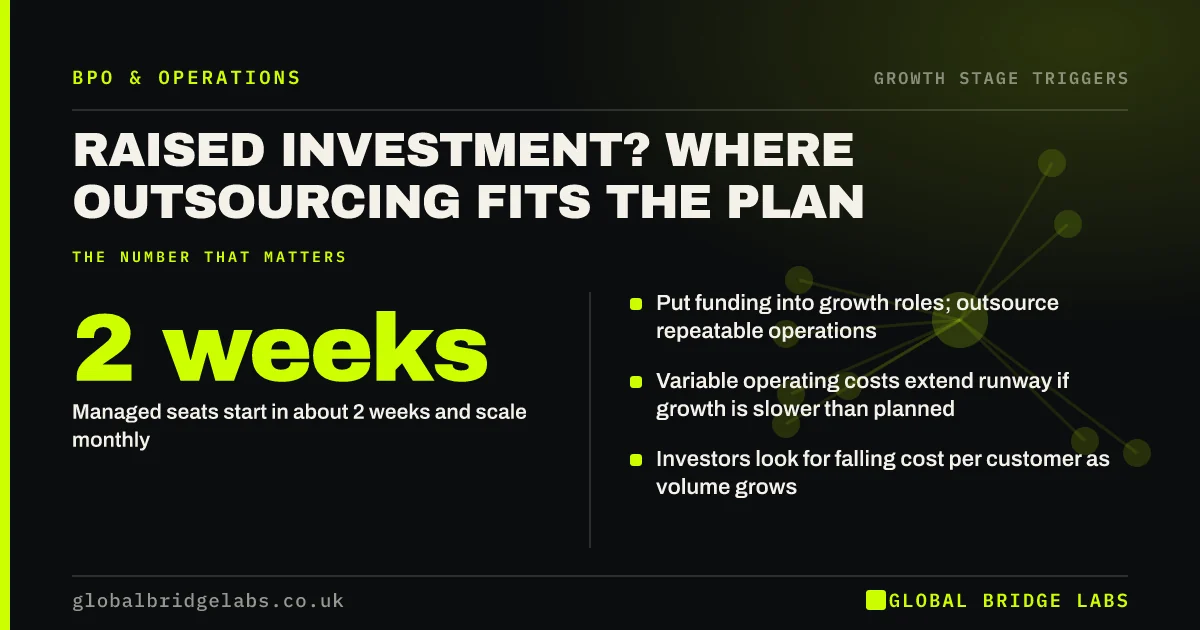
- Put funding into growth roles; outsource repeatable operations.
- Variable operating costs extend runway if growth is slower than planned.
- Managed seats start in about 2 weeks and scale monthly.
- Investors look for falling cost per customer as volume grows.
Just raised and planning hires? Message us on WhatsApp with your plan.
Chat on WhatsApp →Why do funded businesses consider outsourcing?
Because funding comes with a growth plan and a deadline. Recruiting a full back-office team takes months and adds fixed cost that eats runway if growth is slower than forecast. Outsourcing repeatable operations lets the business scale service and admin with customers while the funding goes on the roles that create growth.
What should a funded business outsource?
Outsource operations that grow with customers and are not the product: customer support, onboarding admin, order processing, data entry, invoicing and credit control. Keep product, engineering, sales leadership and customer success for key accounts in-house, because those are where investors expect the capability to be built.
How does outsourcing affect runway?
It lowers fixed cost and makes operating cost follow customer numbers. If growth arrives on plan, outsourced capacity scales with it. If growth is slower, it scales down on notice terms, without redundancy costs. That flexibility can add months of runway compared with a team hired ahead of demand.
Want to see the runway effect with your numbers? Ask us on WhatsApp.
Chat on WhatsApp →What do investors want to see?
Investors want evidence that operations scale efficiently: cost per customer or per order falling as volume grows, service levels holding, and no single person the business cannot run without. A documented, outsourced operation with a weekly scorecard is easy to show in a board pack.
What are the risks of outsourcing too early after funding?
Outsourcing before the process is stable, or before you understand customers well, can lock in the wrong way of working. Founders should run customer support themselves long enough to learn what customers need. Once the common questions are clear and repeatable, hand them over.
What about data protection and due diligence?
Investors and future acquirers will ask how customer data is handled. Any provider handling personal data needs a processor contract under UK GDPR, and an offshore team needs a valid transfer safeguard. Keep a simple register of providers, what data they access and where. It saves time in every future due diligence.
How do you plan outsourcing alongside a hiring plan?
Split the hiring plan into roles that build capability and roles that add volume. Keep the first group as hires. For the second, cost an outsourced alternative and choose case by case. Review the split every quarter against actual growth, because volume roles are the ones most likely to change.
Which operations scale best with outsourcing after a raise?
The operations that grow in direct proportion to customers and follow clear rules. They are also the ones that typically take up the largest share of a growing back-office budget if they are hired for.
- First-line customer support and onboarding questions.
- Order processing, refunds and account changes.
- Data entry, CRM updates and reporting preparation.
- Invoicing, payment chasing and supplier admin.
What does this look like in practice?
A pattern we see in UK start-ups after a seed or Series A round: the plan includes three support hires. Outsourcing first-line support instead, with one in-house support lead, gets cover in place within weeks and frees budget for engineering. The support lead owns quality and the knowledge base, and the outsourced team scales with users.
Post-investment checklist
Use this when planning spend after a raise.
- Split planned hires into capability and volume roles.
- Cost outsourcing for each volume role.
- Keep product, engineering and sales leadership in-house.
- Document processes before handing them over.
- Put processor contracts and a provider register in place.
- Report cost per customer to the board monthly.
Next step
Send us your hiring plan. We will tell you which roles could be outsourced and what it would do to your runway.
Message us on WhatsApp about your plan, or book a 30-minute consultation.
Chat on WhatsApp →Sources and further reading
- Contracts and liabilities between controllers and processors · Information Commissioner's Office
- International transfers of personal data · Information Commissioner's Office
- Redundancy: your rights · GOV.UK
Frequently asked questions
Should a startup outsource after raising funding?
Often, for repeatable operations such as first-line support, order processing and admin. It keeps fixed costs down and lets funding go on product and growth roles. Founders should still understand customers directly before handing support over.
Does outsourcing extend runway?
It can. Outsourced capacity on short notice terms scales with customers and can be reduced without redundancy costs if growth is slower than planned. A team hired ahead of demand is a fixed cost that shortens runway if the forecast slips.
What will investors ask about outsourcing?
They will ask how operations scale, what cost per customer looks like, how data is protected and whether the business depends on any one person or provider. A documented process, service levels, a scorecard and processor contracts answer most of these.
Written by

Global Bridge Labs (GBL) is a UK–Sri Lanka partner for social media, websites and BPO. Everything here comes from client delivery, not theory.