
On this page
- 01Key takeaways
- 02Where do e-commerce operating costs go?
- 03What does admin cost per order look like?
- 04Which costs should you remove first?
- 05What does the saving look like?
- 06What can a managed team take on?
- 07What does UK law require of online sellers?
- 08What does this look like in practice?
- 09E-commerce cost checklist
- 10Next step
- 11Sources and further reading
- 12Frequently asked questions
Key takeaways
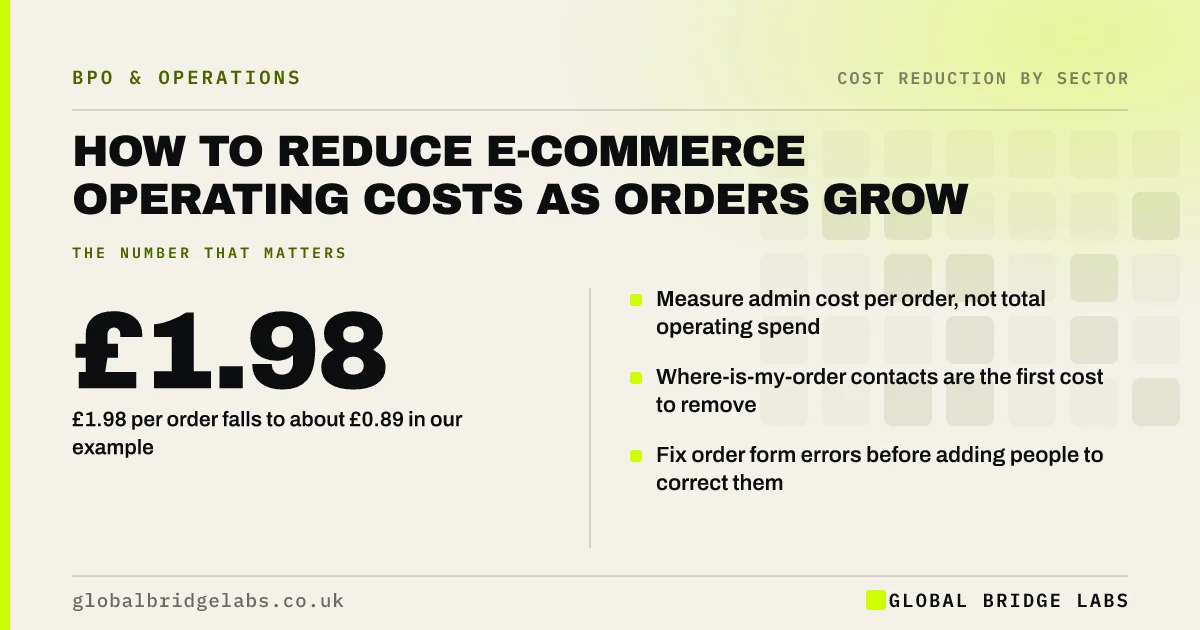
To reduce ecommerce operating costs, work on cost per order, not total spend. The controllable part for most UK online shops is the people time around each order: customer contact, order exceptions and returns. In our example, that admin costs £1.98 per order and falls to about £0.89 by preventing avoidable contacts and moving routine handling to a managed team.
- Measure admin cost per order, not total operating spend.
- £1.98 per order falls to about £0.89 in our example.
- Where-is-my-order contacts are the first cost to remove.
- Fix order form errors before adding people to correct them.
Want your admin cost per order worked out? Message us on WhatsApp with monthly orders and who handles them.
Chat on WhatsApp →Where do e-commerce operating costs go?
E-commerce operating costs go on fulfilment, payment and platform fees, marketing, and the people who answer customers and sort out problems. Fees and postage are largely set by suppliers. The people cost is where a small shop has the most control, and it is the cost that grows fastest when orders rise.
What does admin cost per order look like?
Take an illustrative shop with 3,000 orders a month. Customer contacts run at 0.4 per order, so 1,200 a month at 6 minutes each: 120 hours. Order exceptions affect 8% of orders, 240 at 15 minutes: 60 hours. Returns run at 10%, 300 at 12 minutes of handling: 60 hours.
That is 240 hours a month. At a loaded £19.81 per worked hour it is about £4,750 before management time, or roughly £1.58 per order. With supervision at an illustrative 30 hours a month and £40 an hour, the figure is about £1.98.
- Contacts: 1,200 a month, 120 hours.
- Order exceptions: 240 a month, 60 hours.
- Returns: 300 a month, 60 hours.
- Admin cost: about £1.98 per order with supervision.
Which costs should you remove first?
Remove the work that should not exist. In most online shops that is order-status contacts, exceptions caused by the checkout and returns caused by product pages. Each has a fix that costs little and lowers volume permanently.
- Send dispatch and delivery updates automatically.
- Make address and option fields validated and compulsory.
- Correct sizing, photos and descriptions on high-return products.
- Publish clear delivery, returns and refund answers.
What does the saving look like?
In the same illustrative shop, automatic updates and better product pages cut contacts by a quarter to 900, exceptions by half to 120 and returns by a sixth to 250. Monthly handling falls from 240 hours to 170. About 30 of those hours are physical returns inspection, which stays in-house at £19.81 and costs about £590. The other 140 hours, run by a managed team at an indicative £12 an hour, cost £1,680.
Add 10 hours of in-house review at £40, and the total is about £2,670, or roughly £0.89 per order. The rate change and the removed work contribute in similar measure. These are example figures, not a quote.
- How much can a small business save by outsourcing?
- How to reduce customer service costs without slower replies
Want this modelled on your order numbers? Send them on WhatsApp and we will discuss your requirements.
Chat on WhatsApp →What can a managed team take on?
A managed team can take customer email, chat and social messages, order amendments, returns authorisation, refund processing within limits and marketplace message handling. Indicative market ranges are £9–£18 per hour offshore and £20–£35 onshore. Stock handling, product decisions and supplier relationships stay with you.
Extended hours are often the larger benefit. Shoppers browse in the evening, and a reply before morning saves the sale.
What does UK law require of online sellers?
Under the Consumer Contracts Regulations, most online consumer orders can be cancelled within 14 days of delivery, and refunds are due within 14 days of the goods coming back or proof of return. Any team handling returns must work to those deadlines. Under UK GDPR you remain responsible for customer data a provider handles.
What does this look like in practice?
A pattern we see in shops that have grown quickly: the founder still answers customer email at night, and the plan is to hire. Tagging a week of messages shows that most are about delivery timing, which no email currently explains. The first fix is a sentence in the confirmation email. The hire can wait.
E-commerce cost checklist
Review these each quarter.
- Calculate contacts, exceptions and returns per 100 orders.
- Work out admin cost per order.
- Tag contacts and returns by reason.
- Fix the top cause of each.
- Automate order status updates.
- Write replies for the 20 commonest questions.
- Compare the cost of remaining volume in-house and managed.
Next step
Send us your monthly orders, contact volume and return rate. We will calculate your admin cost per order and show what could be removed and what could be run for less.
Message us on WhatsApp for an e-commerce cost review, or book a 30-minute consultation.
Chat on WhatsApp →Sources and further reading
- Internet sales as a percentage of total retail sales · Office for National Statistics
- Consumer Contracts (Information, Cancellation and Additional Charges) Regulations 2013 · legislation.gov.uk
- Online and distance selling for businesses · GOV.UK
Frequently asked questions
What are the main operating costs of an e-commerce business?
The main operating costs are fulfilment and postage, payment and platform fees, marketing, software, and staff time for customer service, order administration and returns. Staff time is usually the most controllable and tends to rise fastest as order volume grows.
How can an online store reduce cost per order?
Reduce the contacts, exceptions and returns generated by each order. Send automatic delivery updates, validate checkout fields and improve product information. Then lower the handling cost of what remains with standard replies and a managed team.
Is outsourcing e-commerce customer service worth it?
It is usually worth it once contact volume is steady and the common questions are documented. A managed team costs less per contact and can cover evenings and weekends, when many shoppers are active. Keep product decisions and escalations in-house.
How much customer contact is normal per order?
It varies by product and how clear the site is, so there is no reliable universal figure. Measure your own contacts per 100 orders and watch the trend. A rising ratio means something in the journey is confusing customers.
Written by

Global Bridge Labs (GBL) is a UK–Sri Lanka partner for social media, websites and BPO. Everything here comes from client delivery, not theory.


