On this page
- 01Key takeaways
- 02What are unit economics?
- 03How do you calculate contribution per order?
- 04Why does cost to serve get missed?
- 05How do you improve unit economics?
- 06What difference does the hourly cost make?
- 07When are unit economics misleading?
- 08What does this look like in practice?
- 09Unit economics checklist
- 10Next step
- 11Sources and further reading
- 12Frequently asked questions
Key takeaways
Unit economics for a small business is the profit made on one order, job or customer after the costs that sale directly causes. Most owners count materials and delivery and forget the minutes of support and admin each sale creates. If the unit does not make money, growing only multiplies the loss.
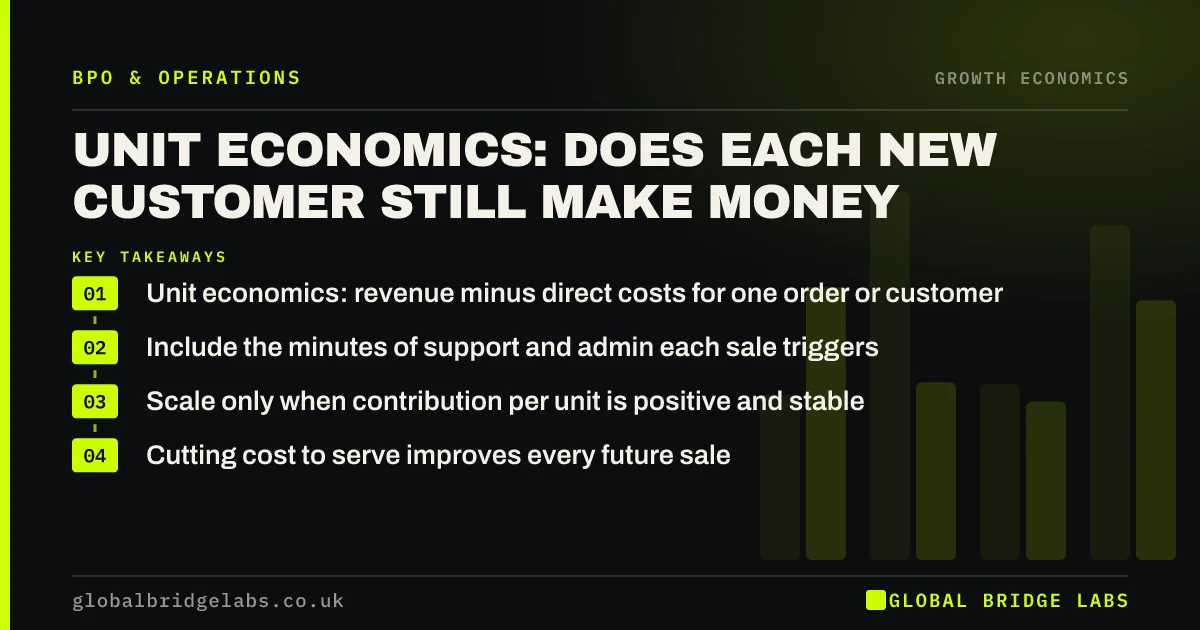
- Unit economics: revenue minus direct costs for one order or customer.
- Include the minutes of support and admin each sale triggers.
- Scale only when contribution per unit is positive and stable.
- Cutting cost to serve improves every future sale.
Not sure what an order really costs to serve? Message us on WhatsApp with your numbers.
Chat on WhatsApp →What are unit economics?
Unit economics are the revenues and costs associated with a single unit of what a business sells, such as one order, one job or one customer. The key figure is contribution: what remains from the sale after its direct, variable costs, which then goes towards fixed overheads and profit.
How do you calculate contribution per order?
Take an illustrative order of £80. Goods cost £40, delivery £6 and payment fees £2. The order also causes about 6 minutes of customer contact and 5 minutes of admin. At £19.81 per worked hour for a £30,000 employee, those 11 minutes cost about £3.63. Contribution is £28.37.
- Revenue: £80.00.
- Goods: £40.00. Delivery: £6.00. Payment fees: £2.00.
- Support and admin time: about £3.63.
- Contribution: about £28.37.
Why does cost to serve get missed?
Cost to serve gets missed because it sits inside salaries, not on an invoice. Nobody sees a line that says customer questions per order. Yet as volume grows, those minutes become the hours that trigger the next hire. Measuring them per unit shows the cost of growth before it arrives.
How do you improve unit economics?
Improve unit economics by raising price, lowering direct costs or cutting the time each sale consumes. The third is usually the most controllable. Fewer avoidable contacts, less re-keying and a lower hourly cost for routine handling all raise contribution on every future order.
- Remove causes of repeat contact.
- Automate confirmations and updates.
- Cut duplicate data entry.
- Use managed capacity for routine handling.
- How to scale customer support without hiring more agents
- The cost of manual processes, and what to fix first
Want to discuss your requirements for lowering cost to serve? Send us your order volumes on WhatsApp.
Chat on WhatsApp →What difference does the hourly cost make?
In the example, 11 minutes at an indicative £12 per hour from a managed offshore team costs £2.20 instead of £3.63, a saving of about £1.43 an order. At 2,000 orders a month that is roughly £2,860 a month. The figures are illustrative, but the method works for any volume.
When are unit economics misleading?
Unit economics mislead when averages hide differences. A few customers or product lines may consume most of the support time. Split the calculation by product, channel or customer type before acting. They also ignore fixed costs, so a positive unit does not guarantee an overall profit at low volume.
What does this look like in practice?
A pattern we see in UK online and trade suppliers: one product range generates three times the customer queries of the others, because sizing or fitting information is unclear. On paper it has the best margin. Once support minutes are counted it has the worst. Fixing the product page does more than adding staff.
Unit economics checklist
Work through this for your main product or service.
- Define the unit: order, job or customer.
- List direct costs that occur with each one.
- Count contacts and admin steps per unit.
- Time them and price at the loaded hourly cost.
- Calculate contribution per unit.
- Split by product, channel or customer type.
- Recalculate quarterly as volume grows.
Next step
Send us your average order value, direct costs and monthly volumes of orders and contacts. We will work out contribution per order with the support and admin time included.
Message us on WhatsApp for a unit economics review, or book a 30-minute consultation.
Chat on WhatsApp →Sources and further reading
- Rates and thresholds for employers 2026 to 2027 · HM Revenue & Customs
- National Minimum Wage and National Living Wage rates · GOV.UK
- The Green Book: appraisal and evaluation in central government · HM Treasury
Frequently asked questions
What does unit economics mean?
Unit economics means the revenue and direct costs attached to one unit of what you sell, such as a single order or customer. It shows how much each sale contributes towards overheads and profit, and therefore whether selling more will make the business more or less profitable.
How do you calculate unit economics for a small business?
Choose a unit, such as one order. Take its average revenue and subtract the costs that sale directly causes: goods or materials, delivery, payment fees, and the staff time spent on support and admin for that order. The result is contribution per unit.
What is cost to serve?
Cost to serve is the cost of the activities needed to fulfil and support a customer or order beyond the product itself: order processing, customer service, delivery handling, returns and invoicing. It varies widely between customers and products and is often hidden inside staff salaries.
Why do unit economics matter before scaling?
Because growth multiplies whatever each sale produces. If each unit contributes a healthy margin, more volume builds profit. If cost to serve is eating the margin, more volume increases workload and cost faster than profit. Fixing the unit first makes scaling worthwhile.
Written by

Global Bridge Labs (GBL) is a UK–Sri Lanka partner for social media, websites and BPO. Everything here comes from client delivery, not theory.