On this page
- 01Key takeaways
- 02What breaks first in a growing online shop?
- 03Which e-commerce work grows with orders?
- 04What should you automate first?
- 05What can a managed team take on?
- 06What does it cost and how does peak work?
- 07What should founders keep?
- 08What does this look like in practice?
- 09E-commerce scaling checklist
- 10Next step
- 11Sources and further reading
- 12Frequently asked questions
Key takeaways
To scale an e-commerce business without hiring, deal with the three workloads that grow with every order: customer contact, order and returns admin, and product content. Automate status updates, publish clear delivery and returns information, and move the remaining volume to a managed team. Founders then stay on product, marketing and suppliers.
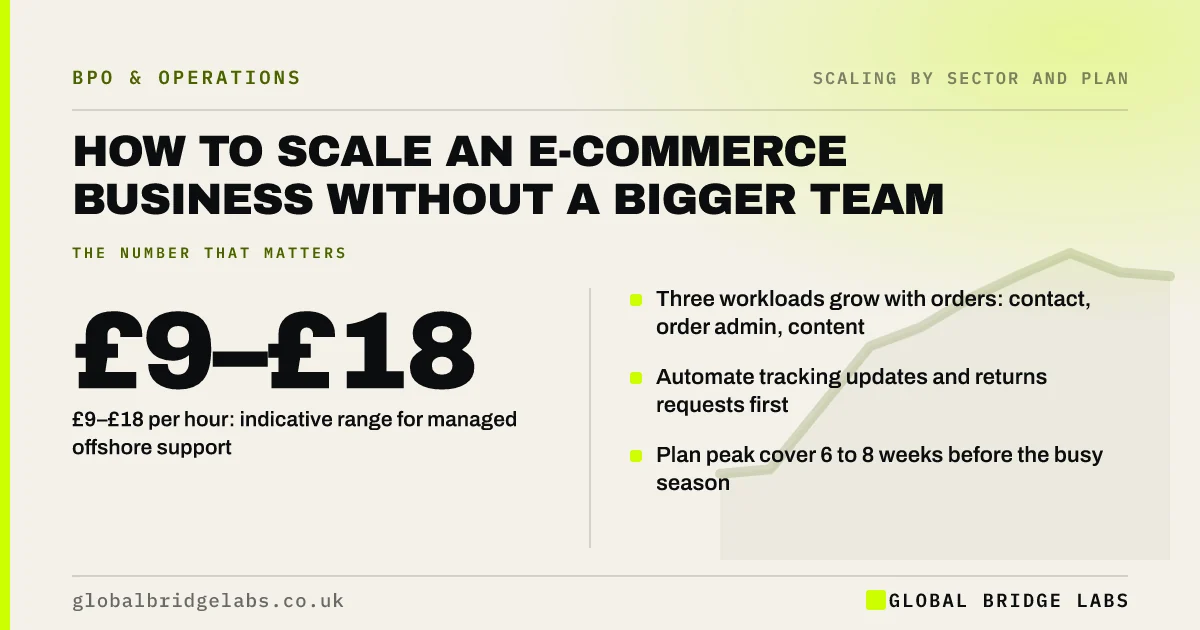
- Three workloads grow with orders: contact, order admin, content.
- Automate tracking updates and returns requests first.
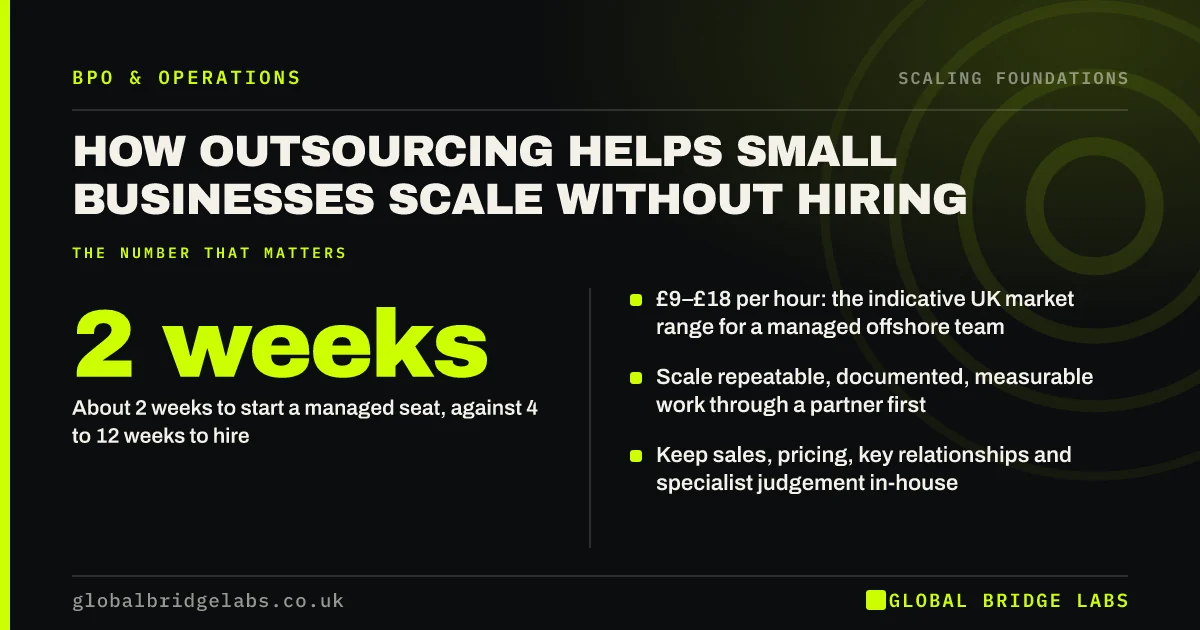
- £9–£18 per hour: indicative range for managed offshore support.
- Plan peak cover 6 to 8 weeks before the busy season.
Orders growing faster than your team? Message us on WhatsApp with monthly orders and contacts.
Chat on WhatsApp →What breaks first in a growing online shop?
The inbox breaks first. Each order produces questions about delivery, changes and returns, and a successful campaign multiplies them overnight. Founders answer in the evenings, replies slip, and reviews start to mention slow service. Order admin and product updates fall behind soon after.
Which e-commerce work grows with orders?
Three kinds of work grow almost in line with orders. Customer contact: where is my order, changes, complaints. Order administration: address fixes, stock issues, refunds and returns. Product content: listings, images and descriptions for a growing range. Each can be measured per order.
- Contacts per 100 orders.
- Admin minutes per order.
- Returns as a share of orders.
- New or updated listings per week.
What should you automate first?
Automate what customers ask most. Send dispatch and delivery updates with a tracking link. Provide a self-service returns request. State delivery times and costs plainly on product pages. UK consumers buying online normally have 14 days to cancel under the Consumer Contracts Regulations, so a clear returns process is a legal need as well as a service one.
What can a managed team take on?
A managed team can run the customer inbox, chat and social messages, process returns and refunds within your rules, correct orders, update listings and chase suppliers for stock dates. They work inside your shop platform and helpdesk with limited permissions and escalate anything outside the rules.
Want to discuss your requirements for e-commerce support? Send us your platform and volumes on WhatsApp.
Chat on WhatsApp →What does it cost and how does peak work?
As indicative market ranges, managed offshore support costs £9–£18 per hour and onshore £20–£35 per hour. Internet sales are a large share of UK retail, and volumes rise sharply before Christmas. Agree extra hours with a provider six to eight weeks ahead of peak, and step them down afterwards.
What should founders keep?
Founders should keep product selection, pricing, supplier relationships, brand and marketing direction. They should also keep reading a sample of customer messages each week: the inbox is the best source of product and website improvements, even when someone else is answering it.
What does this look like in practice?
A pattern we see in UK online brands at a few hundred orders a week: two founders split the inbox between them and neither has time for the next product launch. A managed team taking customer contact and returns, with a weekly summary of common issues, returns the founders to the work that grows the shop.
E-commerce scaling checklist
Put these in place before the next campaign.
- Measure contacts per 100 orders and their reasons.
- Automate dispatch and delivery notifications.
- Add a self-service returns form.
- Publish clear delivery and returns information.
- Write reply templates and refund rules.
- Arrange managed cover with peak hours agreed.
- Review customer themes weekly.
Next step
Send us your monthly orders, contact volumes and the platform you use. We will show what could be automated and what cover the rest would need.
Message us on WhatsApp for an e-commerce operations review, or book a 30-minute consultation.
Chat on WhatsApp →Sources and further reading
- Internet sales as a percentage of total retail sales · Office for National Statistics
- Consumer Contracts (Information, Cancellation and Additional Charges) Regulations 2013 · legislation.gov.uk
- Online and distance selling for businesses · GOV.UK
Frequently asked questions
How do you scale an e-commerce business?
Scale an e-commerce business by making sure each order needs less manual work as volume grows. Automate order updates and returns requests, give clear delivery information, and use a managed team for customer contact and order admin so founders can focus on product, marketing and suppliers.
When should an online store outsource customer service?
An online store should outsource customer service when founders are answering messages outside working hours, response times are slipping, or contact volume swings with campaigns and seasons. Having templates and returns rules written down makes the handover straightforward.
How many staff does an e-commerce business need?
It depends on order volume, product complexity and how much is automated. Many small online shops run with a core team of two to five covering product, marketing and operations, supported by outsourced customer service, fulfilment and specialist help as volume grows.
How do I prepare an online shop for peak season?
Forecast orders and contacts from last year's figures, confirm stock and delivery capacity, update delivery cut-off information, prepare reply templates, and arrange additional customer service hours six to eight weeks ahead. Test the website under load before major campaigns.
Written by

Global Bridge Labs (GBL) is a UK–Sri Lanka partner for social media, websites and BPO. Everything here comes from client delivery, not theory.