
On this page
- 01Key takeaways
- 02What is included in returns processing cost?
- 03What does one return cost in numbers?
- 04What does UK law require?
- 05How do you lower the cost of returns?
- 06Which parts can be handed over?
- 07When is a generous returns policy worth the cost?
- 08What does this look like in practice?
- 09Returns cost checklist
- 10Next step
- 11Sources and further reading
- 12Frequently asked questions
Key takeaways
Returns processing cost is everything a retailer spends to take an item back: customer contact, admin, inspection, refund, restocking and any postage it funds. The admin and contact part is the most controllable. In our example, 500 returns a month use 100 hours of handling. Clear policies and a standard process reduce both the number and the cost.
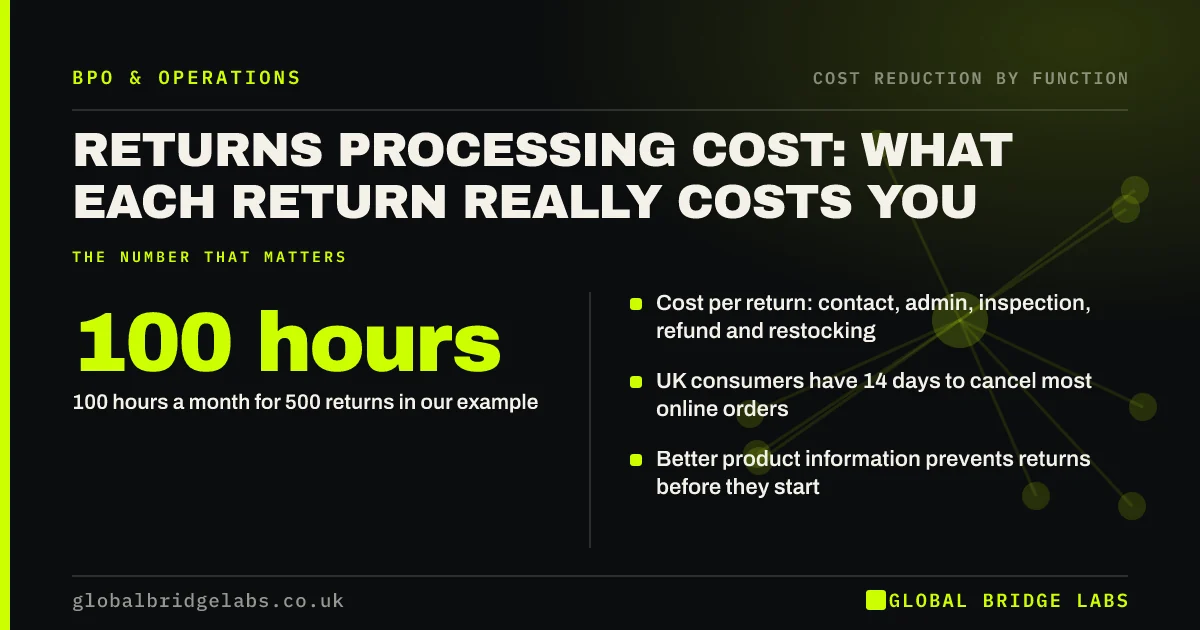
- Cost per return: contact, admin, inspection, refund and restocking.
- 100 hours a month for 500 returns in our example.
- UK consumers have 14 days to cancel most online orders.
- Better product information prevents returns before they start.
Want your cost per return worked out? Message us on WhatsApp with your monthly returns volume.
Chat on WhatsApp →What is included in returns processing cost?
Returns processing cost is the total cost of handling a returned order from the customer's first message to the item being back on sale or written off. It includes staff time at each step and any direct costs the business pays.
- Customer contact: the request and any follow-up.
- Authorisation and labels.
- Receiving and inspection.
- Refund or exchange.
- Restocking, repackaging or disposal.
- Return postage, if you pay it.
What does one return cost in numbers?
In an illustrative online shop, each return needs about 12 minutes of handling: 4 on customer contact, 3 on receiving and inspection, 3 on the refund and records, and 2 on restocking. At a loaded £19.81 per worked hour that is about £3.96 of labour per return, before postage.
At 500 returns a month, that is 100 hours and about £1,980. Run by a managed team at an indicative £12 an hour, the contact and admin part, 7 of the 12 minutes, would cost about £700 a month instead of £1,155.
- Handling time per return: 12 minutes.
- Labour cost per return: about £3.96.
- 500 returns a month: 100 hours, about £1,980.
- Work out your cost per task before you outsource
- Unit economics: does each new customer still make money?
Want this broken down for your own returns? Send us the steps on WhatsApp.
Chat on WhatsApp →What does UK law require?
Under the Consumer Contracts Regulations, consumers buying online can usually cancel within 14 days of receiving goods, and then have a further 14 days to send them back. You must refund within 14 days of getting the goods back, or of the customer providing evidence of return. Some items, such as bespoke or perishable goods, are exempt.
Slow refunds are a common cause of repeat contact and complaints, so the deadline is a cost issue as well as a legal one.
How do you lower the cost of returns?
Lower the cost by preventing returns, then by making the remaining ones routine. Prevention starts on the product page: accurate sizes, real photographs and honest descriptions. Routine means one process, one form and one set of rules.
- Tag every return with a reason and fix the top causes.
- Use a self-service returns form with required fields.
- Send automatic status updates at each stage.
- Set clear rules for refund, exchange and inspection.
- Batch inspection and restocking at fixed times.
Which parts can be handed over?
The contact and administration can be handed over: answering return requests, issuing authorisations, updating order records and processing refunds within agreed limits. Physical inspection and restocking stay wherever the stock is. Splitting the process this way works as long as both sides update the same system.
When is a generous returns policy worth the cost?
A generous policy is worth its cost when it increases sales by more than the returns it creates, which is plausible for clothing and other products people need to try. It is not worth it if nobody has checked. Measure return rate and reason by product, and tighten or loosen with evidence.
What does this look like in practice?
A pattern we see in growing online shops: returns are handled by whoever is free, through email, with no reason recorded. One product accounts for a large share of them because its sizing chart is wrong. Nobody has noticed, because nobody counts. A reason code on every return finds it in a fortnight.
Returns cost checklist
Review these each quarter.
- Time each step of a return.
- Calculate labour cost per return.
- Record a reason for every return.
- Rank products by return rate.
- Check refunds meet the 14-day deadline.
- Automate status updates.
- Decide which steps a managed team could run.
Next step
Send us your monthly returns volume and how the process runs today. We will work out the cost per return with you and show where it can come down.
Message us on WhatsApp to review your returns process, or book a 30-minute consultation.
Chat on WhatsApp →Sources and further reading
- Consumer Contracts (Information, Cancellation and Additional Charges) Regulations 2013 · legislation.gov.uk
- Online and distance selling for businesses · GOV.UK
- Internet sales as a percentage of total retail sales · Office for National Statistics
Frequently asked questions
How much does it cost to process a return?
It depends on handling time, wages and whether you pay return postage. Time each step for a sample of returns and multiply by your loaded hourly cost. In our illustrative example, 12 minutes of handling costs about £3.96 in labour before postage and any loss in the item's value.
How long does a UK retailer have to refund a return?
For most online consumer sales, the retailer must refund within 14 days of receiving the goods back or of the customer providing evidence they were sent. This comes from the Consumer Contracts Regulations. Some goods, such as personalised items, are exempt from the right to cancel.
How can an online shop reduce returns?
Record why each item is returned and fix the commonest causes. These are often inaccurate sizing, photographs that mislead, vague descriptions and damage in transit. Improving product information usually reduces returns more than making the policy stricter.
Can returns handling be outsourced?
The customer contact and administration can: answering requests, authorising returns, updating records and processing refunds within set limits. Inspection and restocking need to happen where the stock is held. Both sides should work in the same order system.
Written by

Global Bridge Labs (GBL) is a UK–Sri Lanka partner for social media, websites and BPO. Everything here comes from client delivery, not theory.


