On this page
- 01Key takeaways
- 02What is order processing outsourcing?
- 03Why do manufacturers and brands outsource order admin?
- 04What can an order processing team handle?
- 05How do you keep order accuracy high?
- 06What does order processing outsourcing cost?
- 07Should you automate order entry instead?
- 08Which exceptions should be escalated?
- 09What does this look like in practice?
- 10Checklist: outsource order processing
- 11Next step
- 12Sources and further reading
- 13Frequently asked questions
Key takeaways
Order processing outsourcing hands order entry, confirmations, stock and dispatch updates, returns admin and exception chasing to a managed team working inside your order, ERP or e-commerce systems. It suits manufacturers and product brands whose sales and operations people spend their days keying orders from emails and PDFs.
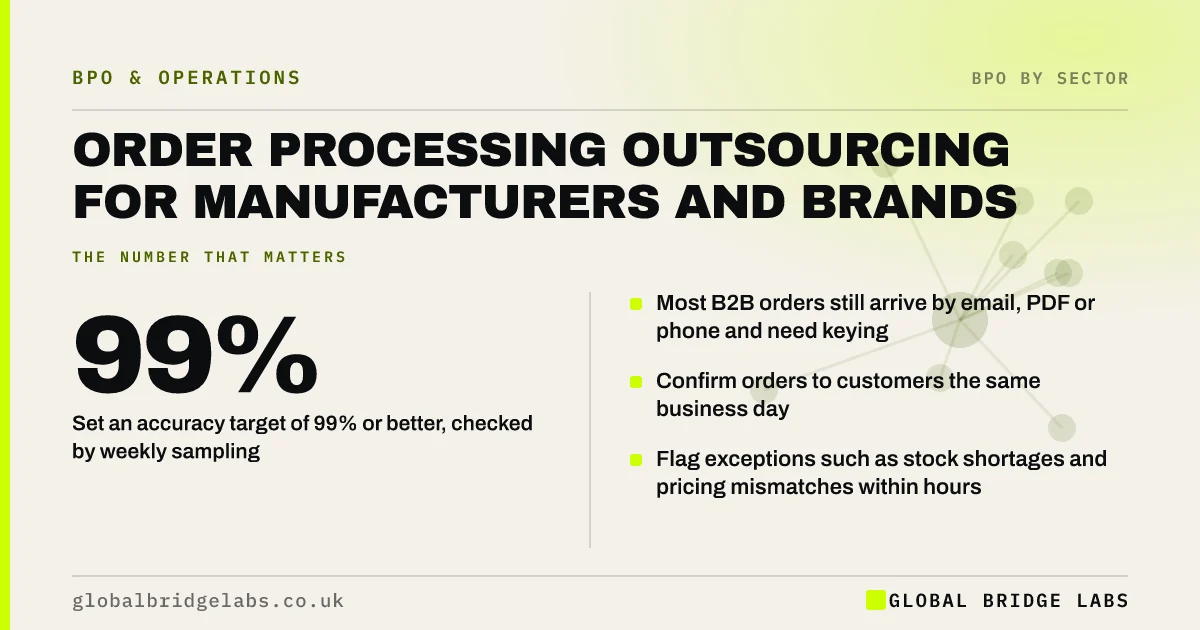
- Most B2B orders still arrive by email, PDF or phone and need keying.
- Set an accuracy target of 99% or better, checked by weekly sampling.
- Confirm orders to customers the same business day.
- Flag exceptions such as stock shortages and pricing mismatches within hours.
- Managed offshore order admin typically costs £9–£18 per hour.
Sales team keying orders all day? Message us on WhatsApp with your daily order volume.
Chat on WhatsApp →What is order processing outsourcing?
Order processing outsourcing is a back-office business process outsourcing (BPO) service in which a provider's team manages the steps between receiving an order and it being fulfilled: entering it, checking it against prices and stock, confirming it to the customer, updating status and handling exceptions.
It covers both B2B orders arriving by email, PDF, portal or phone, and D2C orders that need manual handling, such as custom or made-to-order products.
Why do manufacturers and brands outsource order admin?
Because order admin grows with sales and quietly consumes the people who should be selling or running production. Orders keyed from emails, spreadsheets that do not match the ERP, customers chasing confirmations and exceptions noticed only at dispatch are all signs the process has outgrown the team.
Errors are expensive: a wrong quantity or address means rework, extra shipping and an unhappy customer.
What can an order processing team handle?
The team works to written rules inside your systems, handling the routine and flagging the rest.
- Entering orders from emails, PDFs, portals and calls.
- Checking prices, product codes and stock availability.
- Sending order confirmations and delivery dates.
- Updating dispatch status and tracking for customers.
- Processing returns, credits and replacements within limits.
- Flagging exceptions: stock shortages, price mismatches, credit holds.
How do you keep order accuracy high?
Accuracy comes from rules, validation and checking. Write field-by-field rules for each order type, use validation in your systems for product codes and prices, and sample a share of orders each week against the source documents. Aim for 99% or better, and treat any repeated error as a procedure fix.
For high-value or custom orders, add a second-person check before the order goes to production.
What does order processing outsourcing cost?
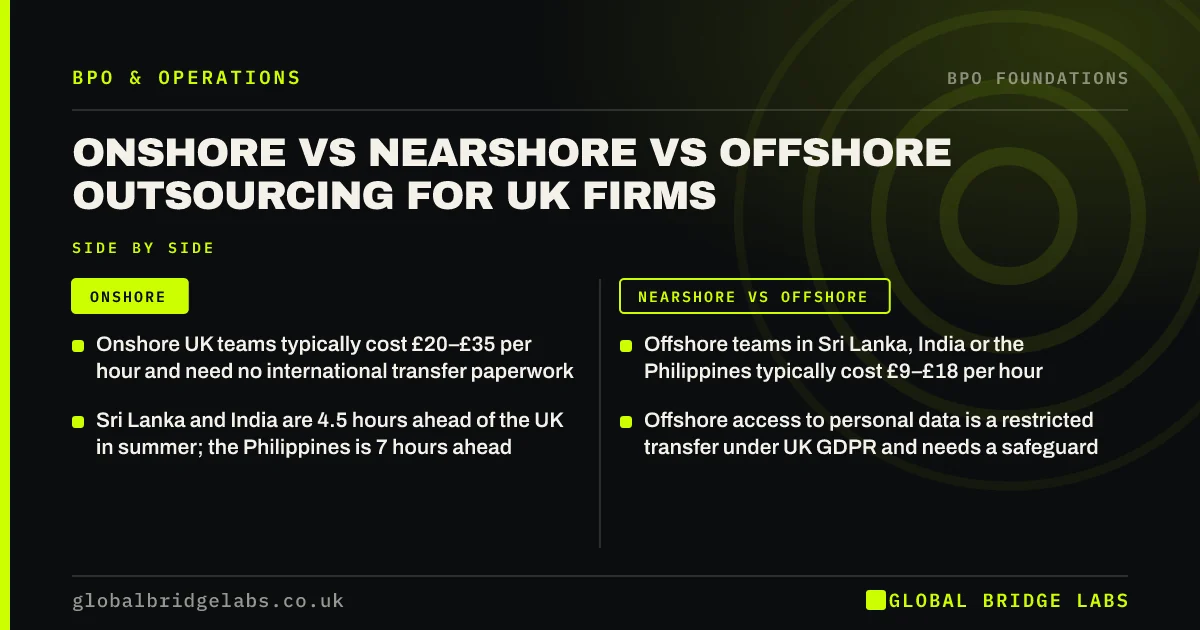
As indicative market ranges, managed offshore order admin costs around £9–£18 per hour and onshore UK providers around £20–£35. Per-order pricing is common once volumes are stable, which ties cost directly to sales.
An in-house order administrator on £26,000 costs about £29,743 a year once employer National Insurance and pension are added, or about £17.09 per worked hour after holiday. When salespeople key orders themselves, the real cost is the selling time lost.
Want a costed plan for your order admin? Send us your daily order volume and order types on WhatsApp and we will discuss your requirements.
Chat on WhatsApp →Should you automate order entry instead?
Automate where orders arrive in structured, consistent formats, such as EDI, portal feeds or e-commerce integrations. Use people where orders arrive as varied emails and PDFs, where customers change their minds, or where exceptions need judgement. Many businesses combine both: document extraction tools read the order, and a person checks and completes it.
Which exceptions should be escalated?
Most orders go through without a problem. The ones that do not need to reach the right person quickly, with the details already gathered. Write an escalation list so the team knows exactly what to flag and to whom.
- Stock shortages that affect the promised delivery date.
- Prices that do not match the agreed price list or contract.
- Customers on credit hold or over their credit limit.
- Custom specifications that need production sign-off.
- Orders above a value threshold that need a second check.
What does this look like in practice?
The custom packaging manufacturer on our projects page describes the problem: growth was stretching spreadsheets. The outcome it describes is order, production and fulfilment connected, so it can expand product lines and regions without losing control. A managed order processing routine is what keeps that connection working day to day.
Checklist: outsource order processing
Prepare these before go-live.
- Count orders by channel and type per day.
- Write field-by-field entry rules for each order type.
- Add validation for product codes, prices and addresses.
- Define exceptions and who resolves them.
- Give system access with limited permissions.
- Set accuracy and confirmation time targets.
- Sample orders weekly and fix recurring errors.
Next step
Tell us how orders reach you and how many you handle, and we will design the order processing routine and cost it. 30 minutes, no pitch.
Message us on WhatsApp for an order processing plan, or book a 30-minute consultation.
Chat on WhatsApp →Sources and further reading
- Contracts and liabilities between controllers and processors · Information Commissioner's Office
- International transfers of personal data · Information Commissioner's Office
- Rates and thresholds for employers 2026 to 2027 · HM Revenue & Customs
Frequently asked questions
What is included in order processing?
Order processing covers receiving and entering orders, checking prices, codes and stock, confirming orders and delivery dates to customers, updating dispatch and tracking status, handling returns and credits, and flagging exceptions such as shortages or pricing mismatches for resolution.
Can order processing be outsourced offshore?
Yes. Order entry and admin are well suited to offshore teams working inside your ERP, order or e-commerce systems. Use individual logins with limited permissions, a processor contract and, because customer data is involved, a UK GDPR transfer safeguard with a transfer risk assessment.
How accurate is outsourced order entry?
With clear rules, system validation and weekly sampling, 99% or better at field level is a realistic target once the team is trained. Add a second-person check for high-value or custom orders, and treat any repeated error as a procedure or training fix.
Should I automate order entry or outsource it?
Automate structured, consistent orders such as EDI or e-commerce feeds. Outsource varied orders arriving by email, PDF or phone, and exception handling. Many businesses combine the two, with extraction tools reading orders and a trained team checking and completing them.
Written by

Global Bridge Labs (GBL) is a UK–Sri Lanka partner for social media, websites and BPO. Everything here comes from client delivery, not theory.