On this page
- 01Key takeaways
- 02What is three-way matching?
- 03What does it prevent?
- 04How does the process work?
- 05What is the difference from two-way matching?
- 06What does it cost, and is it worth it?
- 07Can matching be outsourced?
- 08What does this look like in practice?
- 09Three-way matching checklist
- 10Next step
- 11Sources and further reading
- 12Frequently asked questions
Key takeaways
Three way matching is an accounts payable control that compares a supplier's invoice with the purchase order and the record of what was received before payment is released. It stops overpayments, duplicate invoices and payment for goods that never arrived. Small businesses can run a light version with thresholds, so only larger invoices get the full check.
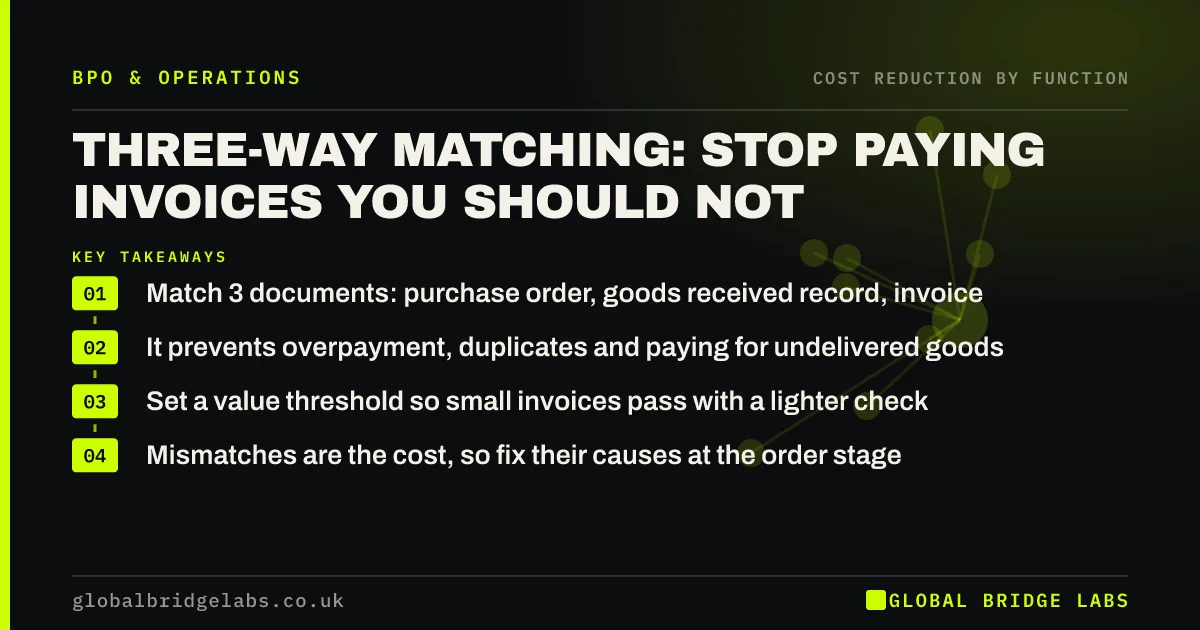
- Match 3 documents: purchase order, goods received record, invoice.
- It prevents overpayment, duplicates and paying for undelivered goods.
- Set a value threshold so small invoices pass with a lighter check.
- Mismatches are the cost, so fix their causes at the order stage.
Want a simple matching process designed for your volumes? Message us on WhatsApp with your monthly invoice count.
Chat on WhatsApp →What is three-way matching?
Three-way matching is the process of checking that three documents agree before a supplier is paid: the purchase order, which shows what was ordered and at what price; the goods received note or delivery record, which shows what arrived; and the supplier's invoice, which shows what is being charged.
What does it prevent?
It prevents money leaving the business that should not. Without matching, payment relies on someone recognising the invoice and assuming it is right. That works until it does not.
- Paying for more than was delivered.
- Paying a higher price than was agreed.
- Paying the same invoice twice.
- Paying for an order nobody placed.
- Paying a fraudulent invoice made to look familiar.
How does the process work?
The process works by having each document created at its own moment by the right person. The match is then a comparison, not an investigation.
- 1. Raise a purchase order with quantity and price.
- 2. Record what was received when it arrives.
- 3. Receive the invoice quoting the order number.
- 4. Compare quantity and price across all three.
- 5. Pay if they agree within tolerance.
- 6. Query the supplier if they do not.
What is the difference from two-way matching?
Two-way matching compares only the invoice and the purchase order. It confirms the price and quantity ordered but not what arrived. It is adequate for services and subscriptions where there is nothing to receive. Three-way matching adds the delivery record and suits physical goods.
What does it cost, and is it worth it?
The cost is the time to raise orders, record receipts and compare. In an illustrative firm with 250 supplier invoices a month, a clean match takes about 4 minutes and a mismatch about 25. With one invoice in ten mismatching, clean matches use 15 hours and mismatches use about 10.
Whether it is worth it depends on what it catches. A single duplicated £3,000 invoice pays for months of matching. The sensible design is a threshold: full three-way matching above an agreed value, a lighter check below.
- Work out your cost per task before you outsource
- False economy in business: when the cheap option costs more
Want help setting a matching threshold? Send us your invoice volumes on WhatsApp.
Chat on WhatsApp →Can matching be outsourced?
Matching is well suited to a managed team because it is rule-based, frequent and easy to check. The team matches and prepares, and your own staff approve and release payment. Keeping payment authority in-house preserves the separation of duties that makes the control work.
Company records, including purchase invoices, must generally be kept for six years, so agree where matched documents are stored.
What does this look like in practice?
A pattern we see in growing firms: invoices are approved by whoever recognises the supplier, and nobody raises purchase orders because it feels like bureaucracy. The first duplicate payment is found by accident, months later. Introducing order numbers for anything above a set value is usually enough to close the gap.
Three-way matching checklist
Set up the control with these steps.
- Require a purchase order above an agreed value.
- Ask suppliers to quote the order number on invoices.
- Record receipts on the day of delivery.
- Set a tolerance for small differences.
- Separate matching from payment approval.
- Log every mismatch with a reason.
- Review the reasons monthly.
Next step
Tell us how many supplier invoices you process and how they are approved today. We will suggest a matching process and threshold that fit your size.
Message us on WhatsApp to tighten your invoice process, or book a 30-minute consultation.
Chat on WhatsApp →Sources and further reading
Frequently asked questions
What is 3 way matching in accounts payable?
Three-way matching compares a supplier invoice with the purchase order and the goods received record before payment. If quantity and price agree across all three, the invoice is approved. If not, it is held and queried. It is a standard control against overpayment and fraud.
Do small businesses need three-way matching?
Small businesses buying physical goods benefit from it, at least for larger invoices. A full check on every small purchase is rarely worth the effort. Setting a value threshold gives most of the protection for a fraction of the work.
What causes invoices to fail a match?
Common causes are part deliveries, price changes not reflected on the order, missing order numbers, delivery charges not on the order and receipts recorded late. Most can be prevented by clearer ordering and by asking suppliers to quote the order number.
Can three-way matching be automated?
Yes. Many accounting and purchasing systems match automatically and flag only the exceptions. Automation works well when orders and receipts are recorded consistently. Where they are not, the system will flag most invoices and the saving is lost.
Written by

Global Bridge Labs (GBL) is a UK–Sri Lanka partner for social media, websites and BPO. Everything here comes from client delivery, not theory.