On this page
- 01Key takeaways
- 02Why are outsourcing quotes hard to compare?
- 03What should your scope document include?
- 04How do you normalise the prices?
- 05Which inclusions should you check?
- 06Which contract terms change the real cost?
- 07How do you weigh price against quality?
- 08What questions reveal the real price?
- 09What does this look like in practice?
- 10Quote comparison checklist
- 11Next step
- 12Sources and further reading
- 13Frequently asked questions
Key takeaways
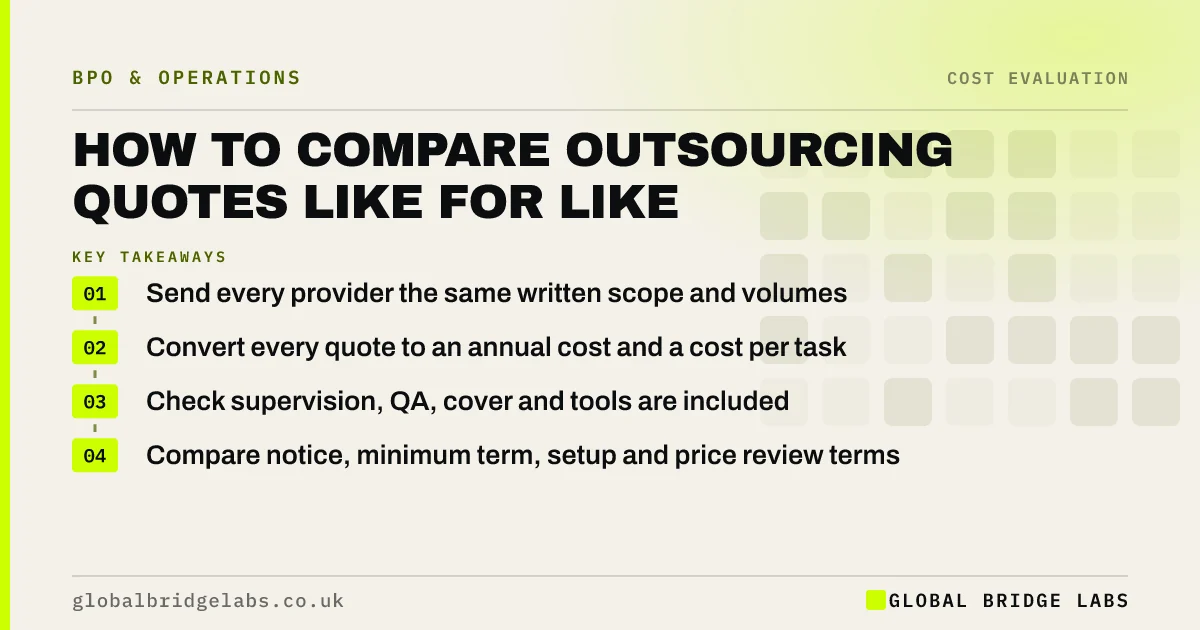
To compare outsourcing quotes, give every provider the same written scope, then normalise the answers: hours per month, what is included, cost per task and contract terms. Quotes that look 20% cheaper often exclude supervision, cover or setup. Compare the annual total for the same work under the same terms.
- Send every provider the same written scope and volumes.
- Convert every quote to an annual cost and a cost per task.
- Check supervision, QA, cover and tools are included.
- Compare notice, minimum term, setup and price review terms.
Got quotes to compare? Send them to us on WhatsApp for a like-for-like check.
Chat on WhatsApp →Why are outsourcing quotes hard to compare?
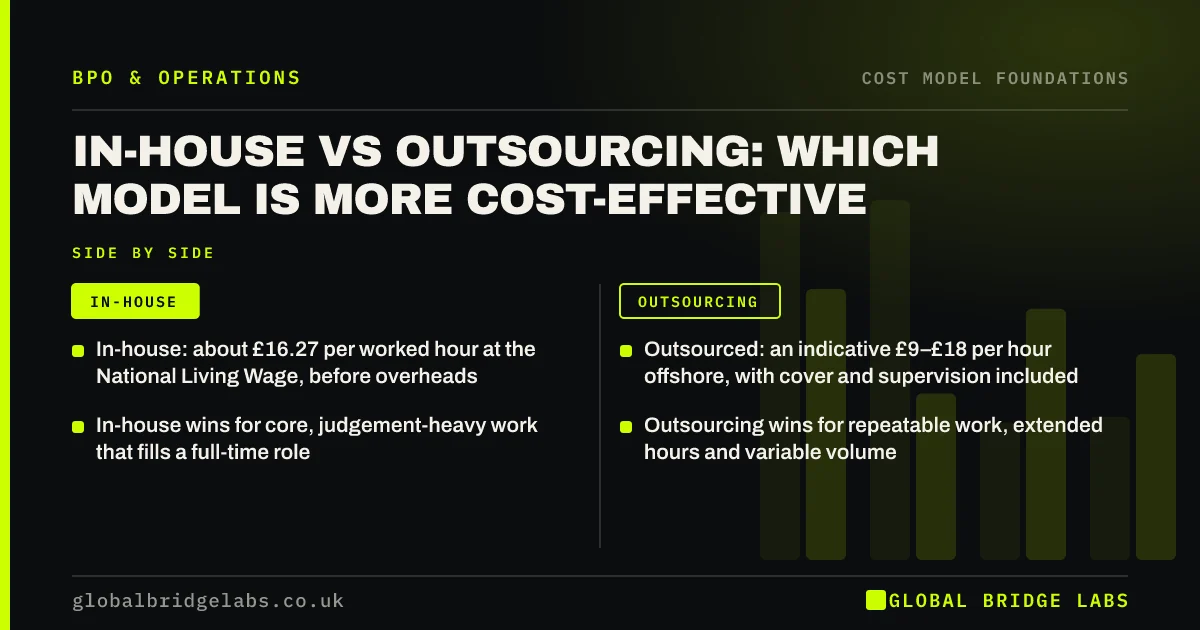
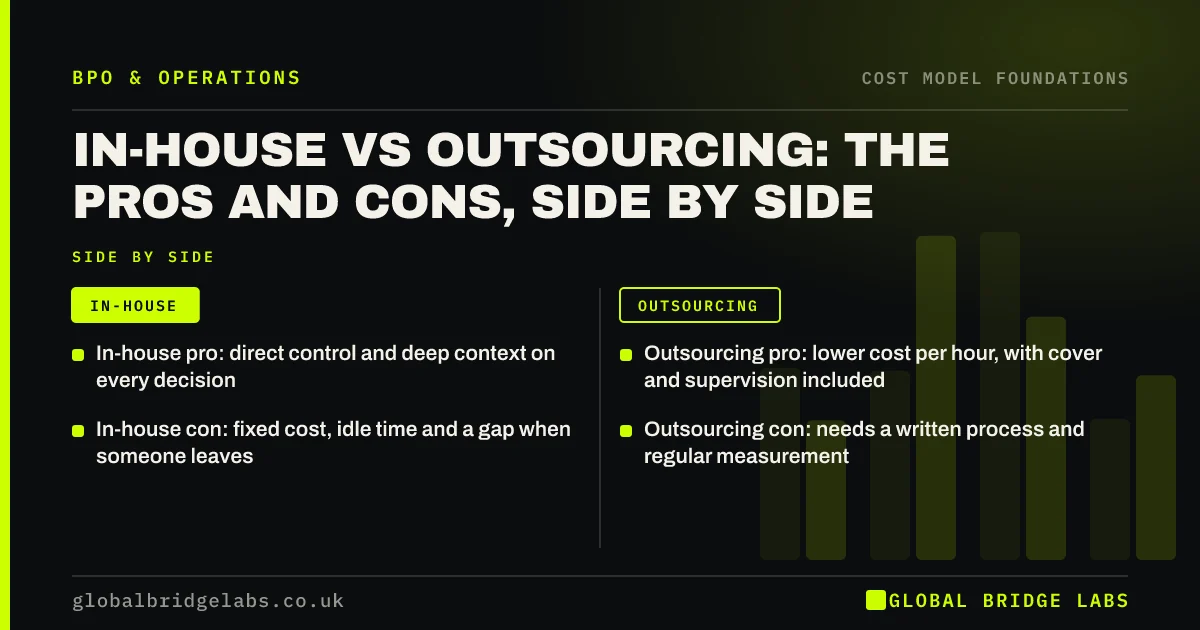
Providers price in different units, such as per hour, per seat, per task or per month, and include different things. One quote includes a team lead, quality checks and holiday cover; another charges them as extras. Without normalising, the lowest headline number often turns out not to be the lowest cost.
What should your scope document include?
Send the same short scope to every provider.
- Tasks, with examples and monthly volumes.
- Hours of cover and service levels.
- Systems the team will use.
- Quality standards and reporting you expect.
- Data protection requirements.
- Start date and expected growth.
How do you normalise the prices?
Convert each quote to an annual cost for your volumes. Check how many hours a monthly seat really covers: 160 hours a month and 173 hours a month are both called full time. Then divide by expected tasks to get cost per task, using each provider's stated productivity.
Want your quotes normalised for you? Send them over on WhatsApp.
Chat on WhatsApp →Which inclusions should you check?
A managed rate should include recruitment, training, supervision, quality checks, holiday and sickness cover, equipment and reporting. Ask each provider to confirm in writing which of these are included, and price any that are not.
Which contract terms change the real cost?
Minimum term, notice period, setup fees, annual price review mechanisms, the invoicing currency and exit charges all change what you will pay. A lower rate with a 12-month minimum term can cost more than a slightly higher rate on 30 days' notice if volume falls.
How do you weigh price against quality?
Score each provider on price, quality evidence, references, security and fit, and weight price at no more than half. Ask for a paid pilot with the top two. The GOV.UK Sourcing Playbook uses the same principle: judge on whole-life value, not the lowest bid.
What questions reveal the real price?
Ask every provider the same questions in writing. Their answers show what the headline rate leaves out.
- How many hours does a monthly seat cover?
- Are a team lead, QA and cover included?
- What productivity do you expect for this work?
- What is charged outside the rate?
- How are annual price reviews calculated?
What does this look like in practice?
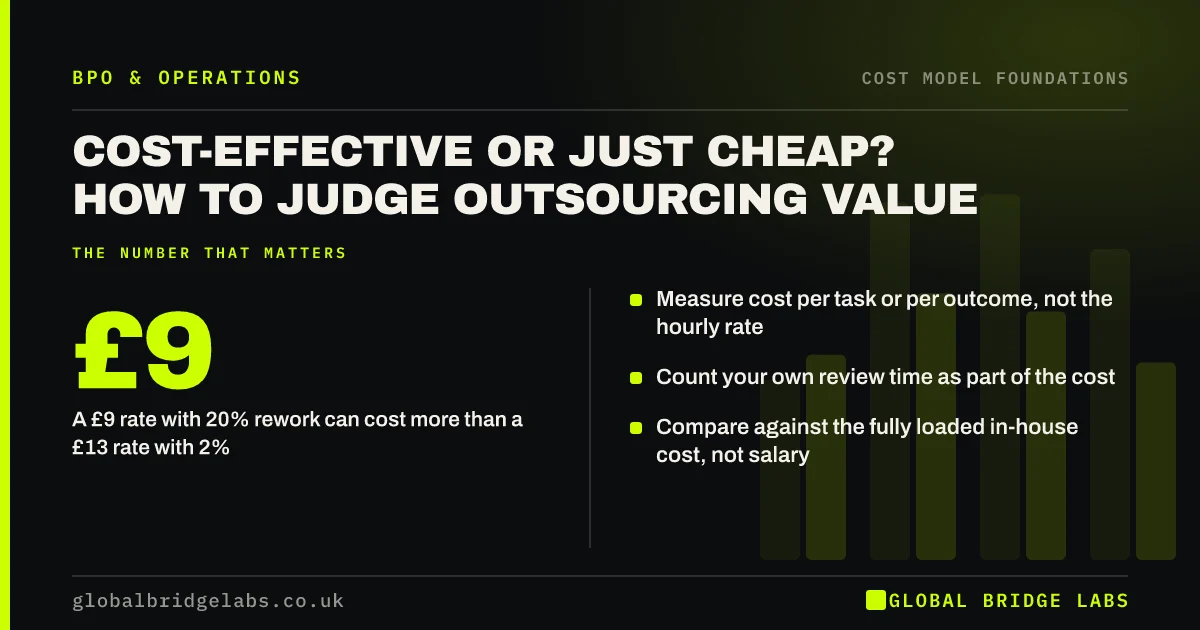
A pattern we see in UK SMEs: three quotes range from £9 to £14 per hour. Normalised, the £9 quote excludes a team lead, QA and cover, and requires a 12-month term. Once those are added, the gap to the £14 quote shrinks to a few pounds a day.
Quote comparison checklist
Use these steps.
- Send one written scope to every provider.
- Convert quotes to annual cost for your volumes.
- Confirm hours per seat and productivity.
- List inclusions and price the gaps.
- Compare terms, currency and exit charges.
- Pilot the top two before signing.
Next step
Send us the quotes you have. We will normalise them and point out the differences in a 30-minute call, including where our own quote would sit.
Message us on WhatsApp for a quote comparison, or book a 30-minute consultation.
Chat on WhatsApp →Sources and further reading
- The Sourcing and Consultancy Playbooks · Cabinet Office
- Contracts and liabilities between controllers and processors · Information Commissioner's Office
Frequently asked questions
How do you compare outsourcing providers on price?
Give each provider the same written scope, convert every quote to an annual cost for your volumes, check what is included, and calculate cost per task using each provider's stated productivity. Then compare contract terms such as minimum term, notice, setup fees and price reviews.
Why is the cheapest outsourcing quote not always cheapest?
Because it may exclude supervision, quality checks, holiday cover or tools, assume fewer hours per seat, or come with a long minimum term and high exit charges. Once quotes are normalised to the same scope and terms, the gap to higher quotes often shrinks or reverses.
Should price be the main factor in choosing a provider?
No. Weight price at no more than half, alongside quality evidence, references, security and fit with your business. Then run a short paid pilot with the top one or two candidates before committing, so the decision rests on real results rather than proposals.
How many outsourcing quotes should I get?
Two or three is usually enough for an SME, as long as each provider receives the same written scope and questions. More quotes rarely add insight and take time to normalise. Spend the saved time on references and a short pilot instead.
Written by

Global Bridge Labs (GBL) is a UK–Sri Lanka partner for social media, websites and BPO. Everything here comes from client delivery, not theory.