On this page
- 01Key takeaways
- 02What is lock-in in outsourcing?
- 03How do small businesses get locked in?
- 04Which contract terms reduce the risk?
- 05Which practical habits reduce it?
- 06How do you test your exit?
- 07When is commitment worth it?
- 08What does this look like in practice?
- 09Lock-in prevention checklist
- 10Next step
- 11Sources and further reading
- 12Frequently asked questions
Key takeaways
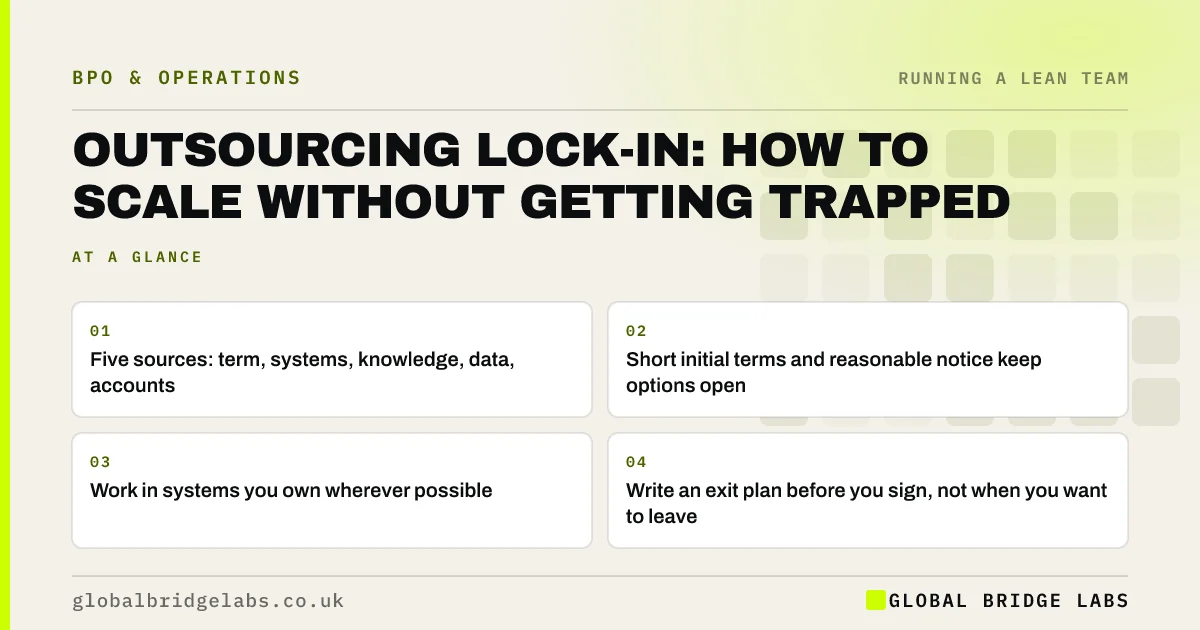
Vendor lock-in in outsourcing is being unable to change or leave a provider without serious cost or disruption. It comes from five sources: long contracts, the provider's own systems, undocumented processes, data you cannot easily extract and accounts in the provider's name. Each has a simple safeguard if it is agreed at the start.
- Five sources: term, systems, knowledge, data, accounts.
- Short initial terms and reasonable notice keep options open.
- Work in systems you own wherever possible.
- Write an exit plan before you sign, not when you want to leave.
Signing a contract and want the exit terms checked? Message us on WhatsApp.
Chat on WhatsApp →What is lock-in in outsourcing?
Lock-in is a situation in which a customer depends on a supplier so heavily that switching is impractical. In outsourcing it rarely comes from one clause. It builds over time as the provider accumulates knowledge, data and control that the client has not kept for itself.
How do small businesses get locked in?
Small businesses get locked in through convenience. The provider offers to set up the tools, write the process and manage the accounts. Each offer saves time now. Together they leave the client without the means to move the work. Long minimum terms and auto-renewals complete the picture.
- Term: multi-year minimums and automatic renewal.
- Systems: work held in the provider's own platform.
- Knowledge: no current guide in your hands.
- Data: no agreed format or timescale for return.
- Accounts: phone numbers, domains or logins in their name.
Which contract terms reduce the risk?
Four contract terms do most of the work. A short initial term, typically three to six months, before any longer commitment. A notice period of about one to three months. A duty to return data in a usable format. And exit assistance for a defined period at an agreed rate.
Want to discuss your requirements for terms that stay flexible? Send us the draft on WhatsApp.
Chat on WhatsApp →Which practical habits reduce it?
Practical habits matter as much as terms. Use your own helpdesk, CRM and phone system, with the provider as a user. Register numbers, domains and software in your business name. Keep the process guide in your drive. Have one person inside who could brief a replacement team.
- Your systems, their logins.
- Your accounts, your administrator rights.
- Your guide, kept current.
- Your process owner, involved weekly.
How do you test your exit?
Test your exit on paper once a year. List what would have to move: people, knowledge, data, access and telephone numbers. Estimate how long each would take and who would do it. If any item has no answer, fix it now. A rehearsed exit is rarely needed, which is the point.
When is commitment worth it?
Commitment is worth it when it buys something: a lower rate, a dedicated team or investment in training. A 12-month term after a successful pilot is reasonable. The aim is not to avoid commitment but to make sure it is a choice, with a workable way out if circumstances change.
What does this look like in practice?
A pattern we see when UK firms come to change provider: the customer service number, the helpdesk and the knowledge base all belong to the outgoing supplier. Moving means a new number and starting the documentation again. Firms that kept those three things in their own name make the same change in a few weeks.
Lock-in prevention checklist
Confirm these before signing.
- Initial term of six months or less.
- Notice period stated for both sides.
- No automatic renewal without a reminder.
- Work carried out in systems you own.
- Accounts and numbers in your business name.
- Data return format and timescale agreed.
- Exit assistance described and priced.
Next step
Send us the terms you have been offered or the arrangement you have now. We will point out where dependence is building and how to reduce it.
Message us on WhatsApp for a lock-in review, or book a 30-minute consultation.
Chat on WhatsApp →Sources and further reading
- The Sourcing and Consultancy Playbooks · Cabinet Office
- Contracts and liabilities between controllers and processors · Information Commissioner's Office
- Business transfers, takeovers and TUPE · GOV.UK
Frequently asked questions
What is vendor lock-in?
Vendor lock-in is when a customer cannot easily switch supplier because of contractual, technical or practical barriers. In outsourcing, the usual causes are long contract terms, work held in the supplier's systems, missing documentation, data that is hard to extract and accounts registered to the supplier.
How can a small business avoid being locked into an outsourcing provider?
Start with a short initial term and clear notice, work in systems you own, keep accounts and numbers in your business name, hold the process documentation yourself, and agree in the contract how data will be returned and what help the provider gives at exit.
Is it risky to rely on one outsourcing provider?
It carries some concentration risk, but for most small businesses one well-managed provider is simpler and safer than several. The risk is controlled through documentation, owning your systems, short notice terms and a continuity plan, not by splitting small volumes across suppliers.
What is an exit plan in outsourcing?
An exit plan sets out how services would be moved to another provider or back in-house. It lists what must be transferred, including knowledge, data, access and assets, who does what, the timescale and the support the outgoing provider must give. It is best agreed before the contract starts.
Written by

Global Bridge Labs (GBL) is a UK–Sri Lanka partner for social media, websites and BPO. Everything here comes from client delivery, not theory.