
On this page
- 01Key takeaways
- 02What is currency risk in outsourcing?
- 03How does the invoicing currency decide who carries the risk?
- 04How large can currency moves be?
- 05Which contract terms manage currency risk?
- 06Does currency risk change the outsourcing decision?
- 07Can a weaker local currency lower your price?
- 08How do you test currency risk in your numbers?
- 09What does this look like in practice?
- 10Currency risk checklist
- 11Next step
- 12Sources and further reading
- 13Frequently asked questions
Key takeaways
Currency risk in outsourcing is decided mainly by the invoicing currency. If the provider invoices in pounds sterling, it carries the exchange rate risk and may reprice at renewal. If it invoices in US dollars or local currency, you carry it month by month. Agree the currency, a fixed-price period and a capped review before signing.
- Invoiced in GBP: the provider carries currency risk day to day.
- Invoiced in USD or local currency: you carry it.
- Fix the price for 12 months where you can.
- Cap annual reviews so currency moves cannot surprise you.
Want your contract's currency terms checked? Message us on WhatsApp.
Chat on WhatsApp →What is currency risk in outsourcing?
Currency risk is the chance that exchange rate movements change what you pay, or what the provider earns, under an offshore contract. Offshore providers pay staff in local currency, while UK clients usually budget in pounds. Whoever holds the gap between the two currencies carries the risk.
How does the invoicing currency decide who carries the risk?
If you are invoiced in pounds sterling at a fixed rate, your cost is stable and the provider absorbs currency moves, at least until the next price review. If you are invoiced in US dollars or the provider's local currency, your sterling cost moves with the exchange rate every month.
- GBP invoice: stable cost for you; risk with the provider.
- USD invoice: you carry GBP/USD movements.
- Local currency invoice: you carry GBP/local movements.
How large can currency moves be?
Large. During Sri Lanka's 2022 economic crisis, the rupee fell sharply against sterling and the dollar within months, and the Central Bank of Sri Lanka publishes current and historical rates. Sterling itself has moved sharply against the dollar at times. A contract that assumes stable rates for years is optimistic.
Want to understand how currency terms affect your quote? Ask us on WhatsApp.
Chat on WhatsApp →Which contract terms manage currency risk?
Agree these before signing.
- Invoice currency, ideally pounds sterling.
- A fixed-price period, such as 12 months.
- An annual review with a cap on increases.
- What happens if rates move beyond a set band.
- Notice to leave if a review is not acceptable.
Does currency risk change the outsourcing decision?
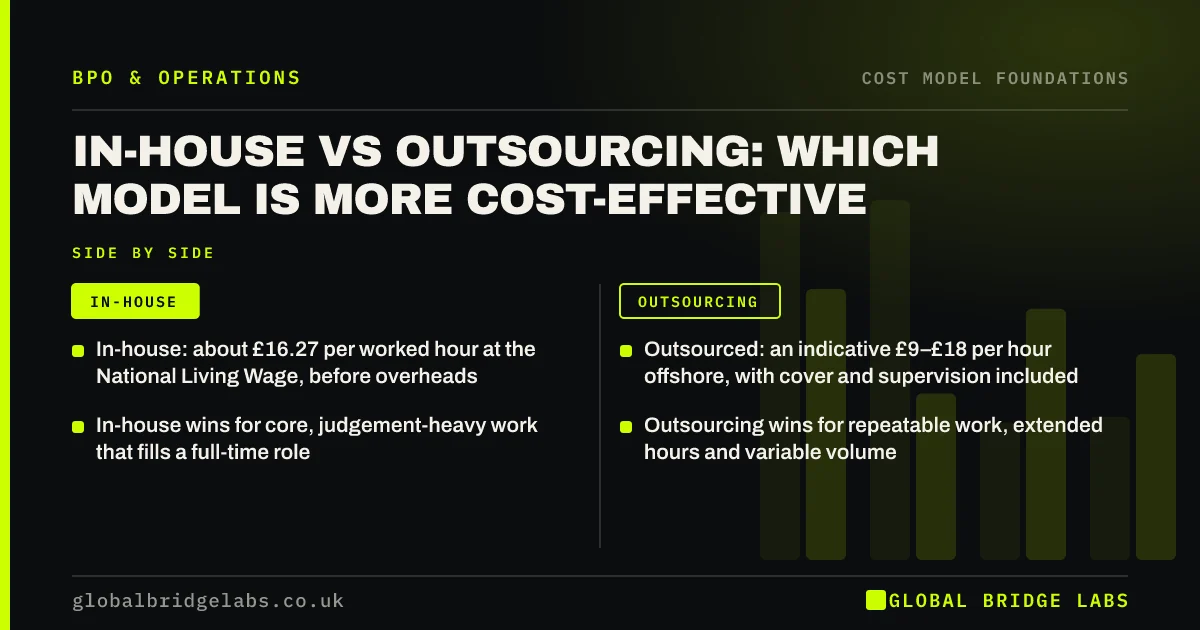
Rarely on its own. With managed offshore rates at an indicative £9–£18 per hour and loaded UK costs from £16.27 per worked hour, a moderate currency move still leaves most repeatable work cheaper offshore. But include a sensitivity test, for example a 10% rise in the outsourced rate, in your comparison.
Can a weaker local currency lower your price?
Sometimes at renewal, if you are invoiced in local currency. But a sudden devaluation often brings local inflation and pressure on staff pay, and good providers raise pay to keep people. Stable GBP pricing with fair reviews usually serves both sides better than chasing currency gains.
How do you test currency risk in your numbers?
Run your in-house vs outsourcing comparison with the outsourced rate 10% and 20% higher. If outsourcing still wins at plus 20%, currency risk is unlikely to change the decision. If it only wins at today's rate, negotiate a longer fixed-price period or a tighter cap on reviews before signing.
What does this look like in practice?
A pattern we see with UK SMEs moving from a US dollar contract: monthly costs varied with the exchange rate, which made budgeting hard. Moving to a sterling price fixed for 12 months, with a capped annual review, gave the finance lead a stable number to plan around.
Currency risk checklist
Check these before signing.
- Which currency will you be invoiced in?
- How long is the price fixed?
- Is the annual review capped?
- Have you tested a 10% rate rise in your comparison?
- Can you leave if a review is not acceptable?
Next step
Send us the currency and review terms you have been offered. We will explain the risk and how to limit it in a 30-minute call.
Message us on WhatsApp for a currency terms review, or book a 30-minute consultation.
Chat on WhatsApp →Sources and further reading
- Exchange rates · Central Bank of Sri Lanka
- The Sourcing and Consultancy Playbooks · Cabinet Office
Frequently asked questions
Who carries currency risk in an outsourcing contract?
Mainly whoever's home currency is not the invoicing currency. If you are invoiced in pounds sterling, the provider carries exchange rate risk day to day. If you are invoiced in US dollars or the provider's local currency, you carry it every month in your sterling costs.
Should I pay an offshore provider in GBP or USD?
For budgeting, GBP is usually better for a UK business, because your cost is stable and predictable. Agree a fixed-price period and a capped annual review, so currency moves are handled fairly at renewal rather than landing unexpectedly on monthly invoices.
Does currency risk make offshore outsourcing too risky?
Rarely. Most repeatable work remains cheaper offshore even after a moderate currency move. Include a sensitivity test, such as a 10% or 20% rate rise, in your comparison, and agree sensible review terms so any change is gradual and visible in advance.
Can a provider raise prices because of exchange rates?
Only if the contract allows it. Check whether the price is fixed for a period, how reviews are calculated, and whether currency is named as a reason for change. A cap on annual increases and the right to leave on notice protect you if a review is not acceptable.
Written by

Global Bridge Labs (GBL) is a UK–Sri Lanka partner for social media, websites and BPO. Everything here comes from client delivery, not theory.