On this page
- 01Key takeaways
- 02Why not just push the rate down?
- 03Which levers lower the price properly?
- 04How much does a clear scope save?
- 05What terms should you negotiate besides price?
- 06Should you ask for a pilot price?
- 07When should you renegotiate an existing contract?
- 08What does this look like in practice?
- 09Negotiation checklist
- 10Next step
- 11Sources and further reading
- 12Frequently asked questions
Key takeaways
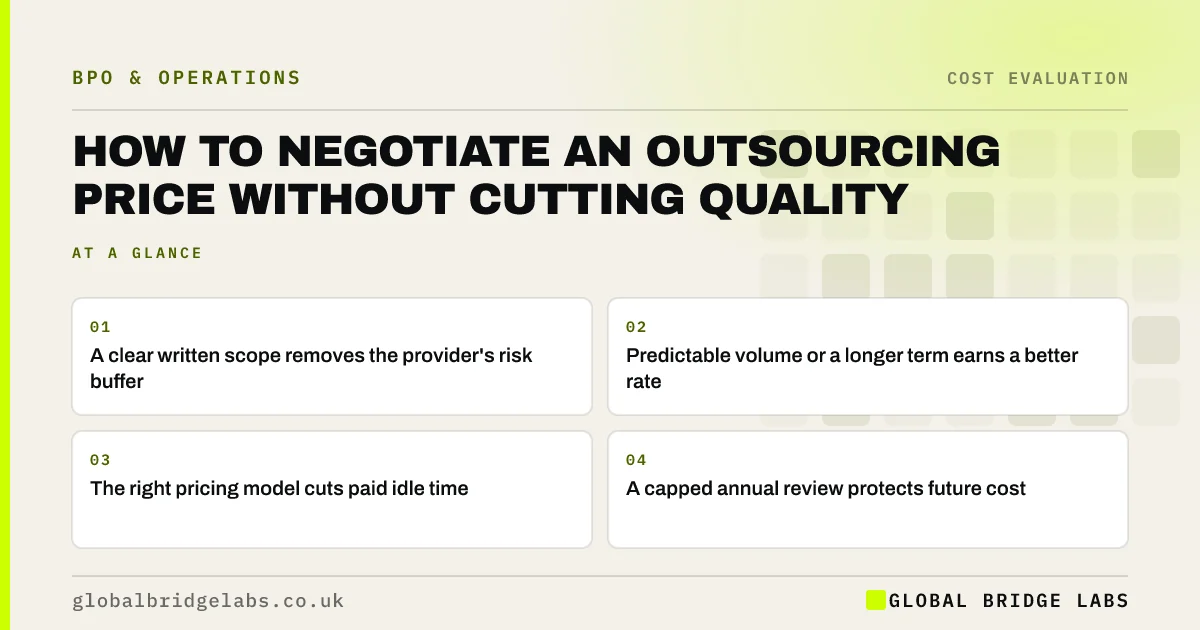
To negotiate an outsourcing price without cutting quality, change what you are buying rather than squeezing the rate. The best levers are a clear scope, predictable volume, a sensible term, the right pricing model and a capped annual review. Pushing the hourly rate too low tends to raise staff turnover and errors.
- A clear written scope removes the provider's risk buffer.
- Predictable volume or a longer term earns a better rate.
- The right pricing model cuts paid idle time.
- A capped annual review protects future cost.
Negotiating with a provider now? Message us on WhatsApp for a view on the terms.
Chat on WhatsApp →Why not just push the rate down?
Because the rate pays for the people, supervision and quality checks. A provider squeezed below a sustainable rate cuts pay, supervision or training, and turnover and errors rise. The saving on the invoice is lost in rework and management time.
Which levers lower the price properly?
These reduce the provider's cost or risk, so a lower price is sustainable.
- Scope clarity: a documented process with examples.
- Volume: a committed minimum or a forecast the provider can plan around.
- Term: a longer commitment in exchange for a better rate, with a break clause.
- Hours: covering core hours in-house and outsourcing the rest.
- Pricing model: per task for stable work, hourly for varied work.
- Ramp pricing: lower volume at a set rate while the team learns.
How much does a clear scope save?
A provider pricing an unclear scope adds a buffer for the unknown. A written process with the ten most common cases, volumes by month and examples lets it price closer to cost. It also shortens setup, which reduces any setup fee.
Want help writing a scope that gets sharper quotes? Ask us on WhatsApp.
Chat on WhatsApp →What terms should you negotiate besides price?
Notice period, minimum term, setup fees, the annual price review and exit support. A cap on annual increases, or a link to a published index, protects you. Short notice keeps the provider focused on service. Agree exit support and data return in writing.
Should you ask for a pilot price?
A paid pilot at an agreed rate for 60 to 90 days is reasonable and lets both sides learn the real workload. Agree in advance what happens to the rate after the pilot, so the pilot price is not a teaser.
When should you renegotiate an existing contract?
At the annual review, when volumes have grown materially, when the process has become simpler through automation or better documentation, or when your pricing model no longer matches how work arrives. Bring data: volumes, productivity and quality over the last six months. Providers respond better to evidence than to a request for a discount.
What does this look like in practice?
A pattern we see in UK SMEs: a business asks for 20% off the hourly rate. Instead, it agrees per-task pricing for its stable data work and hourly pricing for support, with a written process and volume forecast. The total cost falls by a similar amount with no change to the team.
Negotiation checklist
Use these before you negotiate.
- Write a clear scope with volumes and examples.
- Decide what term you can commit to.
- Choose the pricing model that fits the work.
- Ask for a cap on annual increases.
- Agree notice, exit support and data return.
- Keep the rate sustainable for the provider's team.
Next step
Tell us what you are negotiating. We will suggest the levers that fit your situation in a 30-minute call.
Message us on WhatsApp for negotiation advice, or book a 30-minute consultation.
Chat on WhatsApp →Sources and further reading
- The Sourcing and Consultancy Playbooks · Cabinet Office
- Contracts and liabilities between controllers and processors · Information Commissioner's Office
Frequently asked questions
How can I reduce outsourcing costs?
Give a clear written scope, commit to predictable volume or a sensible term, choose the pricing model that fits the work, move only the right hours and cap annual increases. These reduce the provider's cost and risk, so a lower price is sustainable without cutting quality.
Is it wise to negotiate the hourly rate down hard?
Only within reason. The rate pays for staff, supervision and quality checks. A rate squeezed too low tends to raise staff turnover and errors, and the saving on the invoice is lost in rework, repeat contacts and your own time spent managing problems.
What contract terms matter most in an outsourcing deal?
Minimum term, notice period, setup fees, the annual price review mechanism and exit support, including data return. These often change the real cost more than a small difference in hourly rate, especially if volumes fall or you need to change provider.
Should I ask for a discount for a longer contract?
It is reasonable, because a longer commitment lowers the provider's risk. Protect yourself with a break clause after the first period, service levels with remedies, and a cap on annual price increases, so a lower rate does not lock you into poor service.
Written by

Global Bridge Labs (GBL) is a UK–Sri Lanka partner for social media, websites and BPO. Everything here comes from client delivery, not theory.