On this page
- 01Key takeaways
- 02What is the difference between cost-effective and cheap?
- 03How do you measure the cost-effectiveness of outsourcing?
- 04What does a worked example look like?
- 05What makes outsourcing cost-effective?
- 06What are the signs of a false saving?
- 07When is the cheapest provider the right choice?
- 08Which measures show cost-effectiveness each month?
- 09What does this look like in practice?
- 10Cost-effectiveness checklist
- 11Next step
- 12Sources and further reading
- 13Frequently asked questions
Key takeaways
The cost-effectiveness of outsourcing is the cost of each useful output, such as a resolved ticket or a processed invoice, delivered at the quality you need. The cheapest hourly rate is often not the most cost-effective, because rework, slow handling and management time can double the real cost. Measure cost per task, not cost per hour.
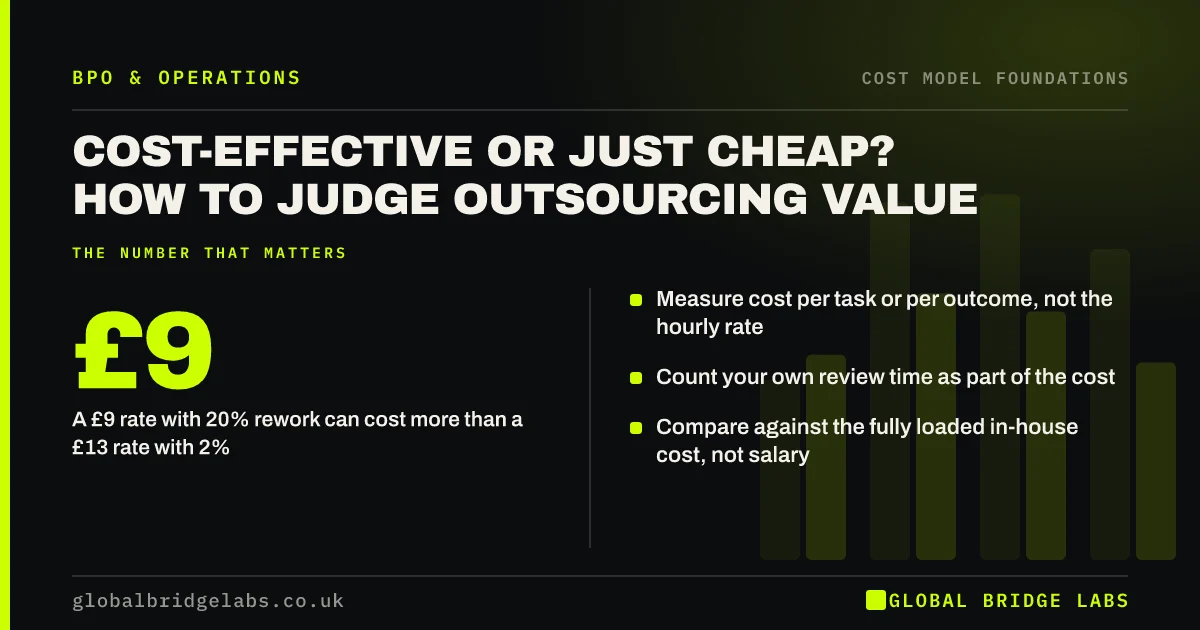
- Measure cost per task or per outcome, not the hourly rate.
- A £9 rate with 20% rework can cost more than a £13 rate with 2%.
- Count your own review time as part of the cost.
- Compare against the fully loaded in-house cost, not salary.
Want to check whether a quote is cost-effective or just cheap? Send it to us on WhatsApp.
Chat on WhatsApp →What is the difference between cost-effective and cheap?
Cheap means a low price per hour or per seat. Cost-effective means a low total cost for each piece of work done to the required standard. The two diverge when a low rate comes with slow handling, errors, missing supervision or heavy management from your side, all of which add cost that the rate does not show.
How do you measure the cost-effectiveness of outsourcing?
Divide the total monthly cost by the number of useful outputs delivered to standard. Total cost is the provider invoice plus your review time and any tools. Useful outputs exclude anything that had to be redone. Compare the result with the same calculation for in-house work.
- Total cost: invoice, plus your management hours at their real value, plus tools.
- Useful outputs: tasks completed to standard, first time.
- Cost-effectiveness: total cost divided by useful outputs.
- Compare with the in-house cost per useful output.
What does a worked example look like?
Provider A charges £9 per hour and processes 10 invoices an hour, but 20% need correcting by your team at 5 minutes each. Provider B charges £13 per hour, processes 12 an hour and has 2% errors. Per 1,000 invoices, A costs £900 plus about 17 hours of correction; B costs about £1,083 plus under 2 hours.
If your team's time is worth £25 an hour, A's real cost is about £1,320 and B's about £1,125. The provider with the higher rate is about 15% more cost-effective.
Want the same test run on quotes you have? Message us on WhatsApp.
Chat on WhatsApp →What makes outsourcing cost-effective?
Outsourcing is cost-effective when the work is documented, the volume is steady enough to keep a trained team busy, quality is measured, and the provider's rate includes supervision and cover. The single biggest factor is a clear written process, because it cuts training time, errors and the questions that consume your own hours.
What are the signs of a false saving?
A false saving is a lower invoice that hides higher total cost. Watch for rework landing back on your team, customers chasing slow replies, you spending more hours managing than before, or a rate that excludes supervision and cover and then adds them as extras.
- Your team is fixing the provider's work.
- Complaints or chasers are rising.
- Your management hours have gone up, not down.
- Extras appear on invoices that were not in the quote.
When is the cheapest provider the right choice?
When the work is simple, highly structured and easy to check, such as straightforward data entry with validation rules. In that case, output quality varies little between providers and price becomes the main difference. For customer-facing or judgement-heavy work, quality differences cost more than rate differences.
Which measures show cost-effectiveness each month?
Cost-effectiveness is not a one-off calculation. Track a small set of measures monthly, so you can see whether the outsourced work is still delivering value as volumes, prices and processes change. Four measures are enough for most SMEs.
- Cost per useful output, including your review time.
- Error or rework rate on a weekly sample.
- Speed against the agreed service level.
- Your own hours spent managing the provider.
What does this look like in practice?
A pattern we see in UK logistics firms: a low-cost provider is chosen for delivery query handling, but first-contact resolution is poor, so customers call back two or three times and the in-house team ends up handling escalations. Moving to a slightly higher rate with better resolution lowers the total cost per resolved query.
Cost-effectiveness checklist
Use these checks on any outsourcing quote.
- Define the output you are paying for.
- Ask for productivity and error rates, not just the hourly rate.
- Confirm supervision, QA and cover are included.
- Estimate your own review time.
- Calculate cost per useful output for each option.
- Re-check the numbers after three months.
Next step
Share the quotes or the in-house numbers you are comparing. We will calculate cost per useful output for each in a 30-minute call.
Message us on WhatsApp for a cost-effectiveness check, or book a 30-minute consultation.
Chat on WhatsApp →Sources and further reading
- The Sourcing and Consultancy Playbooks · Cabinet Office
- Rates and thresholds for employers 2026 to 2027 · HM Revenue & Customs
Frequently asked questions
Is outsourcing always cost-effective?
No. It is cost-effective for documented, repeatable work with enough volume, measured against a clear standard. It is not cost-effective for tiny volumes, work that needs deep judgement, or processes handed over without documentation, where rework and your own management time cancel out the lower rate.
How do you calculate outsourcing value for money?
Add the provider invoice, your management time valued at its real cost, and any tools, then divide by the number of tasks completed to standard first time. Compare that cost per useful output with the fully loaded in-house equivalent calculated the same way, including idle time and overheads.
Should I choose the cheapest outsourcing provider?
Only for simple, easily checked work such as structured data entry. For customer-facing or judgement-heavy work, a slightly higher rate with better productivity and fewer errors is usually cheaper overall once rework, repeat contacts and your own time spent correcting mistakes are counted properly.
What makes an outsourcing arrangement lose value over time?
Processes that change without the documentation being updated, rising error rates that nobody samples, extra charges outside the agreed scope, and annual price increases without a cap. A monthly review of cost per output, quality and scope keeps value from quietly slipping away.
Written by

Global Bridge Labs (GBL) is a UK–Sri Lanka partner for social media, websites and BPO. Everything here comes from client delivery, not theory.