On this page
- 01Key takeaways
- 02What is a BPO transition plan?
- 03Phase 1 (weeks 1–2): what happens in preparation?
- 04Phase 2 (weeks 2–4): how does training work?
- 05Phase 3 (weeks 4–8): how do you go live safely?
- 06Phase 4 (weeks 8–13): what does stabilisation involve?
- 07How much effort does transition take from your side?
- 08What goes wrong in transitions?
- 09What does this look like in practice?
- 10Checklist: your 90-day transition
- 11Next step
- 12Sources and further reading
- 13Frequently asked questions
Key takeaways
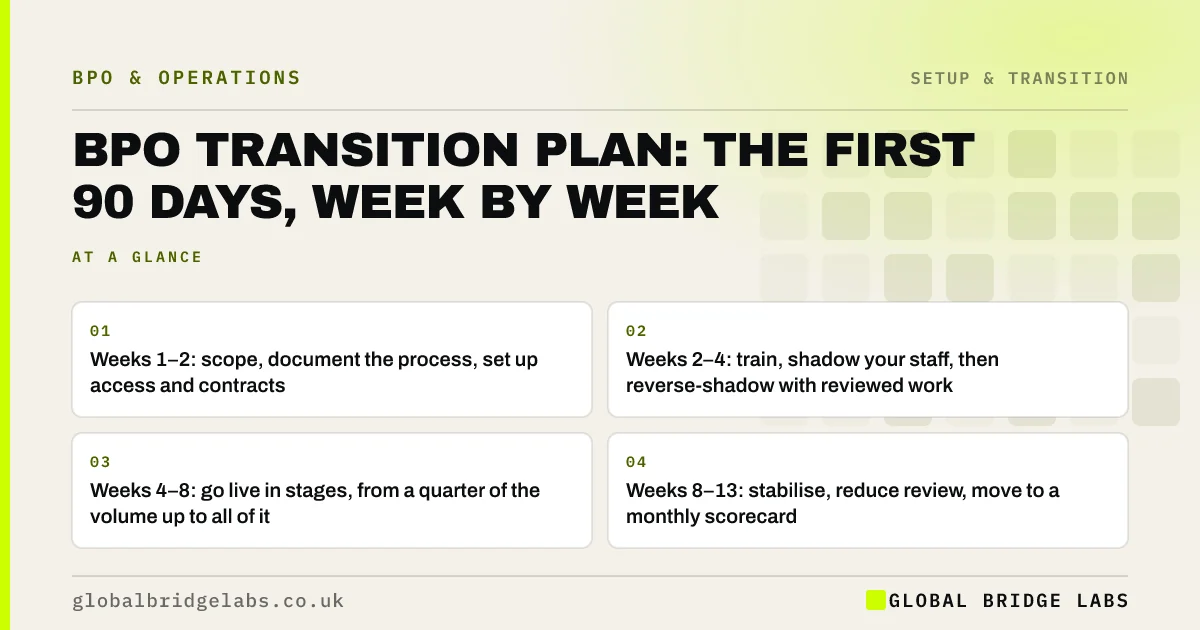
A BPO transition plan moves a process from your team to an outsourced team without customers noticing a dip. For an SME it runs in four phases over roughly 90 days: prepare, train, go live in stages, then stabilise. Each phase ends only when agreed exit criteria are met, not when a date arrives.
- Weeks 1–2: scope, document the process, set up access and contracts.
- Weeks 2–4: train, shadow your staff, then reverse-shadow with reviewed work.
- Weeks 4–8: go live in stages, from a quarter of the volume up to all of it.
- Weeks 8–13: stabilise, reduce review, move to a monthly scorecard.
- Name one internal owner and protect a few hours of their week.
Planning a handover? Message us on WhatsApp and we will sketch the 90-day plan for your process.
Chat on WhatsApp →What is a BPO transition plan?
A BPO transition plan is a phased schedule for handing a business process to an outsourcing provider, setting out who does what, when, and what must be true before each phase ends. It covers documentation, access, training, go-live and the move to steady-state management.
Most outsourcing problems happen in transition, not in steady state. A plan with clear exit criteria prevents the most common failure: switching everything over on a fixed date before the team is ready.
Phase 1 (weeks 1–2): what happens in preparation?
Preparation turns your process into something another team can learn. Agree the scope, write or update the procedures, set up system accounts, and sign the contracts. For simple processes this can take a week; for complex or undocumented ones, longer.
- Agree a one-page scope: process, volumes, hours, systems, service levels.
- Document the process, common scenarios, exceptions and escalations.
- Create individual logins with least-privilege permissions and MFA.
- Sign the processor contract and, if offshore, the IDTA or Addendum.
- Agree the scorecard and baseline measures.
Phase 2 (weeks 2–4): how does training work?
Training moves from reading to watching to doing. The team studies the procedures, then shadows your staff handling real work, then does the work itself while your staff review every item before it goes out. Exit criterion: accuracy above an agreed threshold, such as 95%, on reviewed work for a full week.
Phase 3 (weeks 4–8): how do you go live safely?
Go live in stages rather than all at once. Stage by volume (25%, 50%, 100%), by channel (email first, then chat, then phone), or by customer type (new enquiries before existing clients). Each stage lasts at least a week and moves on only when service levels and quality hold.
Keep a rollback option. If quality drops, the stage steps back while the cause is fixed. That is far cheaper than a public service failure.
- Stage 1: 25% of volume or one channel; review a large sample daily.
- Stage 2: 50% of volume; review a sample daily, then every other day.
- Stage 3: 100% of volume; weekly QA sample and weekly review meeting.
Phase 4 (weeks 8–13): what does stabilisation involve?
Stabilisation reduces your involvement to steady-state levels. Review frequency drops from daily to weekly, the procedure is updated with everything learned, and the relationship moves to a monthly scorecard review. Exit criterion: service levels met for four consecutive weeks with no increase in escalations.
How much effort does transition take from your side?
Budget two to four hours a week of an internal owner's time for the first three months, plus time from the staff who currently do the work while they are shadowed. That effort falls to about an hour a week once the process is stable.
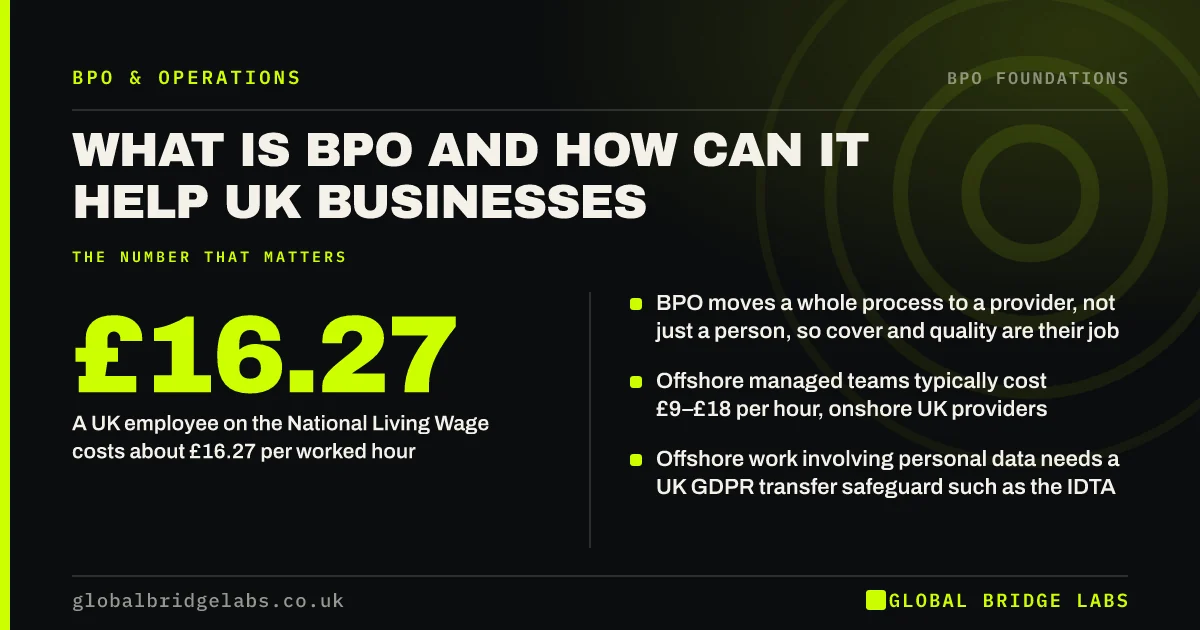
The cost of that time is real but small compared with the alternative. A UK employee on the April 2026 National Living Wage costs about £16.27 per worked hour after employer National Insurance, pension and holiday, and most transitions free far more hours than they consume within the first two months.
Want a transition plan and costed plan for your process? Send us the scope on WhatsApp and we will discuss your requirements.
Chat on WhatsApp →What goes wrong in transitions?
The common failures are a fixed-date big-bang switch, thin documentation, no internal owner, and staff who feel threatened and do not share what they know. Address the last one directly: explain what the change means for them, and involve them as the experts training the team.
If UK employees currently do the work and their roles are affected, check whether TUPE applies before announcing changes.
What does this look like in practice?
At Global Bridge Labs (GBL), a single seat on a documented process typically goes live on part of the volume within two weeks. Larger teams are phased so training and quality checks keep up. The principle is the same at any size: move on when the numbers say the team is ready, not when the calendar does.
Checklist: your 90-day transition
Tick these off in order.
- Name the internal owner and block time in their diary.
- Agree scope, scorecard and baseline.
- Document the process and exceptions.
- Set up access and sign data protection contracts.
- Complete training, shadowing and reverse shadowing.
- Go live in at least three stages with exit criteria.
- Reduce review only when quality holds.
- Update the procedure and move to monthly reviews.
Next step
Tell us the process you want to hand over and we will draft the 90-day plan with exit criteria for each phase. 30 minutes, no pitch.
Message us on WhatsApp for a transition plan, or book a 30-minute consultation.
Chat on WhatsApp →Sources and further reading
- Contracts and liabilities between controllers and processors · Information Commissioner's Office
- Business transfers, takeovers and TUPE · GOV.UK
- National Minimum Wage and National Living Wage rates · GOV.UK
Frequently asked questions
How long does a BPO transition take?
A single seat on a well-documented process can go live in about two weeks and stabilise within two to three months. Multi-channel support or several back-office processes usually take four to eight weeks to reach full volume. Undocumented processes take longest.
What is reverse shadowing?
Reverse shadowing is the training stage where the outsourced team does the real work while your experienced staff watch and review it before it is sent or saved. It follows ordinary shadowing, where the team watches your staff, and ends when accuracy holds above an agreed threshold.
Should we go live all at once or in stages?
In stages. Starting with part of the volume, one channel or one customer group lets you catch problems before customers notice them. Move to the next stage only when service levels and quality hold for at least a week, and keep the option to step back.
Who should own the transition internally?
One named person who understands the process and has the authority to answer questions and make decisions. They need two to four hours a week for the first three months. Without a named owner, questions go unanswered and the transition stalls.
Written by

Global Bridge Labs (GBL) is a UK–Sri Lanka partner for social media, websites and BPO. Everything here comes from client delivery, not theory.