
On this page
- 01Key takeaways
- 02What is zero-based budgeting?
- 03How is it different from normal budgeting?
- 04How does a small business run a light version?
- 05What does it find in practice?
- 06What are the drawbacks?
- 07Where does outsourcing fit?
- 08What does this look like in practice?
- 09Zero-based budgeting checklist
- 10Next step
- 11Sources and further reading
- 12Frequently asked questions
Key takeaways
Zero based budgeting for small business means building next year's budget from nothing, so every cost has to be justified instead of carried forward. It finds spending that survives only out of habit. A full exercise is heavy. A light version, applied to one cost area a year, gives most of the benefit for a week of effort.
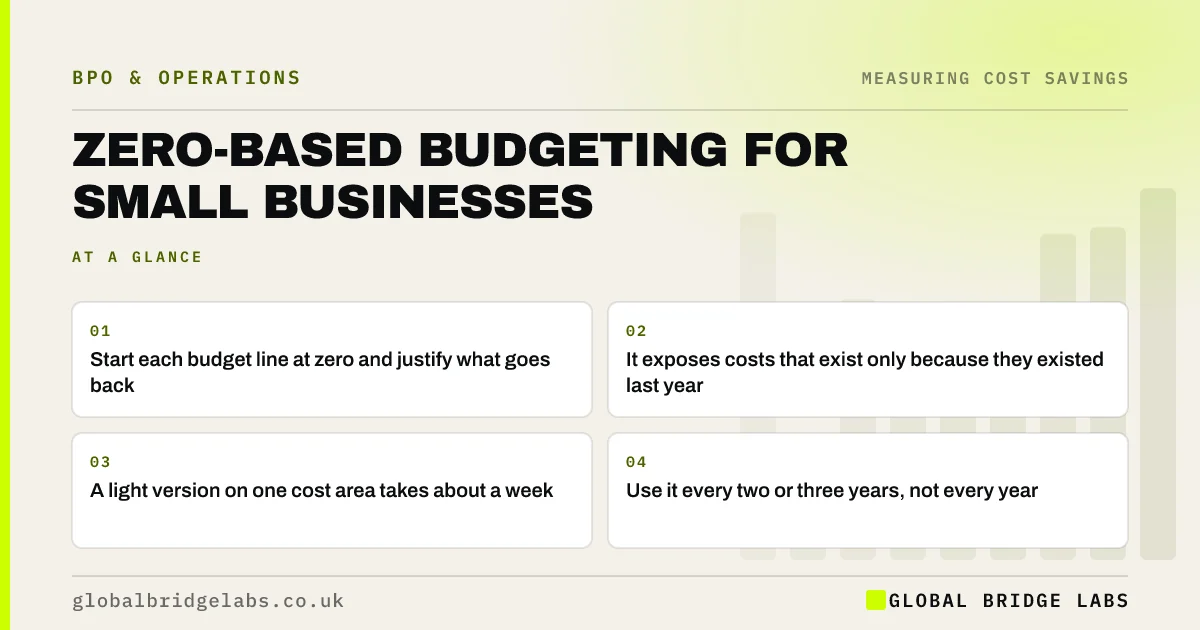
- Start each budget line at zero and justify what goes back in.
- It exposes costs that exist only because they existed last year.
- A light version on one cost area takes about a week.
- Use it every two or three years, not every year.
Want help running a light zero-based review? Message us on WhatsApp with the cost area you would start with.
Chat on WhatsApp →What is zero-based budgeting?
Zero-based budgeting is a budgeting method in which every expense must be justified for each new period, starting from a base of zero. It was developed by Peter Pyhrr at Texas Instruments around 1970. Nothing is approved because it was spent before. Each activity is described, costed and ranked.
How is it different from normal budgeting?
Normal budgeting is incremental: take last year's figure and adjust it by a few per cent. It is quick and it preserves every old decision. Zero-based budgeting asks whether each cost should exist at all, and at what level. It takes longer and it questions the base, which is where most waste sits.
- Incremental: last year plus or minus a percentage.
- Zero-based: what does this activity need to achieve its purpose?
- Incremental protects history.
- Zero-based protects only what can be justified.
How does a small business run a light version?
Run a light version by picking one cost area, listing the activities inside it and asking three questions of each: what is it for, what happens if we stop, and what is the cheapest way to get the same result? Rank the activities and fund from the top down until the money runs out.
- 1. Choose one area, such as administration or software.
- 2. List every activity or subscription within it.
- 3. State the purpose and the user of each.
- 4. Cost each one, including staff time.
- 5. Rank by value to customers and the business.
- 6. Fund from the top and challenge the rest.
What does it find in practice?
Take an illustrative firm reviewing its £48,000 administration budget this way. It lists 22 activities. Four have no clear user and cost £4,300 a year between them. Six could be done a cheaper way, saving about £9,200. Twelve are confirmed as they are.
The result is a budget of £34,500, about 28% lower, with nothing removed that anyone could defend. An incremental budget would have added 3% and moved on. These are example figures to show the method.
- How to reduce back-office costs in a UK small business
- The cost lever scorecard: find savings process by process
Want to try this on your admin or software spend? Send us the list on WhatsApp.
Chat on WhatsApp →What are the drawbacks?
The drawbacks are effort, short-term thinking and conflict. Justifying every line each year is exhausting and people learn to game it. Long-term spending such as training is hard to justify line by line and gets cut. And managers defend their territory. This is why occasional, focused use works better than an annual ritual.
Where does outsourcing fit?
Outsourcing enters at the third question. When an activity is confirmed as needed, the cheapest reliable way to deliver it might be a simpler process, a tool or a managed team. Zero-based thinking stops you outsourcing work that should have been removed, which is the commonest way to waste an outsourcing budget.
What does this look like in practice?
A pattern we see in budget season: every department asks for last year plus inflation, and the owner trims each request by the same amount. Nothing is examined. The one year a firm asks why instead of how much, it usually finds several costs that outlived the reason they were started.
Zero-based budgeting checklist
Use this for a one-week light review.
- One cost area is chosen.
- Every activity in it is listed.
- Each has a stated purpose and user.
- Each is costed, including time.
- Activities are ranked by value.
- Unjustified items are stopped or tested.
- The next area is scheduled for next year.
Next step
Tell us which cost area has grown most without anyone deciding it should. We will help you list its activities and work out which earn their place.
Message us on WhatsApp to plan a zero-based review, or book a 30-minute consultation.
Chat on WhatsApp →Sources and further reading
Frequently asked questions
What is zero-based budgeting in simple terms?
Zero-based budgeting means starting your budget from nothing each period and adding back only the costs you can justify. Last year's spending earns no automatic place. Each activity has to show what it is for and why it is worth the money.
Is zero-based budgeting suitable for small businesses?
A light version is. Reviewing one cost area a year from zero is manageable and finds real savings. Running the full method across the whole business every year is usually too much effort for a small team and brings diminishing returns.
What are the advantages of zero-based budgeting?
It exposes spending kept out of habit, forces a clear purpose for every cost, and directs money to what matters most. It also prompts the question of whether each activity could be delivered more cheaply, which incremental budgeting never asks.
What are the disadvantages of zero-based budgeting?
It is time-consuming, it can favour short-term costs over long-term investment, and it can cause friction as people defend their budgets. Used too often, it becomes a paperwork exercise. Occasional, targeted reviews avoid most of these problems.
Written by

Global Bridge Labs (GBL) is a UK–Sri Lanka partner for social media, websites and BPO. Everything here comes from client delivery, not theory.


