On this page
- 01Key takeaways
- 02Why does nobody own website speed?
- 03How do you work out whose problem it is?
- 04What should you ask each one?
- 05When do you need a specialist?
- 06What can you do without a developer?
- 07What does this look like in practice?
- 08Speed ownership checklist
- 09Next step
- 10Sources and further reading
- 11Frequently asked questions
Key takeaways
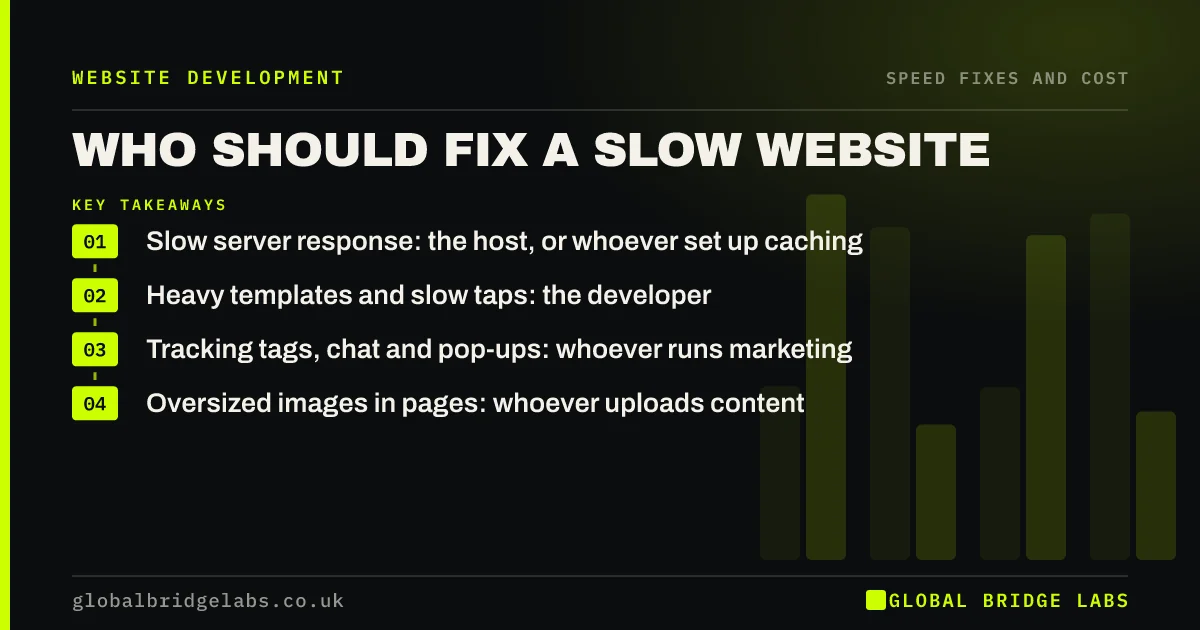
A slow website usually has more than one owner, which is why it stays slow. The host is responsible for how quickly the server replies. The developer is responsible for the theme, templates and code. Marketing is responsible for the tags and tools it adds. Whoever uploads content is responsible for image sizes. Find where the time goes first, and the right person to fix it becomes obvious.
- Slow server response: the host, or whoever set up caching.
- Heavy templates and slow taps: the developer.
- Tracking tags, chat and pop-ups: whoever runs marketing.
- Oversized images in pages: whoever uploads content.
Being passed between your host and your developer? Send us the URL on WhatsApp and we will say whose it is.
Chat on WhatsApp →Why does nobody own website speed?
Nobody owns speed because each party controls one part and can see the others. The host says the server is fine and the site is heavy. The developer says the code is fine and the hosting is cheap. The marketing agency added six tags and considers speed a technical matter. All three can be right about their own part.
Speed is the sum of those parts. It needs one person, usually on the client's side, who holds the others to a shared result.
How do you work out whose problem it is?
A test report tells you where the time goes, and each kind of delay has an owner.
- Time to first byte over a second: hosting or caching.
- Large images listed under opportunities: content and image handling.
- Third-party code with long blocking time: marketing tools and tags.
- Unused code and slow responses to taps: theme, builder or plugins.
- Layout shift: templates, banners and embeds.
- Slow form, booking or checkout: the developer or the tool's supplier.
What should you ask each one?
Ask specific questions that have factual answers.
- Host: what is the server response time for these three pages, and is page caching on?
- Developer: which scripts load on the first screen, and which can be removed or delayed?
- Marketing: which tags are active, what is each for, and which platforms are no longer used?
- Content editors: are images resized before upload, or does the site do it?
- Tool suppliers: is there a lighter or delayed loading option?
Want those questions asked and the answers brought together? Ask us on WhatsApp.
Chat on WhatsApp →When do you need a specialist?
You need a specialist when the obvious fixes have been made and pages still fail, when the site is a shop or application with complex scripts, or when the parties disagree and nobody can adjudicate. A speed specialist or an agency that offers it will diagnose across hosting, code and marketing tools and give one prioritised list.
Indicative UK market ranges are £500 to £1,500 for an audit with a ranked fix list and £1,500 to £3,000 for an audit with fixes on key templates. For a small brochure site with clear causes, your existing developer is usually enough.
What can you do without a developer?
Several of the commonest fixes need no code. Resize images before uploading them. Delete plugins and tools you no longer use. Ask marketing to pause tags for platforms that are not running. Switch on the caching your host includes. Then test again.
Stop at anything that changes how scripts load or how the theme works. Those are the changes that break forms and checkouts when done by trial and error.
What does this look like in practice?
A pattern we see in businesses with several suppliers: a slow site is reported to the developer, who refers it to the host, who replies that the server is healthy. Months pass. A single test shows the server is indeed fine and most of the delay is five marketing tags and a chat widget nobody at either supplier installed.
Putting the evidence in front of all three in one message ends the loop. Global Bridge Labs (GBL) acts as that single point of ownership when clients ask for it.
Speed ownership checklist
- Run a test and note where the time goes.
- Match each delay to its owner.
- Send each owner a specific question.
- Name one person to hold the whole result.
- Make the no-code fixes yourself.
- Bring in a specialist if pages still fail.
Next step
The fastest way to get a slow site fixed is to stop asking who is to blame and start showing where the time goes. We can do the diagnosis and tell you who needs to do what.
Message us on WhatsApp for a speed diagnosis with owners named, or book a 30-minute consultation.
Chat on WhatsApp →Sources and further reading
- About PageSpeed Insights · Google for Developers
- Time to First Byte (TTFB) · web.dev (Google)
- Loading third-party JavaScript · web.dev (Google)
- Best practices for tags and tag managers · web.dev (Google)
Frequently asked questions
Who is responsible for website speed?
Several parties. The host is responsible for server response, the developer for the theme and code, marketing for tags and tools, and content editors for image sizes. Someone on the business side should own the overall result and hold the others to it.
Should I ask my host or my developer to fix a slow website?
Check server response time first. If the server takes more than about a second to reply, start with the host and with caching. If it replies quickly and the page is still slow, the cause is on the page, which is the developer's or marketing's area.
Can I fix a slow website myself?
Partly. Resizing images, removing unused plugins and tools, pausing old tracking tags and turning on included caching need no code and often help noticeably. Changes to themes and script loading are best left to a developer.
How much does it cost to hire someone to speed up a website?
Indicative UK market ranges are £500 to £1,500 for an audit with a ranked fix list and £1,500 to £3,000 for an audit plus fixes on key templates. The right figure depends on the causes and the number of page templates involved.
Written by

Global Bridge Labs (GBL) is a UK–Sri Lanka partner for social media, websites and BPO. Everything here comes from client delivery, not theory.