On this page
- 01Short answer
- 02What are the three options?
- 03When does a website builder make sense?
- 04When does a freelancer make sense?
- 05When does an agency make sense?
- 06How do the costs compare over three years?
- 07When is a hybrid approach best?
- 08What does this look like in practice?
- 09Decision checklist
- 10Next step
- 11Sources and further reading
- 12Frequently asked questions
Short answer
Choose a website builder if you are starting out, have more time than budget and need a simple site. Choose a freelancer for a professional site with a defined scope and budget of roughly £1,500 to £5,000. Choose an agency when the site must drive significant revenue, needs integrations or content support, or needs a team for ongoing improvement.
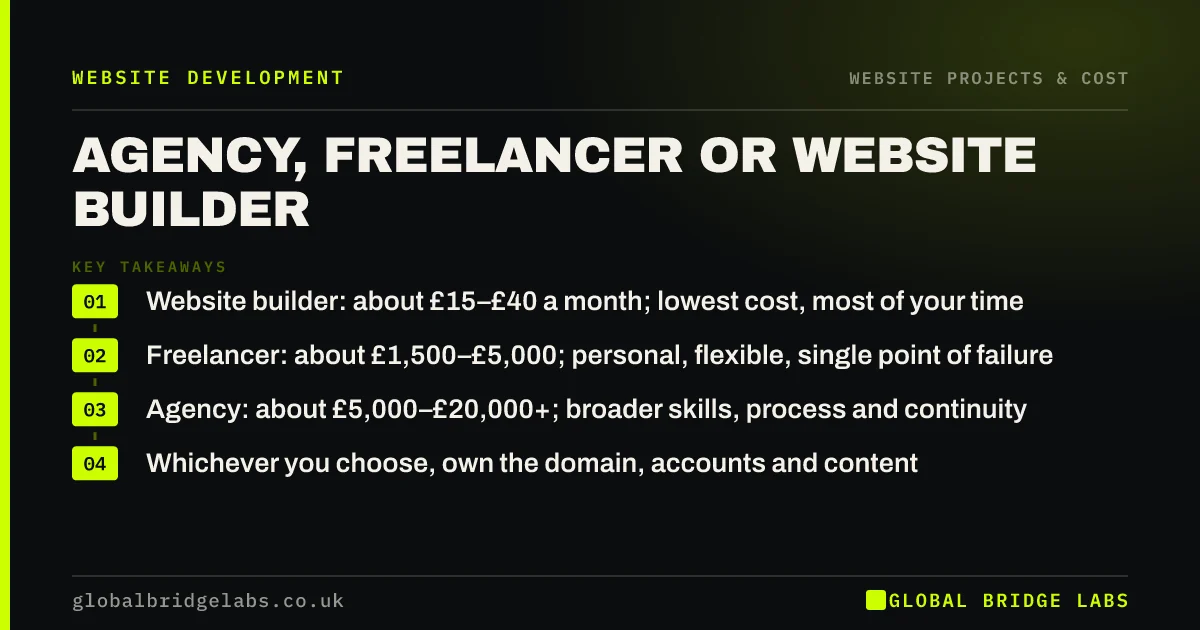
- Website builder: about £15–£40 a month; lowest cost, most of your time.
- Freelancer: about £1,500–£5,000; personal, flexible, single point of failure.
- Agency: about £5,000–£20,000+; broader skills, process and continuity.
- Whichever you choose, own the domain, accounts and content.
Not sure which route fits your business? Message us on WhatsApp with your goals and budget.
Chat on WhatsApp →What are the three options?
A website builder is a hosted platform, such as Squarespace, Wix or Shopify, that lets a business create a site from templates without code. A freelancer is an independent designer or developer who builds the site for you. An agency is a company with a team covering strategy, design, development, content and often ongoing marketing.
Each can produce an effective website. The differences are in cost, time, skills available, risk and what happens after launch.
When does a website builder make sense?
Builders make sense for new businesses, sole traders and small firms that need a clean, credible site quickly and cheaply. Modern builders handle hosting, security and updates, and produce mobile-friendly pages by default.
The limits are your time and skills. Copywriting, structure, SEO and tracking are still your job. Builders can also be harder to extend with custom features, and some add weight that makes Core Web Vitals harder to pass.
- Strengths: low cost, quick to launch, hosting and security handled.
- Weaknesses: your time, limited customisation, content and SEO left to you.
When does a freelancer make sense?
A good freelancer suits a business that needs a professional site with a clear scope: a small number of pages, perhaps a booking or form integration, and a moderate budget. You get direct contact with the person doing the work, and often flexible pricing.
The risks are capacity and continuity. One person may not cover copywriting, SEO migration and tracking as well as design, and if they become unavailable, support can stop. Make sure you own every account and file.
- Strengths: cost-effective, personal, flexible.
- Weaknesses: limited range of skills, single point of failure.
When does an agency make sense?
An agency suits businesses where the website must produce significant revenue, where the project involves integrations or migration, or where the business wants ongoing help with content, SEO and conversion rather than a one-off build.
The risks are cost and fit. Agencies vary widely: some are design studios, others are commercially focused. Choose one that talks about your enquiries and revenue, not only about design.
- Strengths: broad skills, process, continuity, ongoing improvement.
- Weaknesses: higher cost, risk of being a small client in a large agency.
Want to compare a freelancer and agency quote side by side? Send both to us on WhatsApp.
Chat on WhatsApp →How do the costs compare over three years?
Compare total cost of ownership, not build price. As typical UK ranges: a builder site might cost £500 to £1,500 over three years in subscriptions, plus your time. A freelancer site might cost £1,500 to £5,000 to build plus £1,500 to £5,000 in hosting and support. An agency site might cost £5,000 to £20,000 or more to build plus £3,000 to £15,000 in hosting, care and improvement.
Then set those against what each is expected to produce. Across our client work, we have seen a 2.4x enquiry rate after a website rebuild, and the gain came from strategy, content and tracking that many cheaper routes leave out.
When is a hybrid approach best?
Hybrid approaches often work well for SMEs: build on a website builder yourself but pay a specialist for copy, structure and tracking set-up, or have an agency plan and design the site while you maintain content in-house.
The trade-off is coordination. Someone has to own the overall result. If that is you, be sure you have the time.
What does this look like in practice?
A pattern among growing SMEs: a builder site created by the owner in the first year, which served its purpose, but now has 30 pages added over time, no clear structure and no tracking, while the business wants more enquiries for its most profitable service.
At that stage the question is not which tool, but who owns the strategy. The builder may still be the right platform, with a specialist brought in to restructure content and set up tracking.
Decision checklist
Answer these to choose your route.
- How much revenue must the site produce?
- How much time can you personally give?
- Do you need integrations or migration?
- Who will write copy and set up tracking?
- What is your three-year budget?
- Who will support the site after launch?
- Will you own every account and file?
Next step
If you are deciding between a builder, freelancer and agency, we will talk through your goals and budget with you in 30 minutes and recommend a route, even if it is not us.
Message us on WhatsApp for a recommendation, or book a 30-minute consultation.
Chat on WhatsApp →Sources and further reading
- Understanding Core Web Vitals and Google search results · Google Search Central
- How copyright protects your work · GOV.UK
- SEO Starter Guide · Google Search Central
Frequently asked questions
Should I use a website builder or hire a web designer?
Use a website builder if you are starting out, have more time than budget and need a simple site. Hire a designer or agency when the site must produce significant enquiries or sales, needs integrations, or when you lack time to handle copy, structure, SEO and tracking yourself.
Is a freelancer cheaper than an agency?
Usually for the build, often costing £1,500 to £5,000 compared with £5,000 to £20,000 or more from an agency. Compare total cost over three years and what each will deliver, including copy, SEO migration, tracking and ongoing support, rather than the build price alone.
Are website builders bad for SEO?
No. Modern builders such as Squarespace, Wix and Shopify can rank well when pages are well structured, clearly written and fast. Limitations come from heavy templates, less control over some technical settings and, most often, from content and structure left undone by the owner.
What should I check before hiring a freelance web designer?
Check relevant examples and references, confirm who handles copy, SEO and tracking, agree a fixed scope and price, and make sure the domain, hosting and accounts will be in your name with copyright assigned to you. Ask what happens if they become unavailable.
Written by

Global Bridge Labs (GBL) is a UK–Sri Lanka partner for social media, websites and BPO. Everything here comes from client delivery, not theory.