On this page
- 01Key takeaways
- 02What is a performance budget?
- 03What should a small business budget include?
- 04How do you set the numbers?
- 05Who enforces it?
- 06When should you break the budget?
- 07What does this look like in practice?
- 08Performance budget checklist
- 09Next step
- 10Sources and further reading
- 11Frequently asked questions
Key takeaways
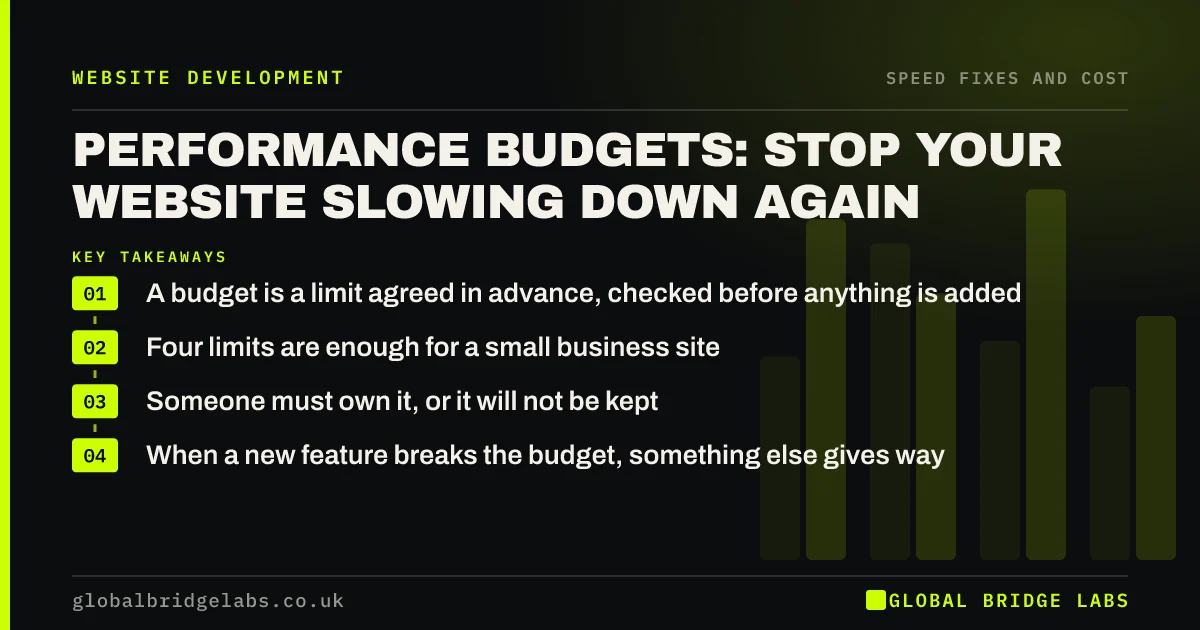
A performance budget is a set of limits a website agrees not to exceed, such as how long the first screen may take and how many third-party scripts may load. It exists because sites do not slow down by decision. They slow down by addition. A budget turns 'can we add this?' into 'what comes off to make room?', which is the only question that keeps a site fast after a speed project.
- A budget is a limit agreed in advance, checked before anything is added.
- Four limits are enough for a small business site.
- Someone must own it, or it will not be kept.
- When a new feature breaks the budget, something else gives way.
Want a simple budget written for your site? Message us on WhatsApp.
Chat on WhatsApp →What is a performance budget?
A performance budget is a defined limit on the things that affect a website's speed, used to judge whether a proposed change is acceptable.
It works like a financial budget. Nobody objects to a single small expense, and a year of them breaks the plan. A website gains a chat tool, a pop-up, a new font, a tracking pixel and a video in the same way, each reasonable alone. The budget makes the total visible.
What should a small business budget include?
Keep it to limits a non-technical owner can check. These four are a working starting point, to adjust for your site.
- Experience: key pages pass Core Web Vitals on mobile.
- First screen: main content within 2.5 seconds on a mid-range phone.
- Weight: first load of a key page at or under about one megabyte.
- Third parties: a fixed maximum number of external scripts.
- Optional: no image above an agreed file size.
How do you set the numbers?
Set the numbers from where you are and where you need to be.
- 1. Measure your three key pages today.
- 2. Fix the obvious problems first, so the baseline is sensible.
- 3. Set each limit slightly tighter than the current result.
- 4. Write the limits on one page with the date.
- 5. Check them monthly and before any new feature goes live.
- How to test website speed the way customers feel it
- Website speed monitoring: catch slowdowns before customers
Want your current figures measured as a baseline? Ask us on WhatsApp.
Chat on WhatsApp →Who enforces it?
A budget needs one owner with the authority to say 'not until something comes off'. In a small business that is usually whoever manages the website supplier or the marketing lead. Without an owner, the budget is a document.
The rule in practice is one in, one out. If marketing wants a new pixel and the script limit is reached, an old one is removed. If a new template is heavier than the weight limit, the designer finds the saving before launch.
When should you break the budget?
Break the budget deliberately when a feature will earn more than the speed it costs, and say so. A booking system that takes most of your appointments justifies its weight. Record the exception and the reason, then reset the limit. What the budget prevents is the unconsidered addition, not the considered one.
A budget that is never adjusted becomes an obstacle people work around. Review it twice a year.
What does this look like in practice?
A pattern we see a year after a successful speed project: the site has returned to roughly where it started. Nobody did anything wrong. Six small additions, each approved by a different person, used up the gains.
A one-page budget with a named owner, checked before each addition, would have forced the trade-off at the time. Global Bridge Labs (GBL) hands one over with every speed project for that reason.
Performance budget checklist
- Measure key pages and record the baseline.
- Agree four limits and write them down.
- Name the owner.
- Apply one in, one out for scripts and widgets.
- Check the budget before any feature goes live.
- Review the limits every six months.
Next step
Making a site fast is a project. Keeping it fast is a habit, and a budget is how the habit is enforced. We can set the limits with you and show whoever owns them how to check.
Message us on WhatsApp for a one-page performance budget.
Chat on WhatsApp →Sources and further reading
- Performance budgets 101 · web.dev (Google)
- Understanding Core Web Vitals and Google search results · Google Search Central
- Loading third-party JavaScript · web.dev (Google)
Frequently asked questions
What is a performance budget for a website?
It is a set of agreed limits on things that affect speed, such as load time for the first screen, total page weight and the number of third-party scripts. Proposed changes are checked against the limits before they go live.
Does a small business need a performance budget?
A simple one, yes. Small sites slow down through accumulated additions that nobody tracks. Four limits on one page, with a named owner, are enough to stop a speed project being undone within a year.
What is a good page weight for a business website?
As a working target, about one megabyte or less for the first load of a key page on mobile. It is a guide, not a standard. What matters is that the first screen appears within about 2.5 seconds on a mid-range phone.
What happens when a new feature exceeds the budget?
Something else is removed or lightened to make room, or the exception is approved deliberately because the feature earns more than it costs. Either way the trade-off is made openly, instead of the site getting slower unnoticed.
Written by

Global Bridge Labs (GBL) is a UK–Sri Lanka partner for social media, websites and BPO. Everything here comes from client delivery, not theory.