On this page
- 01Short answer
- 02What is website hosting?
- 03Why does hosting affect enquiries?
- 04Which type of hosting suits which business?
- 05What should you check before choosing a host?
- 06Does hosting have to be in the UK?
- 07When should you move hosts?
- 08What does this look like in practice?
- 09Hosting checklist
- 10Next step
- 11Sources and further reading
- 12Frequently asked questions
Short answer
Website hosting for UK small businesses should be chosen on speed, security, backups and support, not on the lowest monthly price. Most SMEs are best served by managed hosting at roughly £20 to £100 a month, which includes updates, daily backups, security monitoring and a content delivery network. Cheap shared hosting is often why sites are slow.
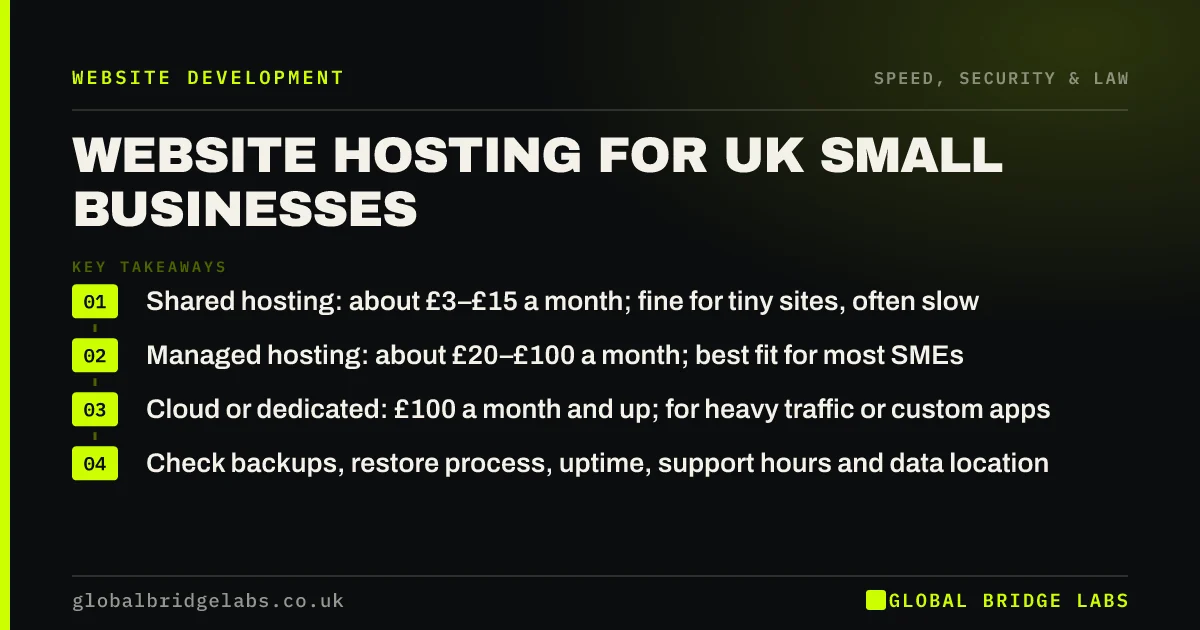
- Shared hosting: about £3–£15 a month; fine for tiny sites, often slow.
- Managed hosting: about £20–£100 a month; best fit for most SMEs.
- Cloud or dedicated: £100 a month and up; for heavy traffic or custom apps.
- Check backups, restore process, uptime, support hours and data location.
Not sure whether your hosting is holding your site back? Message us on WhatsApp with your provider and plan.
Chat on WhatsApp →What is website hosting?
Website hosting is the service of storing a website's files, database and software on a server connected to the internet, so that visitors can load the site at any time.
The hosting plan determines how quickly the server responds, how well the site copes with traffic, how it is backed up and secured, and who helps when something breaks. It is infrastructure, and like most infrastructure you notice it only when it fails.
Why does hosting affect enquiries?
Hosting affects enquiries through speed and reliability. Slow server response delays everything else on the page and can push Largest Contentful Paint past Google's 2.5-second threshold. Downtime means every visitor during the outage sees an error instead of your offer.
Security matters too. The UK government's Cyber Security Breaches Survey 2025/2026 found that 43% of businesses experienced a breach or attack in the previous year. Hosting without updates, backups and monitoring makes a website an easy target.
Which type of hosting suits which business?
The ranges below are typical UK market prices and vary by provider and specification.
- Shared hosting (£3–£15 a month): your site shares a server with many others. Suits very small, low-traffic sites.
- Managed WordPress or platform hosting (£20–£100 a month): tuned servers, automatic updates, backups, caching and expert support. Suits most SMEs.
- Hosted builders (£10–£40 a month): hosting bundled with Squarespace, Wix or Shopify plans. Simple, but less control.
- Cloud or dedicated (£100 a month and up): scalable resources for high traffic, e-commerce at scale or custom applications.
What should you check before choosing a host?
Ask these questions before signing, and get the answers in writing.
- How often are backups taken, where are they stored, and how quickly can you restore?
- What uptime is committed to, and what happens if it is missed?
- Are software and security updates applied automatically?
- Is a content delivery network and free SSL certificate included?
- Where is data stored, and is there a UK GDPR data processing agreement?
- What support is available, when, and how quickly do they respond?
- Who owns the account, and can you move the site out easily?
Want a second opinion on a hosting quote? Send it to us on WhatsApp.
Chat on WhatsApp →Does hosting have to be in the UK?
No. UK GDPR does not require website data to be stored in the UK. It requires appropriate safeguards when personal data is transferred outside the UK, and a processing agreement with your host. Many reputable hosts use UK or EU data centres, which keeps transfers simple.
Server location affects speed less than it used to, because content delivery networks serve pages from locations close to each visitor. For a UK audience, choosing UK or nearby EU servers plus a CDN is a sensible default.
When should you move hosts?
Move when server response is consistently slow, when downtime recurs, when support is unhelpful, or when backups cannot be restored quickly. Also move when your provider cannot give you full access to your own site.
The trade-off is risk. A move needs planning: full backup, test on the new host, DNS change at a quiet time, and checks afterwards. Done properly it causes no downtime and no loss of search rankings.
What does this look like in practice?
A pattern in small businesses: a site on the cheapest shared plan bought years ago alongside the domain, with no working backups and server response times of more than a second, so every page starts slow.
Moving to managed hosting with caching, a CDN and daily off-site backups often improves loading noticeably before any other optimisation. The monthly cost rises, but the site becomes faster, safer and recoverable.
Hosting checklist
Review your hosting against these once a year.
- Confirm daily off-site backups.
- Test a restore at least once.
- Check uptime and server response time.
- Confirm automatic security updates.
- Enable SSL and a CDN.
- Get a data processing agreement.
- Make sure the account is in the business's name.
Next step
If you do not know where your site is hosted or whether it is backed up, that is the first thing to find out. We will check it with you in 30 minutes.
Message us on WhatsApp for a hosting review, or book a 30-minute consultation.
Chat on WhatsApp →Sources and further reading
- Cyber security breaches survey 2025/2026 · DSIT and Home Office
- Understanding Core Web Vitals and Google search results · Google Search Central
- Advice for small organisations · Information Commissioner's Office
Frequently asked questions
How much does website hosting cost for a small business in the UK?
Typical UK prices are about £3 to £15 a month for shared hosting, £20 to £100 a month for managed hosting, and £100 a month or more for cloud or dedicated servers. Most small businesses get the best balance of speed, security and support from managed hosting.
What is the difference between shared and managed hosting?
Shared hosting puts your site on a server with many others and leaves updates and security largely to you. Managed hosting uses tuned servers and includes updates, backups, caching and expert support. It costs more but is usually faster, safer and less work for a small business.
Does my website need to be hosted in the UK for GDPR?
No. UK GDPR does not require UK hosting, but it does require a data processing agreement with your host and appropriate safeguards if personal data is transferred abroad. Hosting in the UK or EU with a content delivery network is a simple, sensible default for UK businesses.
Can changing hosting affect my Google rankings?
A well-planned move should not harm rankings and can help if the new host is faster. Problems come from downtime, broken pages or changed URLs during the move. Back up fully, test on the new host first and switch DNS at a quiet time.
Written by

Global Bridge Labs (GBL) is a UK–Sri Lanka partner for social media, websites and BPO. Everything here comes from client delivery, not theory.