On this page
- 01Key takeaways
- 02How do plugins slow a WordPress site?
- 03How many plugins is too many?
- 04How do you find the plugins that cost speed?
- 05Which plugins are most often the problem?
- 06When should you leave plugins alone?
- 07What does this look like in practice?
- 08WordPress plugin speed checklist
- 09Next step
- 10Sources and further reading
- 11Frequently asked questions
Key takeaways
Plugins can slow WordPress down, but the number is a poor guide. One badly built plugin that loads scripts on every page can cost more than twenty that only work in the admin area. What matters is what each plugin adds to the pages visitors see. Find the ones that load on the front end, test the site without them and keep those that earn their place.
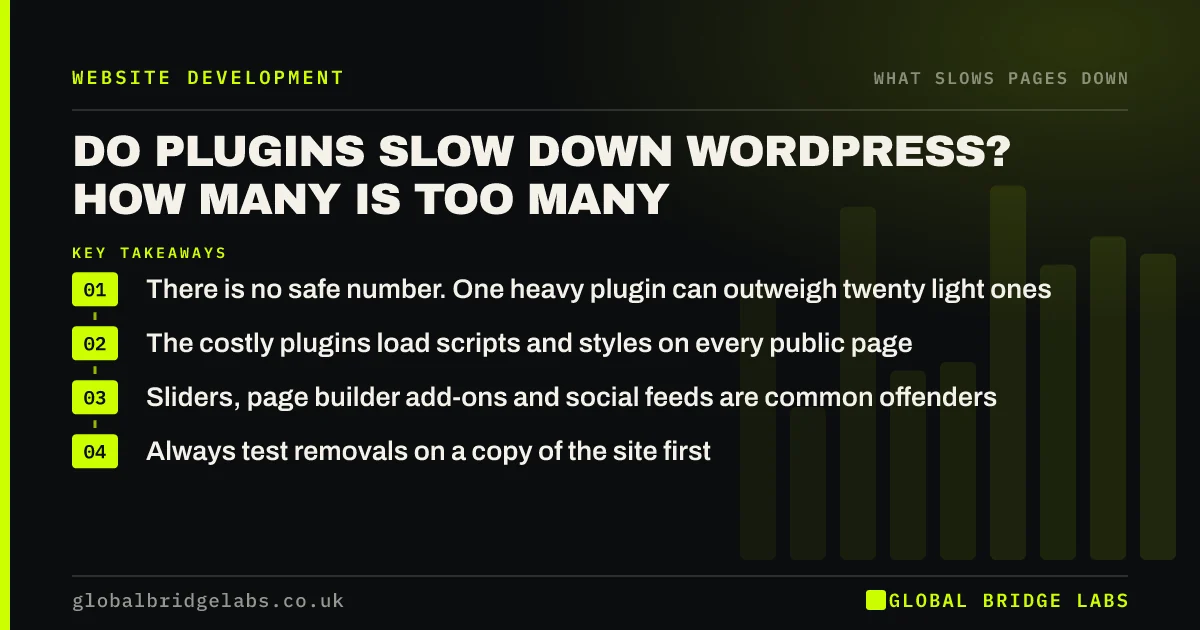
- There is no safe number. One heavy plugin can outweigh twenty light ones.
- The costly plugins load scripts and styles on every public page.
- Sliders, page builder add-ons and social feeds are common offenders.
- Always test removals on a copy of the site first.
Want to know which plugins are slowing your site? Send us the URL on WhatsApp.
Chat on WhatsApp →How do plugins slow a WordPress site?
Plugins slow a site in two places. On the server, each active plugin runs code and may query the database before the page is sent, which lengthens the wait for the first response. In the browser, many plugins add their own scripts and styles to every page, whether or not that page uses the feature.
A contact form plugin that loads its files on all 80 pages of a site, to serve one form, is a typical example.
How many plugins is too many?
There is no number. A well-maintained site can run thirty plugins and stay fast. A site with eight can be slow if two of them are heavy. A better question is how many plugins add something to the public pages, and whether each addition is used.
A high count is still a warning, for a different reason. Each plugin is something to keep updated, and neglected plugins are a security risk as well as a speed one.
How do you find the plugins that cost speed?
Find them by subtraction, on a copy of the site so nothing breaks in public.
- 1. Make a staging copy, or take a full backup first.
- 2. Record a speed test of a key page as the baseline.
- 3. Deactivate plugins one at a time and re-test.
- 4. Note which removals change the result noticeably.
- 5. Check the page still works: forms, menus, layouts.
- 6. Decide for each heavy plugin: remove, replace or restrict to certain pages.
No staging site? Ask us on WhatsApp and we will set one up for the test.
Chat on WhatsApp →Which plugins are most often the problem?
The plugins that most often cost speed are those that produce visible features on every page.
- Slider and carousel plugins.
- Page builders and their add-on packs.
- Social feed and share-button plugins.
- Pop-up and newsletter plugins.
- Related-posts and statistics plugins that query the database heavily.
- Several plugins doing the same job.
When should you leave plugins alone?
Leave plugins alone when they work only in the admin area, such as backup, security scanning and editor tools, or when they are central to how the site earns money. A booking or e-commerce plugin is heavy for a reason.
Be cautious with replacement. Swapping a plugin for custom code removes weight and adds something only your developer understands. For a small site, a well-supported plugin is often the safer choice.
What does this look like in practice?
A pattern we see on WordPress sites a few years old: three slider plugins are active because each redesign added a new one, two form plugins load on every page and a social feed plugin fetches posts from an account last updated two years ago.
Removing the unused ones and limiting the form plugin to the contact page is a small job with a visible effect. Global Bridge Labs (GBL) runs the subtraction test before recommending anything more expensive.
WordPress plugin speed checklist
- List active plugins and what each one does.
- Delete inactive plugins, not just deactivate them.
- Test key pages with each front-end plugin switched off.
- Remove duplicates doing the same job.
- Restrict plugin files to the pages that need them.
- Keep the remaining plugins updated.
Next step
A plugin list tells you what is installed. Only a test tells you what it costs. We will run the test on a copy of your site and report which plugins matter.
Message us on WhatsApp for a WordPress plugin speed test.
Chat on WhatsApp →Sources and further reading
- Advanced administration handbook: optimisation · WordPress.org
- Updating WordPress · WordPress.org
- Loading third-party JavaScript · web.dev (Google)
Frequently asked questions
Do plugins slow down WordPress?
Some do. Plugins that add scripts and styles to every public page, or run heavy database queries, slow a site noticeably. Plugins that work only in the admin area have little effect on visitors. The impact depends on what each plugin loads, not on how many there are.
How many WordPress plugins is too many?
There is no fixed limit. A site can run many light plugins and stay fast, or a few heavy ones and be slow. Review any plugin that adds to public pages, remove duplicates and delete anything inactive.
How do I find which plugin is slowing my site?
On a staging copy, record a speed test, then deactivate plugins one at a time and re-test. The plugins whose removal changes the result are the ones to remove, replace or restrict. Check that the site still works after each change.
Do deactivated plugins slow down WordPress?
Deactivated plugins do not run, so they do not slow pages. They can still be a security risk if they are not updated. Delete plugins you no longer use instead of leaving them inactive.
Written by

Global Bridge Labs (GBL) is a UK–Sri Lanka partner for social media, websites and BPO. Everything here comes from client delivery, not theory.