On this page
- 01Short answer
- 02What is a service page?
- 03Why do most service pages fail?
- 04What are the nine parts of a service page?
- 05How long should a service page be?
- 06How do service pages rank in search and AI answers?
- 07When is one page for several services acceptable?
- 08What does this look like in practice?
- 09Service page checklist
- 10Next step
- 11Sources and further reading
- 12Frequently asked questions
Short answer
To write a service page that wins enquiries, give each service its own page that states the outcome, who it is for, what is included, how the process works, what it typically costs, the proof that you deliver it, and the answers to common objections, then close with one clear action.
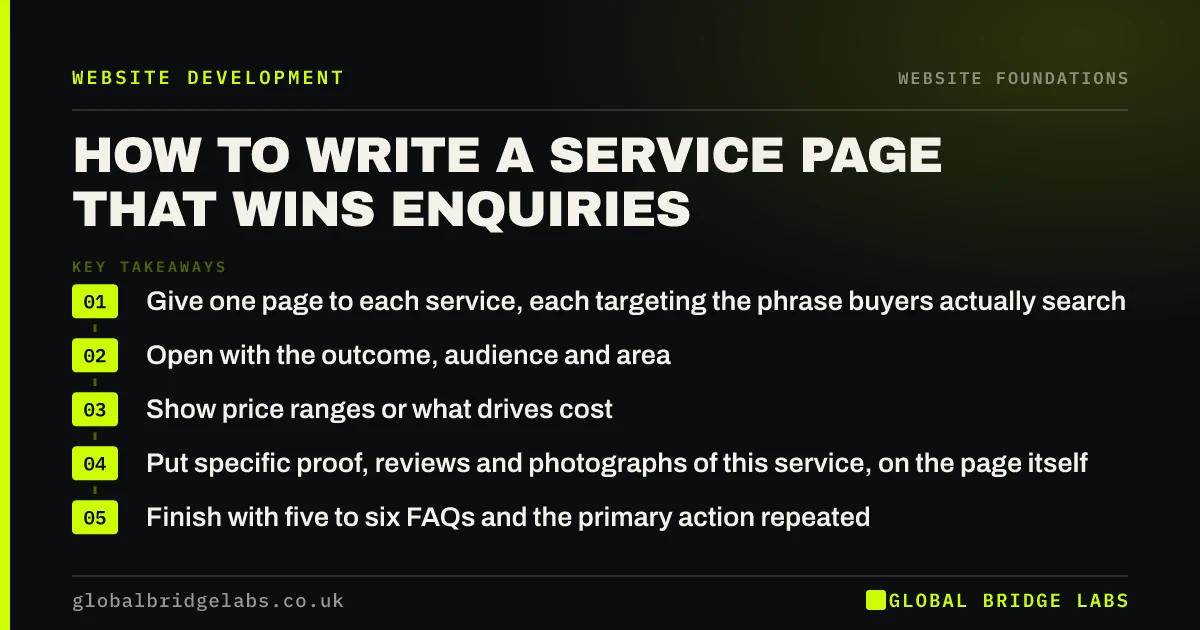
- Give one page to each service, each targeting the phrase buyers actually search.
- Open with the outcome, audience and area, plus a primary action in the first screen.
- Show price ranges or what drives cost: pricing is the question buyers most want answered.
- Put specific proof, reviews and photographs of this service, on the page itself.
- Finish with five to six FAQs and the primary action repeated.
Want one of your service pages rewritten to this structure? Message us on WhatsApp with the link.
Chat on WhatsApp →What is a service page?
A service page is a web page dedicated to one service a business sells, written to rank for searches about that service and to persuade a qualified visitor to enquire about it.
It is usually the most commercially important page type on a small business site. Visitors from search land on it directly, often without seeing the homepage, so it has to stand on its own: explain, prove and ask, all on one page.
Why do most service pages fail?
Most service pages fail because they are too short and too generic. Three paragraphs describing the service in general terms gives search engines nothing to rank and buyers nothing to decide with.
The other common failure is combining several services on one page. A page called Our services that covers boiler repairs, bathroom fitting and drainage cannot rank well for any of them, and the visitor who wanted drainage has to read about bathrooms first.
- One page covering five services, so none of them ranks.
- No pricing information at all, so price-sensitive buyers leave.
- Proof kept on a separate testimonials page.
- No answer to the obvious objection, such as How soon can you start?
What are the nine parts of a service page?
Use this order. It mirrors how buyers evaluate a supplier: is this for me, what do I get, how does it work, what does it cost, can I trust you, and what about my concern.
- 1. Headline naming the service, outcome and area, with the primary action.
- 2. Who it is for, and who it is not for.
- 3. What is included, as a short list.
- 4. How it works, in three to five numbered steps.
- 5. Pricing: ranges, packages or the factors that drive cost.
- 6. Proof: reviews, photographs or case summaries for this service.
- 7. Why choose you: two or three specific differences, not adjectives.
- 8. FAQs: five or six real objections, answered in 40 to 60 words each.
- 9. Final call to action with what happens after they enquire.
How long should a service page be?
Most effective service pages run to 700 to 1,500 words, because that is roughly what it takes to answer the questions a buyer has before enquiring. Length should come from answering questions, never from padding.
Keep it scannable: short paragraphs, clear headings phrased as the questions people ask, and lists for what is included and how it works. That structure also makes it easier for Google's featured snippets and AI Overviews to lift a direct answer.
How do service pages rank in search and AI answers?
Service pages rank when each one targets a single service phrase, uses it naturally in the title, main heading and opening lines, and answers the related questions people search. Google's SEO Starter Guide recommends descriptive titles and useful, people-first content, which is exactly what this structure produces.
For local businesses, add the area served, embed the relevant Google Business Profile details consistently, and use LocalBusiness or Service structured data so search engines can match the page to local queries.
Want a service page brief for your most profitable service? Message us on WhatsApp and we will draft it with you.
Chat on WhatsApp →When is one page for several services acceptable?
Combining services is acceptable when they are genuinely bought together and searched together, such as supply and installation, or when a service is too small to justify its own page. It is also reasonable on a very new site, where it is better to have one strong page than five thin ones.
The trade-off is reach. Every service without its own page is a search you are unlikely to rank for. As soon as a service brings meaningful revenue, give it a page.
What does this look like in practice?
A pattern in construction and trades: one Services page listing eight services in bullet points, and no individual pages. The firm ranks for its brand name and nothing else.
Building separate pages for the three most profitable services, each with a price range, a numbered process, photographs of real jobs and FAQs, gives the site three new ways to be found and three pages that can convert without the homepage. The remaining five services stay on the overview page until they earn their own.
Service page checklist
Use this for every service page before it goes live.
- Target one service phrase per page.
- Name the outcome, audience and area in the headline.
- State who the service is for and who it is not for.
- List what is included.
- Number the steps from enquiry to result.
- Give price ranges or the factors that drive price.
- Add proof specific to this service.
- Answer five or six real objections as FAQs.
- Repeat the primary action at the end.
Next step
If your services share one page, start with the most profitable one. We will outline its dedicated page with you in 30 minutes, including the headings, proof and FAQs it needs.
Message us on WhatsApp for a service page outline, or book a 30-minute consultation.
Chat on WhatsApp →Sources and further reading
- SEO Starter Guide · Google Search Central
- Creating helpful, reliable, people-first content · Google Search Central
- Introduction to structured data markup in Google Search · Google Search Central
Frequently asked questions
Should each service have its own page?
Yes, for any service that brings meaningful revenue. A dedicated page can target the exact phrase buyers search, answer questions specific to that service and show relevant proof. Combining several services on one page usually means none of them ranks well and each converts less.
What should a service page include?
A headline with the outcome and area, who the service is for, what is included, a numbered process, pricing ranges or cost factors, specific proof, reasons to choose you, five or six FAQs and a clear call to action. Together these answer the questions buyers ask before enquiring.
How many words should a service page have?
Most effective service pages have 700 to 1,500 words. That is usually enough to answer pricing, process and trust questions properly. Write until the buyer's questions are answered, then stop, because padding makes the page harder to scan and does not help it rank.
Should I put prices on service pages?
Usually yes, as ranges, starting prices or the factors that drive cost. Price is the question buyers most want answered, and pages that avoid it lose price-conscious visitors to competitors who answer it. A range also filters out enquiries that would never have been affordable.
Written by

Global Bridge Labs (GBL) is a UK–Sri Lanka partner for social media, websites and BPO. Everything here comes from client delivery, not theory.