On this page
- 01Key takeaways
- 02What is information scent?
- 03Why does information scent matter for the customer journey?
- 04What causes weak information scent?
- 05How do you strengthen information scent?
- 06How do you spot weak scent in analytics?
- 07When is a vague label acceptable?
- 08What does this look like in practice?
- 09Information scent checklist
- 10Next step
- 11Sources and further reading
- 12Frequently asked questions
Key takeaways
Information scent is how strongly a link, label or heading signals that clicking it will lead to what the visitor wants. Strong scent keeps people moving along the journey; weak scent makes them hesitate, backtrack or leave. Improve it with specific link labels in customers' words, headings that confirm arrival, and pages that deliver what the link promised.
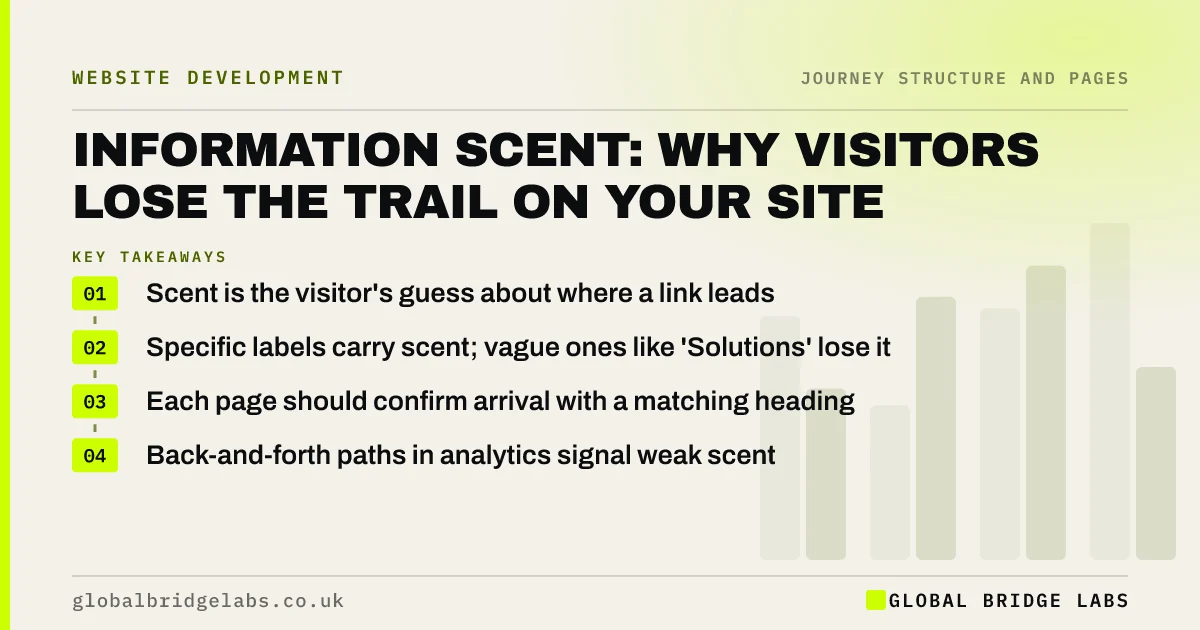
- Scent is the visitor's guess about where a link leads.
- Specific labels carry scent; vague ones like 'Solutions' lose it.
- Each page should confirm arrival with a matching heading.
- Back-and-forth paths in analytics signal weak scent.
Want your menus and links checked for weak scent? Message us on WhatsApp.
Chat on WhatsApp →What is information scent?
Information scent is a visitor's estimate, based on cues such as link labels, headings and images, of how likely a path is to lead to the information they want. Nielsen Norman Group describes it as the user's imperfect estimate of the value a source will deliver. The idea comes from information foraging theory, developed by Peter Pirolli and Stuart Card at Xerox PARC, which compares people seeking information to animals following a scent.
Why does information scent matter for the customer journey?
Information scent matters because every step in a website journey is a choice about where to click next. When the scent is strong, visitors move confidently from landing page to service, proof and contact. When it is weak, they hesitate, try a link, find it wrong and leave. Weak scent turns a short journey into a search.
What causes weak information scent?
Weak scent comes from labels that are vague, clever, internal or inconsistent. 'Solutions', 'Explore' and 'Learn more' tell visitors little. Product names the business invented mean nothing to newcomers. A link that says 'Pricing' but opens a page of general text breaks trust in the next link too.
- Vague labels: 'Solutions', 'Resources', 'Learn more'.
- Internal names buyers have never heard.
- Clever or playful labels that hide meaning.
- Links that do not deliver what they promise.
- Headings that do not match the link clicked.
How do you strengthen information scent?
Strengthen scent by making every link say where it goes, in customers' words, and every page confirm arrival. Replace 'Learn more' with 'See kitchen fitting prices'. Make the heading of the destination page match the link. Add short descriptions under menu items where labels need help. Test labels with a tree test.
- Name the destination in the link: 'Boiler repair prices'.
- Match the page heading to the link text.
- Add one-line descriptions to ambiguous menu items.
- Use customers' words, from interviews and searches.
- Test labels with a tree test.
- Tree testing: check visitors can find things before you build
- Internal links that guide buyers, not just search engines
Want your link labels rewritten in customers' words? Send us your menu on WhatsApp.
Chat on WhatsApp →How do you spot weak scent in analytics?
Spot weak scent in GA4 path explorations where visitors go from page A to B and straight back to A, or bounce between sections. Session recordings show hovering over menus, opening several items and closing them. Site search for terms that match an existing menu item is another sign: visitors could not see that the label meant what they wanted.
When is a vague label acceptable?
A vague label is acceptable when it is a widely understood convention, such as 'Contact' or 'About', or when space is very tight and the context makes it clear. Even then, the destination should confirm arrival. The test is whether a first-time visitor would predict correctly what is behind it.
What does this look like in practice?
A pattern we see in service sites: every service card ends with 'Learn more', and path reports show visitors opening two or three services in turn and leaving. The cards look tidy, but the links do not say what is behind them, so visitors cannot tell which one solves their problem without trying each.
Changing the links to describe the outcome and the price guidance behind them gives each a scent. Across our client work we have seen a 2.4x enquiry rate from conversion changes of this kind. Global Bridge Labs (GBL) reads every link label as a first-time buyer would.
Information scent checklist
- Replace 'Learn more' and 'Click here' with descriptive links.
- Rename internal or clever labels in customers' words.
- Match destination headings to link text.
- Check that links deliver what they promise.
- Look for back-and-forth paths in GA4.
- Tree-test the labels that matter most.
Next step
Weak scent is hard to see from inside the business because you already know where everything is. We will read your links as a newcomer and mark where the trail goes cold.
Message us on WhatsApp for an information scent review, or book a 30-minute consultation.
Chat on WhatsApp →Sources and further reading
- Information scent: how users decide where to go next · Nielsen Norman Group
- Tree testing: fast, iterative evaluation of menu labels and categories · Nielsen Norman Group
- Web Content Accessibility Guidelines (WCAG) 2.2 · W3C
Frequently asked questions
What is information scent in UX?
It is the visitor's estimate, from cues like link labels, headings and images, of how likely a path is to lead to what they want. It comes from information foraging theory, developed by Peter Pirolli and Stuart Card at Xerox PARC. Strong scent keeps people moving; weak scent makes them leave.
How do I improve information scent on my website?
Make link labels specific and in customers' words, replace 'Learn more' with descriptions of the destination, match destination headings to the link text, make sure links deliver what they promise, and test key labels with a tree test.
Is 'Learn more' a bad link label?
Often, yes, especially when repeated. It does not say where the link goes, so visitors have to guess or try several links. A descriptive label such as 'See loft conversion prices' carries far more information scent and helps accessibility.
Written by

Global Bridge Labs (GBL) is a UK–Sri Lanka partner for social media, websites and BPO. Everything here comes from client delivery, not theory.