On this page
- 01Key takeaways
- 02What is customer journey mapping?
- 03How do you prepare for a journey mapping day?
- 04How do you build the map on the day?
- 05What should a small business journey map include?
- 06How do you turn the map into website changes?
- 07How much time and money does journey mapping take?
- 08When is a journey map not worth making?
- 09What does this look like in practice?
- 10Journey mapping checklist
- 11Next step
- 12Sources and further reading
- 13Frequently asked questions
Key takeaways
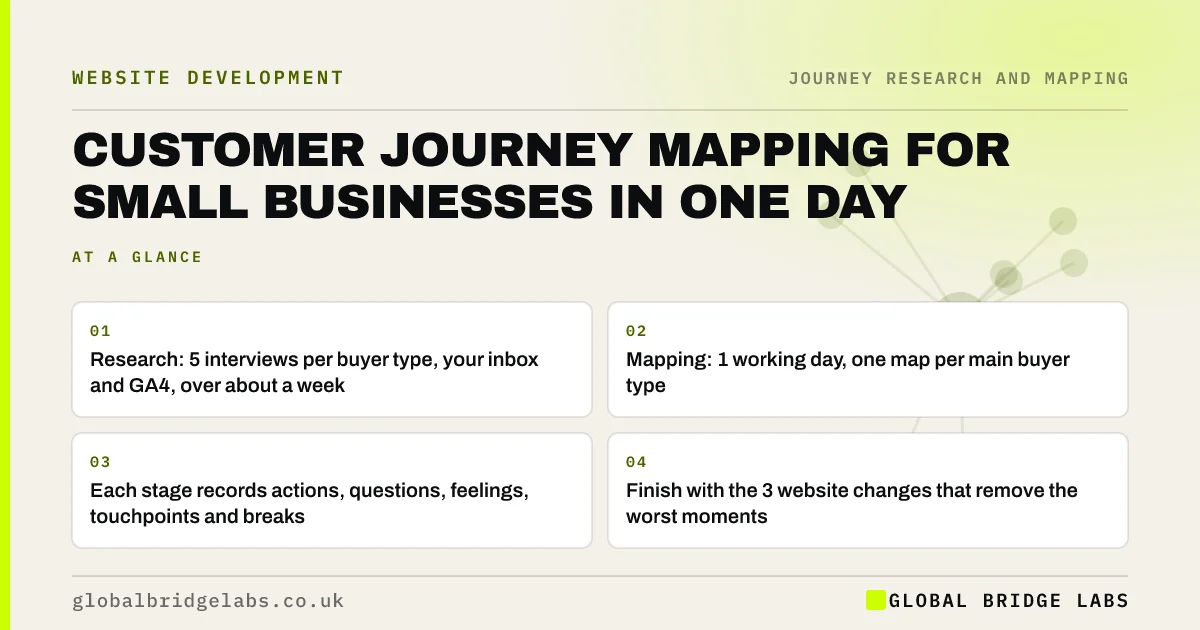
Customer journey mapping for a small business needs one week of light research and one working day to build the map. Interview five recent customers per main buyer type, collect your most-asked questions, pull landing and exit pages from GA4, then lay out each stage with what buyers do, ask and feel. Finish by listing the three website changes that would remove the worst moments.
- Research: 5 interviews per buyer type, your inbox and GA4, over about a week.
- Mapping: 1 working day, one map per main buyer type.
- Each stage records actions, questions, feelings, touchpoints and breaks.
- Finish with the 3 website changes that remove the worst moments.
Want help running your first journey map? Message us on WhatsApp.
Chat on WhatsApp →What is customer journey mapping?
Customer journey mapping is the process of researching and drawing the steps buyers take to choose and use your business, showing at each step what they do, what they need to know, how they feel and where things go wrong. Nielsen Norman Group lists the core parts of a journey map as the actor, the scenario and expectations, journey phases, actions, mindsets and emotions, and opportunities.
For a small business, the useful output is not a poster. It is a short table that tells you which pages to change, which answers to add and which steps after the website need fixing.
How do you prepare for a journey mapping day?
Prepare by choosing which buyers to map and gathering evidence before the day. Pick two to four main customer types, ideally your most valuable or most frequent. For each, interview five recent customers, read the last month of enquiries and calls, and pull GA4 reports on landing pages, exit pages and enquiry sources. Bring all of it to the mapping session.
- Choose 2 to 4 buyer types by value or volume.
- Book 5 short interviews per type, including one who nearly chose a competitor.
- Export a month of enquiry emails, form submissions and call notes.
- Pull GA4 landing pages, exit pages and a path exploration.
- Ask sales or front-desk staff for the questions they hear daily.
How do you build the map on the day?
Build the map stage by stage, using evidence rather than opinion. Write the stages across the top, from noticing a need to life as a customer. Under each, record what buyers do, what they ask, how they feel, which touchpoints they use and where the journey breaks. Mark every claim with its source: an interview, an email or a report.
- Morning: lay out stages and fill actions and questions from the evidence.
- Midday: add feelings and touchpoints; mark breaks in red.
- Afternoon: rank breaks by how many buyers they affect and what they cost.
- End of day: list the 3 changes that fix the worst breaks, with owners.
What should a small business journey map include?
A small business journey map should include the buyer type and their goal, five or six stages, and for each stage: actions, questions, feelings, touchpoints, breaks and website opportunities. Keep it to one page per buyer type. If it does not fit, it is too detailed to act on.
How do you turn the map into website changes?
Turn the map into changes by asking, for each break, whether the website could prevent it. A missing answer becomes a page or section. A confusing step becomes a clearer route or a shorter form. A step that happens off the site, such as a slow quote, becomes an operational fix with an owner. Prioritise by how many buyers the break affects.
- Map your website content to the customer journey
- The customer journey scorecard: score your website in an hour
Have a journey map that never turned into website changes? Send it to us on WhatsApp.
Chat on WhatsApp →How much time and money does journey mapping take?
For most small businesses, journey mapping takes five to ten hours of the owner's time across a week, plus one working day for the map. Done internally, the cost is that time. With an agency, journey research and changes to an existing site typically fall within an indicative £500–£3,000 range, and the research is usually a modest share of a redesign budget.
When is a journey map not worth making?
A journey map is not worth making if nobody will act on it, if the business sells one simple service to one kind of buyer, or if the obvious problem is already known. In those cases, fix the known problem first. Mapping is for when you are unsure where buyers drop out or are about to spend on a redesign.
What does this look like in practice?
A pattern we see in first journey maps: the owner expects the break to be on the website, and the biggest red mark lands after it. Buyers enquire, wait two days for a reply, and book whoever answered first. The website fixes still matter, but the quick win is a same-day reply rule.
The map makes that visible in a way analytics alone cannot. Across our client work we have seen a 2.4x enquiry rate from conversion changes made once the real breaks were clear. Global Bridge Labs (GBL) maps the steps after the form as carefully as the pages before it.
Journey mapping checklist
- Pick 2 to 4 buyer types.
- Run 5 interviews per type.
- Collect a month of enquiries and call notes.
- Pull GA4 landing, exit and path reports.
- Map stages, actions, questions, feelings, touchpoints and breaks.
- Rank breaks and choose 3 changes with owners and dates.
Next step
A first journey map is easier with someone who has run them before and can keep the day on evidence. We can facilitate it with you and turn it into a website plan.
Message us on WhatsApp to plan a journey mapping day, or book a 30-minute consultation.
Chat on WhatsApp →Sources and further reading
- Journey mapping 101 · Nielsen Norman Group
- Why you only need to test with 5 users · Nielsen Norman Group
- Path exploration · Google Analytics Help
- User research · GOV.UK Service Manual
Frequently asked questions
How do I create a customer journey map for a small business?
Choose two to four buyer types, interview five recent customers of each, collect your most-asked questions and pull GA4 landing and exit pages. Then lay out the stages and record actions, questions, feelings, touchpoints and breaks for each. Finish with three website changes that remove the worst breaks.
How long does customer journey mapping take?
For a small business, about a week of light research and one working day to build the map. The owner typically spends five to ten hours in total. Larger firms with several buyer types or long B2B sales may need two to three weeks.
What are the components of a customer journey map?
Nielsen Norman Group lists the actor, the scenario and expectations, journey phases, actions, mindsets and emotions, and opportunities. For website planning, add touchpoints and breaks, and turn opportunities into a short list of specific page or process changes.
Can I do customer journey mapping myself?
Yes. Owners know their customers well, and the method is simple. The risk is mapping what you believe rather than what customers say, so base every step on interviews, emails or analytics. An outside facilitator helps keep the day on evidence.
Written by

Global Bridge Labs (GBL) is a UK–Sri Lanka partner for social media, websites and BPO. Everything here comes from client delivery, not theory.