On this page
- 01Key takeaways
- 02What is audience-based navigation?
- 03When does audience-based navigation help?
- 04When does audience-based navigation confuse visitors?
- 05What is a hybrid approach?
- 06How do you test audience-based navigation?
- 07What about search engines?
- 08What does this look like in practice?
- 09Audience navigation checklist
- 10Next step
- 11Sources and further reading
- 12Frequently asked questions
Key takeaways
Audience-based navigation organises a website's menu by type of customer, such as 'For homeowners' and 'For landlords', instead of by service. It helps when different customers need clearly different services, information or prices, and when they can easily tell which group they belong to. It confuses when groups overlap or when visitors are unsure which label fits them. Test it before adopting it.
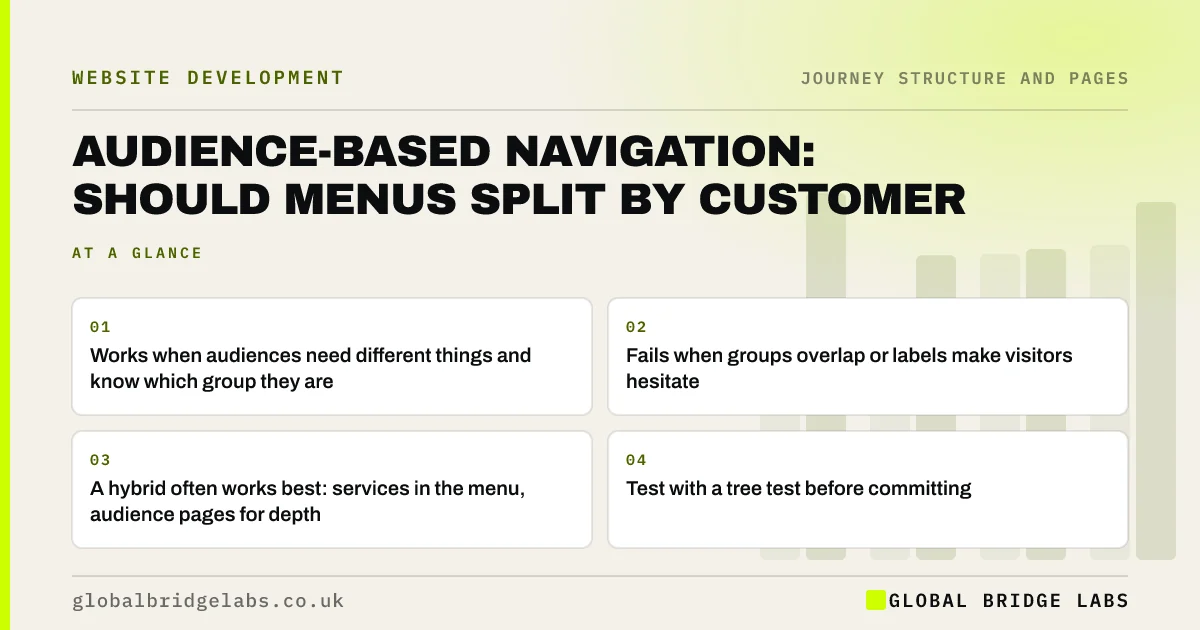
- Works when audiences need different things and know which group they are in.
- Fails when groups overlap or labels make visitors hesitate.
- A hybrid often works best: services in the menu, audience pages for depth.
- Test with a tree test before committing.
Wondering whether your menu should split by customer type? Ask us on WhatsApp.
Chat on WhatsApp →What is audience-based navigation?
Audience-based navigation is a menu structure where top-level items describe types of customer rather than services or topics, for example 'Individuals', 'Businesses' and 'Partners', or 'Homeowners', 'Landlords' and 'Developers'. Visitors choose their group first, then see services and information tailored to it. It is common on university, bank and B2B sites.
When does audience-based navigation help?
Audience navigation helps when customer groups need genuinely different things, such as different services, prices, regulations or proof, and when every visitor can instantly tell which group they are in. An accountant serving sole traders and limited companies, or a trades firm serving homeowners and commercial landlords, may fit. It also lets each group see proof from people like them.
- Groups need different services, prices or information.
- Visitors self-identify instantly and accurately.
- Groups are few, usually two or three.
- Proof and language differ by group.
When does audience-based navigation confuse visitors?
It confuses when groups overlap, when labels make visitors hesitate, or when the same service sits under several audiences with different wording. A landlord who also owns their home, or a small business owner who is also a sole trader, may not know which door to choose. Visitors who arrive looking for a service also have to translate it into an audience first.
What is a hybrid approach?
A hybrid keeps services or topics as the main menu, then adds audience pages that bring together what each group needs: relevant services, proof, pricing notes and answers. Visitors who think in services find their way directly; those who think 'I am a landlord' have a page that speaks to them. For most small businesses, this is safer than a fully audience-based menu.
How do you test audience-based navigation?
Test it by running a tree test on both structures, service-based and audience-based, with the same tasks and a mix of customer types. Compare success and how often people chose the wrong audience. If customers often pick the wrong group or hesitate at the first click, keep services at the top and use audience pages instead.
- Tree testing: check visitors can find things before you build
- Card sorting: let customers organise your website
Want both menu options tree-tested with your customers? Message us on WhatsApp.
Chat on WhatsApp →What about search engines?
Search engines are indifferent to menu style but care about duplicated content. If the same service appears under several audiences, each version needs distinct content, or one canonical page with audience pages linking to it. Copying a service page three times with small changes splits ranking signals and confuses visitors arriving from search.
What does this look like in practice?
A pattern we see after audience redesigns: a firm switches its menu to 'Residential' and 'Commercial', and small landlords and shop owners hesitate, unsure which applies. Analytics shows more back-and-forth between the two sections and fewer visits to service pages.
Restoring a service menu and adding a short 'For landlords' page that links to the right services and shows relevant proof keeps both routes open. Across our client work we have seen a 2.4x enquiry rate from conversion changes of this kind. Global Bridge Labs (GBL) tests audience menus before recommending them.
Audience navigation checklist
- List your customer groups and what each needs.
- Check whether visitors can instantly self-identify.
- Check for overlap between groups.
- Tree-test service-based and audience-based options.
- Prefer a hybrid if results are close.
- Avoid duplicating service pages per audience.
Next step
Choosing between service and audience navigation is a structural decision that is costly to reverse. We can test both with your customers and recommend one.
Message us on WhatsApp to test audience-based navigation, or book a 30-minute consultation.
Chat on WhatsApp →Sources and further reading
- Tree testing: fast, iterative evaluation of menu labels and categories · Nielsen Norman Group
- Information scent: how users decide where to go next · Nielsen Norman Group
- SEO Starter Guide · Google Search Central
Frequently asked questions
What is audience-based navigation?
A menu structure where top-level items describe types of customer, such as homeowners and landlords, rather than services. Visitors choose their group first and then see services and information for it. It suits sites where groups need clearly different things.
Should my small business website have separate sections for different customers?
Only if customer groups need clearly different services, prices or information and can instantly tell which group they belong to. Otherwise keep services in the menu and add audience pages that bring together what each group needs. Test both with a tree test.
Does audience-based navigation hurt SEO?
Not in itself. The risk is duplicating the same service page under several audiences, which splits ranking signals. Keep one main page per service and link to it from audience pages, or make each audience version genuinely distinct.
Written by

Global Bridge Labs (GBL) is a UK–Sri Lanka partner for social media, websites and BPO. Everything here comes from client delivery, not theory.