On this page
- 01Key takeaways
- 02Why are customer questions the best source of website content?
- 03How do you collect customer questions?
- 04How do you sort questions by journey stage?
- 05Where should each answer go on the website?
- 06How do you know the answers are working?
- 07Which questions should you not answer on the website?
- 08What does this look like in practice?
- 09Customer questions checklist
- 10Next step
- 11Sources and further reading
- 12Frequently asked questions
Key takeaways
The questions customers ask by phone, email and WhatsApp are the most reliable guide to what your website is missing. Collect a month of them, group them by journey stage, and answer each one on the page where buyers are when they need it, not only on an FAQ page. Repeated questions that vanish from your inbox are the sign the website is doing its job.
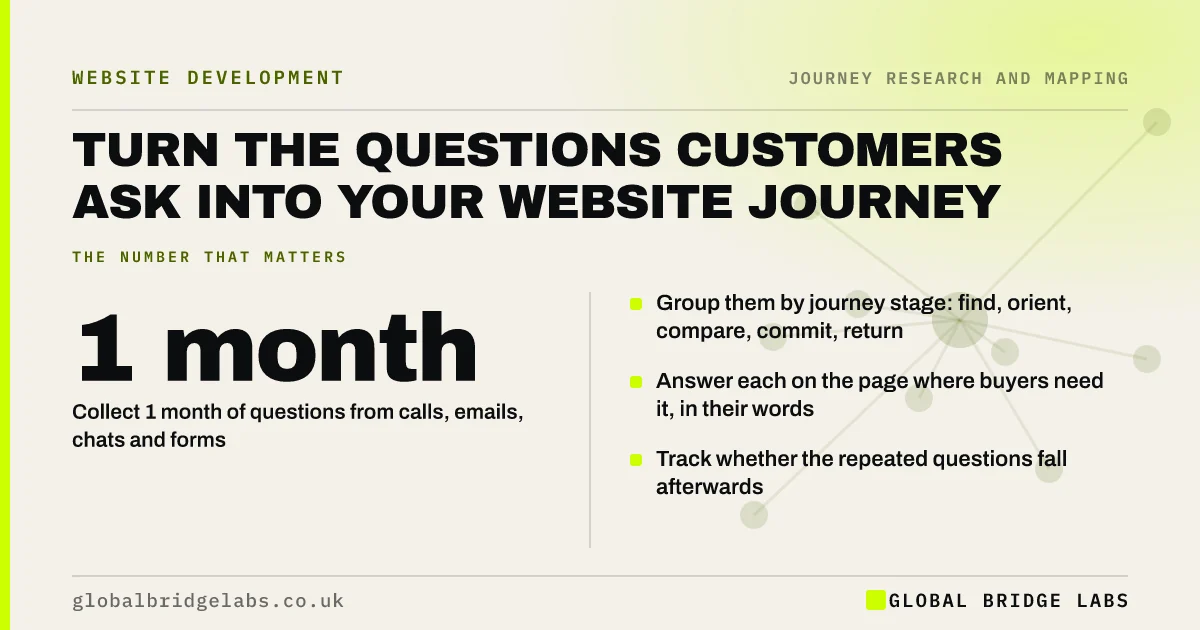
- Collect 1 month of questions from calls, emails, chats and forms.
- Group them by journey stage: find, orient, compare, commit, return.
- Answer each on the page where buyers need it, in their words.
- Track whether the repeated questions fall afterwards.
Send us your ten most-asked questions on WhatsApp and we will show where each belongs.
Chat on WhatsApp →Why are customer questions the best source of website content?
Customer questions are the best source because they show, in buyers' own words, what they needed to know and could not find. Every repeated question is a gap in the journey. They are also what buyers type into search and AI tools, so pages that answer them clearly are more likely to be found and quoted.
How do you collect customer questions?
Collect questions for a month from every channel: phone calls, emails, contact forms, WhatsApp, live chat, social messages and conversations at quotes or visits. Ask whoever answers the phone to keep a simple tally. Write each question exactly as asked and note at what point in the journey it came.
- Phone: a tally sheet by the phone for one month.
- Email and forms: search the inbox for question marks.
- WhatsApp and chat: export or scroll a month of threads.
- Sales and visits: ask staff to note questions after each meeting.
- Reviews: note questions and doubts mentioned in reviews of you and competitors.
How do you sort questions by journey stage?
Sort each question by the stage the buyer was in when they asked it. 'Do you cover Leeds?' is orient. 'How much for a three-bed rewire?' is compare. 'What happens after I book?' is commit. 'How do I change my appointment?' is return. The stage tells you which page should answer it.
- Find: what is this, do I need it, what are my options?
- Orient: do you do this, for people like me, where I am?
- Compare: how much, how long, what proof, why you?
- Commit: what happens next, what do I need, when will you call?
- Return: how do I change, re-order, get help or pay?
Where should each answer go on the website?
Each answer should go where the buyer is when they need it. Compare questions belong on the service page, near the price guidance and proof. Commit questions belong next to the form or button. Return questions belong on a help page and the confirmation page. An FAQ page is a useful backup, but answers buried there are missed by buyers reading a service page.
How do you know the answers are working?
The answers are working when the same questions arrive less often and the questions you do get are more specific and closer to a sale. Re-run the tally for a month after publishing. Also check in GA4 whether visitors to pages with new answers move on to enquire more often than before.
Which questions should you not answer on the website?
Some questions are better answered in conversation: detailed quotes that depend on a survey, advice that carries regulatory risk, or questions that are really a buyer testing whether you will listen. For those, the website should explain what you need to answer properly and make the conversation easy to start.
What does this look like in practice?
A pattern we see in question tallies: three or four questions account for most calls, and they are basic. 'Do you cover my area?', 'roughly how much?', 'how soon can you start?'. The website answers none of them on the service pages, so buyers either call to check or leave to find a site that does.
Adding a short 'areas, prices, timescales' block to each service page reduces repetitive calls and helps buyers who would never have called. Across our client work we have seen a 2.4x enquiry rate from conversion changes of this kind. Global Bridge Labs (GBL) starts content plans with the client's inbox.
Customer questions checklist
- Tally questions from every channel for one month.
- Write each one as the customer asked it.
- Sort by journey stage.
- Answer each on the page where buyers need it.
- Use the customer's words in headings.
- Re-run the tally a month after publishing.
Next step
Your inbox already holds most of the content your website needs. We will sort your questions by stage and show which page should answer each one.
Message us on WhatsApp with your most-asked customer questions, or book a 30-minute consultation.
Chat on WhatsApp →Sources and further reading
- Creating helpful, reliable, people-first content · Google Search Central
- Writing to GOV.UK standards: writing guidelines · GOV.UK
- Journey mapping 101 · Nielsen Norman Group
Frequently asked questions
How do I find out what questions customers ask?
Collect them for a month from phone calls, emails, contact forms, WhatsApp, live chat, social messages and sales conversations. Keep a simple tally by the phone and search your inbox for question marks. Write each question in the customer's words.
Should customer questions go on an FAQ page?
Put each answer where buyers need it first: price and proof questions on service pages, next-step questions by the form, and help questions on aftercare pages. An FAQ page is a useful backup and can collect them all, but answers only on an FAQ page are often missed.
How do customer questions help SEO?
Buyers type the same questions into search engines and AI tools. Pages that answer them clearly, in the buyer's words and near the top of the relevant section, are more likely to match those searches and be quoted in AI answers.
Written by

Global Bridge Labs (GBL) is a UK–Sri Lanka partner for social media, websites and BPO. Everything here comes from client delivery, not theory.