On this page
- 01Key takeaways
- 02What is card sorting?
- 03What is the difference between open and closed card sorting?
- 04How many people do you need for a card sort?
- 05How do you run a card sort for a small business website?
- 06How do you turn card sort results into navigation?
- 07When is card sorting not worth doing?
- 08What does this look like in practice?
- 09Card sorting checklist
- 10Next step
- 11Sources and further reading
- 12Frequently asked questions
Key takeaways
Card sorting is a research method where customers group your website's topics into categories that make sense to them. It shows how buyers think about your services, which labels they understand and where they expect things. Nielsen Norman Group recommends about 15 participants for a card sort. For a small business, a remote card sort can be done in a week at low cost.
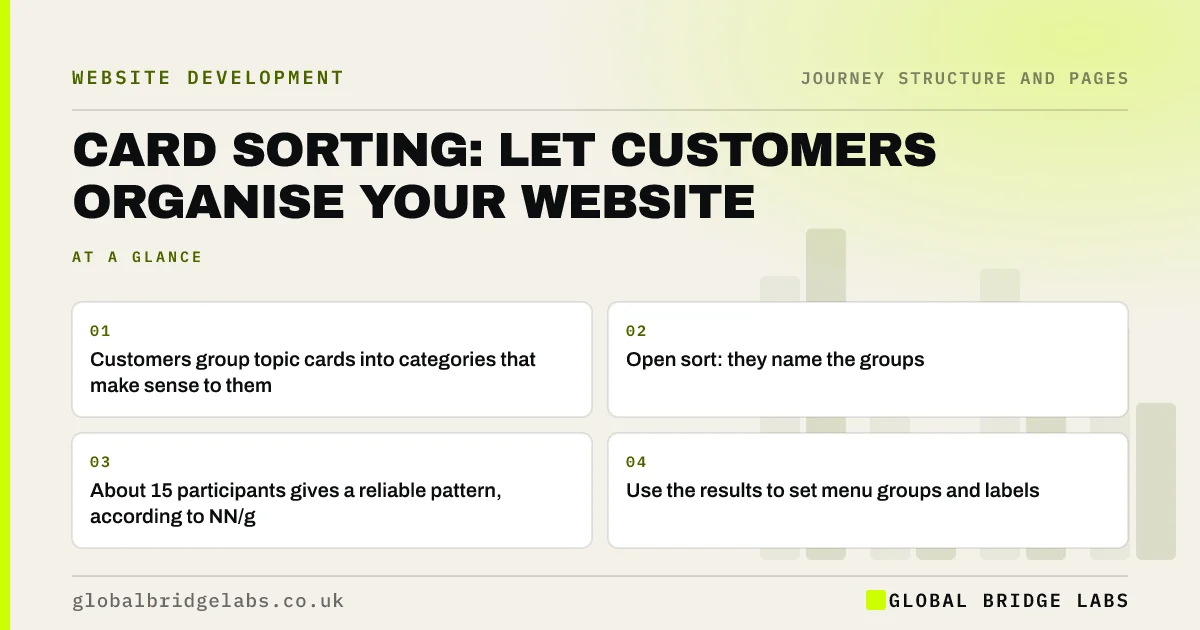
- Customers group topic cards into categories that make sense to them.
- Open sort: they name the groups. Closed sort: you supply the groups.
- About 15 participants gives a reliable pattern, according to NN/g.
- Use the results to set menu groups and labels.
Want a card sort run with your customers? Message us on WhatsApp.
Chat on WhatsApp →What is card sorting?
Card sorting is a user research method in which participants sort a set of cards, each showing a topic, page or service, into groups that make sense to them, and often name those groups. Nielsen Norman Group describes it as a way to uncover users' mental models, meaning how they expect information to be organised. The results guide a website's structure and labels.
What is the difference between open and closed card sorting?
In an open card sort, participants create and name their own groups. It shows how customers naturally think about your services and what they would call each group, so it suits new sites and redesigns. In a closed card sort, you supply the groups and participants place cards into them. It checks whether a proposed structure works. Many projects run an open sort first, then a closed one or a tree test.
- Open sort: discover groupings and labels. Best early in a project.
- Closed sort: check a proposed set of groups.
- Hybrid sort: supplied groups, plus the option to add new ones.
How many people do you need for a card sort?
Nielsen Norman Group recommends testing about 15 users in a card sort. Jakob Nielsen's analysis found that 15 participants reach a correlation of 0.90 with the results of much larger groups, which he described as a comfortable place to stop. Fewer gives a rougher picture; more adds little for most small business sites.
How do you run a card sort for a small business website?
Run a card sort by listing 30 to 50 topics from your site and journey map, writing each as a short card in plain words, and inviting about 15 recent customers or likely buyers to sort them. Online card sorting tools make it remote and quick; paper cards work for in-person sessions. Ask participants to think aloud if you can watch.
- List 30 to 50 topics: services, questions, key pages.
- Write cards in plain words, avoiding your current menu labels.
- Recruit about 15 customers or likely buyers.
- Run an open sort online or in person.
- Look for groups most participants agree on.
- Note the names they give groups: they are label candidates.
Want help choosing the cards for your sort? Send us your page list on WhatsApp.
Chat on WhatsApp →How do you turn card sort results into navigation?
Turn results into navigation by finding cards that most participants placed together and using those clusters as menu sections. Use the most common group names as starting labels. Cards that participants split between groups need either a clearer name or a place in more than one route. Then test the new structure with a tree test before building.
When is card sorting not worth doing?
Card sorting is not worth doing for very small sites with a handful of pages, where the structure is obvious, or when you cannot recruit real customers. Sorting with colleagues tells you how your team thinks, which is the bias you are trying to avoid. In those cases, use customer interviews and your inbox to choose labels instead.
What does this look like in practice?
A pattern we see in card sorts for service firms: the business groups services by method, such as 'Surveys', 'Installation', 'Maintenance', while customers group them by what is being fixed, such as 'Heating', 'Hot water', 'Bathrooms'. Customers also put 'prices' with each service rather than in its own section.
Restructuring the menu around those groups, with price guidance inside each section, matches how buyers look. Across our client work we have seen a 2.4x enquiry rate from conversion changes of this kind. Global Bridge Labs (GBL) lets customers sort before we label.
Card sorting checklist
- List 30 to 50 topics in plain words.
- Choose open sorting for a redesign, closed to check a plan.
- Recruit about 15 real customers or likely buyers.
- Find the clusters most participants agree on.
- Use their group names as label candidates.
- Tree-test the resulting structure.
Next step
A card sort is one of the cheapest ways to get a website's structure right. We can set one up, recruit participants and turn the results into a menu.
Message us on WhatsApp to run a card sort for your website, or book a 30-minute consultation.
Chat on WhatsApp →Sources and further reading
- Card sorting: uncover users' mental models · Nielsen Norman Group
- Card sorting: how many users to test · Nielsen Norman Group
- User research · GOV.UK Service Manual
Frequently asked questions
What is card sorting in UX?
A research method where participants group cards showing topics or pages into categories that make sense to them, and often name the categories. It reveals how people expect information to be organised and guides a website's structure and labels.
How many participants do I need for card sorting?
Nielsen Norman Group recommends about 15. Its analysis found 15 participants reach a correlation of 0.90 with much larger samples. Fewer gives a rougher picture, and more adds little for most small business websites.
Should I use open or closed card sorting?
Use an open card sort early in a redesign to discover how customers group and name your topics. Use a closed card sort, or a tree test, to check a proposed structure. Many projects run an open sort first and then test the result.
Written by

Global Bridge Labs (GBL) is a UK–Sri Lanka partner for social media, websites and BPO. Everything here comes from client delivery, not theory.